

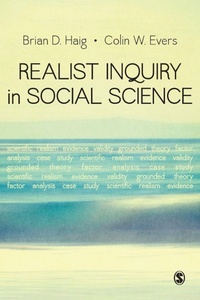
Realist Inquiry in Social Science
1st Edition
Published on 15. December 2015
Book
Paperback/Softback
168 pages
978-1-4462-5885-9 (ISBN)
Description
Realist Inquiry in Social Science is an invaluable guide to conducting realist research. Written by highly regarded experts in the field, the first part of the book sets out the fundamentals necessary for rigorous realist research, while the second part deals with a number of its most important applications, discussing it in the context of case studies, action research and grounded theory amongst other approaches.
Grounded in philosophical methodology, this book goes beyond understanding knowledge justification only as empirical validity, but instead emphasises the importance of theoretical criteria for all good research. The authors consider both quantitative and qualitative research methods, and approach methodology from an interdisciplinary viewpoint. Using abductive reasoning as the starting point for an insightful journey into realist inquiry, this book demonstrates that scientific realism continues to be of major relevance to the social sciences.
Grounded in philosophical methodology, this book goes beyond understanding knowledge justification only as empirical validity, but instead emphasises the importance of theoretical criteria for all good research. The authors consider both quantitative and qualitative research methods, and approach methodology from an interdisciplinary viewpoint. Using abductive reasoning as the starting point for an insightful journey into realist inquiry, this book demonstrates that scientific realism continues to be of major relevance to the social sciences.
Reviews / Votes
The current replication crisis in psychology makes professors' Haig and Evers book as timely as it is erudite. Using philosophical realism as their organizing principle, they take the reader on a creative and insightful tour through validity, Grounded Theory, factor analysis and case studies in an effort to improve and advance psychological research. -- James W. Grice Realist Inquiry in Social Science comes as a complete breath of fresh air in a domain predominated by anti-realism. I was especially charmed and mesmerized by its recognition of the primacy of problems and its focus on abductive reasoning. -- Tim De Mey This book provides an accessible and systematic introduction to Realist methodologies in the social sciences. It covers qualitative and quantitative research methods from a Realist perspective, making clear how this approach provides a fruitful and practical way for social scientists to approach research methods. That a book of such clarity should have been written by Brian Haig and Colin Evers is not surprising. Over the past three decades, Realism has moved from the periphery of methodological considerations to taking centre stage. In the social sciences these authors have been central to the change in Realism's fortunes. -- Hugh LauderMore details
Language
English
Place of publication
London
United Kingdom
Target group
College/higher education
Dimensions
Height: 234 mm
Width: 156 mm
Thickness: 9 mm
Weight
266 gr
ISBN-13
978-1-4462-5885-9 (9781446258859)
Copyright in bibliographic data and cover images is held by Nielsen Book Services Limited or by the publishers or by their respective licensors: all rights reserved.
Schweitzer Classification
Other editions
Additional editions
Brian Douglas Haig | Colin Evers
Realist Inquiry in Social Science
Book
12/2015
1st Edition
SAGE Publications Ltd
€186.40
Shipment within 15-20 days
Brian Douglas Haig | Colin Evers
Realist Inquiry in Social Science
E-Book
11/2015
1st Edition
SAGE Publications Ltd
€85.99
Available for download
Brian Douglas Haig | Colin Evers
Realist Inquiry in Social Science
E-Book
11/2015
1st Edition
SAGE Publications Ltd
€85.99
Available for download
Persons
Brian Haig is a Professor in the Department of Psychology at the University of Canterbury, and a Visiting Professor in the Department of Education at the University of Bath. He is a theoretical psychologist who has published numerous articles in psychology, education, and philosophy journals on the conceptual foundations of quantitative and qualitative research methods, and the nature of psychological science more generally. He recently published a book entitled Investigating the Psychological World (MIT Press, 2014). He is a Fellow of the Association for Psychological Science and the New Zealand Psychological Society.
Colin Evers is Professor of Educational Leadership at the University of New South Wales, having previously worked at The University of Hong Kong, Monash University, and the University of Sydney. He studied mathematics, philosophy, and education before taking his PhD in philosophy of education at the University of Sydney. His teaching and research interests are in educational administration, philosophy of education, and research methodology. He has co-edited and co-authored ten books in his various fields of interest including Knowing Educational Administration, Exploring Educational Administration and Doing Educational Administration (all written with Gabriele Lakomski and published by Pergamon/Elsevier) and many papers.
Colin Evers is Professor of Educational Leadership at the University of New South Wales, having previously worked at The University of Hong Kong, Monash University, and the University of Sydney. He studied mathematics, philosophy, and education before taking his PhD in philosophy of education at the University of Sydney. His teaching and research interests are in educational administration, philosophy of education, and research methodology. He has co-edited and co-authored ten books in his various fields of interest including Knowing Educational Administration, Exploring Educational Administration and Doing Educational Administration (all written with Gabriele Lakomski and published by Pergamon/Elsevier) and many papers.
Content
Chapter 1: Scientific Realism
What is Realism?
Naturalistic Realism
Global and Local Realism
Realist Methodology
The Centrality of Method
Realism in the Social Sciences
Chapter 2: Evidence
Social Science Preliminaries
Empirical Evidence and Theory
Coherentism and Naturalism
Varieties of Evidence: Pragmatic Considerations
Chapter 3: Validity
Test Validity, Operational Definition, and Logical Empiricism
Holism, Realism, and Ontological Commitment
Construct Validity and Logical Empiricism
Construct Validity, Generalization in Experiments, and Epistemology
Paradigms of Validity
Coherence Justification
Chapter 4: Grounded Theory
The Abductive Theory of Method
Problem Formulation
Phenomena Detection
Theory Construction
ATOM as Grounded Theory Method
Chapter 5: Factor Analysis
Exploratory Factor Analysis and Scientific Inference
Methodological Challenges to Exploratory Factor Analysis
Exploratory Factor Analysis and Other Factor Analytic Methods
Chapter 6: Case Study
Constitutive and Regulative Rules
What is A Case?
Generalizing From Cases
A Case Study in China
Making Generalizations
Improving Knowledge of Generalizations
What is Realism?
Naturalistic Realism
Global and Local Realism
Realist Methodology
The Centrality of Method
Realism in the Social Sciences
Chapter 2: Evidence
Social Science Preliminaries
Empirical Evidence and Theory
Coherentism and Naturalism
Varieties of Evidence: Pragmatic Considerations
Chapter 3: Validity
Test Validity, Operational Definition, and Logical Empiricism
Holism, Realism, and Ontological Commitment
Construct Validity and Logical Empiricism
Construct Validity, Generalization in Experiments, and Epistemology
Paradigms of Validity
Coherence Justification
Chapter 4: Grounded Theory
The Abductive Theory of Method
Problem Formulation
Phenomena Detection
Theory Construction
ATOM as Grounded Theory Method
Chapter 5: Factor Analysis
Exploratory Factor Analysis and Scientific Inference
Methodological Challenges to Exploratory Factor Analysis
Exploratory Factor Analysis and Other Factor Analytic Methods
Chapter 6: Case Study
Constitutive and Regulative Rules
What is A Case?
Generalizing From Cases
A Case Study in China
Making Generalizations
Improving Knowledge of Generalizations