

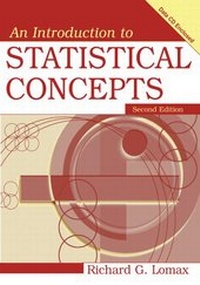
An Introduction to Statistical Concepts
2nd Edition
Published on 12. April 2007
Book
Hardback
484 pages
978-0-8058-5739-9 (ISBN)
Description
Unlike many other statistics texts, this one is comprehensive and flexible enough for either a single or a two-semester course. Instructors can select only the topics that are most appropriate for their course.
Its intuitive approach helps students more easily understand the concepts and interpret software results. Throughout the text, the author demonstrates how many statistical concepts relate to one another. Only the most crucial equations are included.
The new edition features:
SPSS sections throughout with input, output, and APA style write-ups using the book's dataset
A CD with every example and problem dataset used in the text in SPSS format;
More information on confidence intervals, effect size measures, power, and regression models
A revised sequence of the regression and ANOVA chapters for enhanced conceptual flow
De-emphasized computations to provide more discussion of concepts and software
More end of chapter problems with more realistic data and a greater emphasis on interpretation
Many more references
An Instructor's Resource CD with all of the solutions to the problems and other teaching aids.
The first five chapters cover basic descriptive statistics including ways of representing data graphically, statistical measures, the normal distribution and other standard scores, and probability and sampling.
The remainder of the text covers inferential statistics involving means, proportions, variances, and correlations, basic and advanced analysis of variance (ANOVA) and regression models. It contains a number of topics not dealt with in other texts such as robust methods, multiple comparison and nonparametric procedures, and advanced ANOVA and multiple regression models.
Realistic examples from education and the behavioral sciences illustrate the concepts. Each example includes an examination of the various procedures and necessary assumptions, tips on developing an APA style write-up, and sample SPSS output. Useful tables of assumptions and the effects of their violation are included, along with how to test assumptions in SPSS. Each chapter concludes with conceptual and computational problems, about a third of which are new to this edition. Answers to the odd-numbered problems are provided.
Intended for a one- or a two-semester course in introductory statistics taught in education and/or behavioral science departments. Although used predominantly at the master's or doctoral level, the book is also used at the undergraduate level. Only a rudimentary knowledge of algebra is required.
Its intuitive approach helps students more easily understand the concepts and interpret software results. Throughout the text, the author demonstrates how many statistical concepts relate to one another. Only the most crucial equations are included.
The new edition features:
SPSS sections throughout with input, output, and APA style write-ups using the book's dataset
A CD with every example and problem dataset used in the text in SPSS format;
More information on confidence intervals, effect size measures, power, and regression models
A revised sequence of the regression and ANOVA chapters for enhanced conceptual flow
De-emphasized computations to provide more discussion of concepts and software
More end of chapter problems with more realistic data and a greater emphasis on interpretation
Many more references
An Instructor's Resource CD with all of the solutions to the problems and other teaching aids.
The first five chapters cover basic descriptive statistics including ways of representing data graphically, statistical measures, the normal distribution and other standard scores, and probability and sampling.
The remainder of the text covers inferential statistics involving means, proportions, variances, and correlations, basic and advanced analysis of variance (ANOVA) and regression models. It contains a number of topics not dealt with in other texts such as robust methods, multiple comparison and nonparametric procedures, and advanced ANOVA and multiple regression models.
Realistic examples from education and the behavioral sciences illustrate the concepts. Each example includes an examination of the various procedures and necessary assumptions, tips on developing an APA style write-up, and sample SPSS output. Useful tables of assumptions and the effects of their violation are included, along with how to test assumptions in SPSS. Each chapter concludes with conceptual and computational problems, about a third of which are new to this edition. Answers to the odd-numbered problems are provided.
Intended for a one- or a two-semester course in introductory statistics taught in education and/or behavioral science departments. Although used predominantly at the master's or doctoral level, the book is also used at the undergraduate level. Only a rudimentary knowledge of algebra is required.
Reviews / Votes
"The writing style and clarity... is simply the best that I have seen. Both simple and complex ideas are covered in a very approachable manner... I find its coverage of ANOVA to be the best available." - Tim Konold Department of Leadership, Foundations & Policy, University of Virginia"The best thing about the Lomax text is that students find it readable. It helps them understand and learn statistics... Another valuable property... is the flexibility... When I use the text ...I require students to read chapters 13-18. Chapters 1-12 are there for students who want to review material... [It is] suitable for any introductory course - undergraduate or graduate." - L. Suzanne Dancer Department of Educational Psychology, University of Texas, Austin
"The thing that most drew me to this text was that it properly covers everything from the basics... to ANOVA and regression without really skimping on anything. This allows me to pick and choose for my own course, and still give the students access to the background." - Douglas C. Maynard Department of Psychology, SUNY New Paltz
More details
Edition
2nd New edition
Language
English
Place of publication
Mahwah
United States
Publishing group
Taylor & Francis Inc
Target group
College/higher education
Edition type
New edition
Dimensions
Height: 254 mm
Width: 178 mm
Weight
1043 gr
ISBN-13
978-0-8058-5739-9 (9780805857399)
Copyright in bibliographic data and cover images is held by Nielsen Book Services Limited or by the publishers or by their respective licensors: all rights reserved.
Schweitzer Classification
Other editions
New editions
Book
04/2012
3rd Edition
Routledge Academic
€141.13
Article exhausted; check for reprint
Previous edition

Debbie L. Hahs-Vaughn | Richard G. Lomax
An Introduction to Statistical Concepts, Second Edition
Book
07/2000
Lawrence Erlbaum Associates Inc
€88.09
Article exhausted; check for reprint
Content
Preface. Introduction. Data Representation. Univariate Population Parameters and Sample Statistics. The Normal Distribution and Standard Scores. Introduction to Probability and Sample Statistics. Introduction to Hypothesis Testing: Inferences About a Single Mean. Inferences About the Difference Between Two Means. Inferences About Proportions. Inferences About Variances. Bivariate Measures of Association. One-Factor Analysis of Variance - Fixed-Effects Model. Multiple Comparison Procedures. Factorial Analysis of Variance - Fixed-Effects Model. Introduction to Analysis of Covariance: The One-Factor Fixed-Effects Model With a Single Covariate. Random- and Mixed-Effects Analysis of Variance Models. Hierarchical and Randomized Block Analysis of Variance Models. Simple Linear Regression. Multiple Regression.