

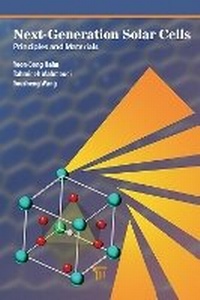
Next-Generation Solar Cells
Principles and Materials
1st Edition
Published on 10. August 2023
Book
Hardback
314 pages
978-981-4968-66-9 (ISBN)
Description
Building a sustainable energy system is one of the great challenges of our time that has prompted both academia and industry to seek alternative energy and renewable energy solutions. Recently, advanced materials and technologies for next-generation solar cells have been exploited to develop economically viable, high-performance solar cells. This book addresses the principles and materials for the development of next-generation solar cells for a sustainable global society. It reviews the structures, working principles, and limitations of solar cells as well as the methods to improve their power-conversion efficiency. It introduces generations of cells as photovoltaic devices, including third-generation solar cells such as organic solar cells, quantum dot solar cells, and organic-inorganic hybrid solar cells. It focuses on the emerging perovskite solar cells (PSCs) and deals with their cell configuration, transport materials, and fabrication processes in detail.
Reviews / Votes
"This book is a comprehensive and authoritative guide to the latest advancements in solar cell research and related technologies. Impressively, it not only enters into all the important details determining device functionality from both a materials science and a device engineering point of view, but also offers a synthetic but clear description of the main techniques applied for full device characterization, which is essentially an important step in understanding the interdisciplinary field sufficiently. Overall, it is an unmissable volume in the library of a scientist working in the broad field of photovoltaic technologies, grounding on the past, with an open and inspired eye to the future of these essential devices."Prof. Alberto Vomiero
Lulea University of Technology, Sweden
"This book releases at a time when the need for a sustainable energy transition is of great importance toward reaching net zero goals. While solar energy will be at the forefront of this drive, the book covers most of the materials technologies that will be key for next-generation devices to be considered. Materials, concepts, devices, and architectures, including characterization techniques are covered in detail, which should be essential reading for graduate courses and researchers in the field."
Prof. S. Ravi P. Silva
Advanced Technology Institute, University of Surrey, UK
More details
Language
English
Place of publication
Singapore
Target group
College/higher education
Professional and scholarly
Academic and Postgraduate
Illustrations
60 s/w Abbildungen, 50 farbige Zeichnungen, 5 s/w Tabellen, 53 s/w Zeichnungen, 7 s/w Photographien bzw. Rasterbilder, 3 Farbfotos bzw. farbige Rasterbilder, 53 farbige Abbildungen
5 Tables, black and white; 50 Line drawings, color; 53 Line drawings, black and white; 3 Halftones, color; 7 Halftones, black and white; 53 Illustrations, color; 60 Illustrations, black and white
Dimensions
Height: 229 mm
Width: 152 mm
Weight
640 gr
ISBN-13
978-981-4968-66-9 (9789814968669)
Copyright in bibliographic data and cover images is held by Nielsen Book Services Limited or by the publishers or by their respective licensors: all rights reserved.
Schweitzer Classification
Other editions
New editions

Yoon-Bong Hahn | Yousheng Wang | Tahmineh Mahmoudi
Next-Generation Solar Cells
Principles and Materials (Second Edition)
Book
approx. 08/2026
2nd Edition
Jenny Stanford Publishing
€238.50
Not yet published
Additional editions
Yoon-Bong Hahn | Tahmineh Mahmoudi | Yousheng Wang
Next-Generation Solar Cells
Principles and Materials
E-Book
08/2023
1st Edition
Pan Stanford Publishing Pte Ltd
€153.99
Available for download
Yoon-Bong Hahn | Tahmineh Mahmoudi | Yousheng Wang
Next-Generation Solar Cells
Principles and Materials
E-Book
08/2023
1st Edition
Pan Stanford Publishing Pte Ltd
€153.99
Available for download
Persons
Yoon-Bong Hahn is a Regents Professor of Jeonbuk National University (JBNU), South Korea, and is a fellow of the Korea Academy of Science and Technology (KAST), American Ceramic Society (ACerS), and the International Association of Advanced Materials (IAAM). He received his PhD in metallurgical engineering from the University of Utah, USA, in 1988, after which he started working at the research center of LG Metals, Korea, until 1991 when he joined JBNU. His research focuses on the synthesis of metal and metal oxide nanostructures and their applications in solar cells, chemical and biological sensors, and printed electronics.
Tahmineh Mahmoudi is a researcher working in collaboration with the Prof. Yoon-Bong Hahn group at the Advanced nano-Materials Processing Laboratory (AMPL), School of Semiconductor and Chemical Engineering, JBNU. She received her PhD in chemical engineering from JBNU in 2015. Her research focuses on metal oxides and graphene-based materials and their applications for hybrid and perovskite solar cells.
Yousheng Wang is an associate professor at the Institute of New Energy Technology, Jinan University, China, since 2019. He received his PhD in semiconductor and chemical engineering from JBNU, where he later became a postdoctoral fellow. His research focuses on the development of hybrid perovskite composites and their applications for next-generation solar cells.
Tahmineh Mahmoudi is a researcher working in collaboration with the Prof. Yoon-Bong Hahn group at the Advanced nano-Materials Processing Laboratory (AMPL), School of Semiconductor and Chemical Engineering, JBNU. She received her PhD in chemical engineering from JBNU in 2015. Her research focuses on metal oxides and graphene-based materials and their applications for hybrid and perovskite solar cells.
Yousheng Wang is an associate professor at the Institute of New Energy Technology, Jinan University, China, since 2019. He received his PhD in semiconductor and chemical engineering from JBNU, where he later became a postdoctoral fellow. His research focuses on the development of hybrid perovskite composites and their applications for next-generation solar cells.
Content
1. Electromagnetic Radiation 2. Physics and Properties of Semiconductors 3. Working Principles and Limitations of Solar Cells 4. Generations of Solar Cells 5. Organic Solar Cells 6. Quantum Dot Solar Cells 7. Organic-Inorganic Hybrid Solar Cells 8. Perovskite Solar Cells 9. Structures, Transport Materials, and Deposition Methods for Perovskite Solar Cells 10. Defects and Ions Migration in Perovskite Solar Cells 11. Quantum Dots, Tandem, and Lead-Free Perovskite Solar Cells 12. Composites-Based Efficient and Stable Perovskite Solar Cells with Interface Engineering 13. Characterization of Solar Cell Materials and Devices