

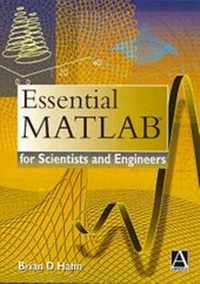
Essential MATLAB for Scientists and Engineers
Published on 26. September 1997
Book
Paperback/Softback
272 pages
978-0-340-69144-1 (ISBN)
Description
This textbook presents the MATLAB computer programming system as a problem-solving tool. It is based on a teach-yourself approach; readers are frequently invited to experiment for themselves in order to discover how particular constructs work. Aimed at scientists and engineers who have no prior knowledge of computer programming, this book does not assume any knowledge of matrices on the part of the reader. MATLAB can be used in two distinct models. It offers immediate execution of statements, or even groups of statements, in the command window. It also offers conventional programming by means of script files. This book makes use of both modes. The fundamentals of MATLAB are motivated throughout with many examples, from a number of different scientific and engineering areas, such as simulation, population, modelling and numerical methods, as well as from business and everyday life. This book should be of interest to beginners and experienced programmers wishing to learn MATLAB as an additional language.
More details
Language
English
Place of publication
Oxford
United Kingdom
Publishing group
Elsevier Science & Technology
Target group
College/higher education
Illustrations
index
Dimensions
Height: 175 mm
Width: 245 mm
Weight
495 gr
ISBN-13
978-0-340-69144-1 (9780340691441)
Copyright in bibliographic data and cover images is held by Nielsen Book Services Limited or by the publishers or by their respective licensors: all rights reserved.
Schweitzer Classification
Other editions
New editions
Daniel T. Valentine | Brian Hahn
Essential MATLAB for Scientists and Engineers
Book
12/2001
2nd Edition
Butterworth-Heinemann
€33.41
Article exhausted; check for reprint
Content
Getting going; MATLAB fundamentals; developing algorithms; MATLAB functions; 0-1 vectors; modelling with matrices; graphics; loops; errors and pitfalls; function M-files; vectors as arrays; strings; simulation; introduction to numerical methods. Epilogue - programming style: syntax quick reference; operators; command and function quick reference; ASCII character codes; solutions to selected exercises.