

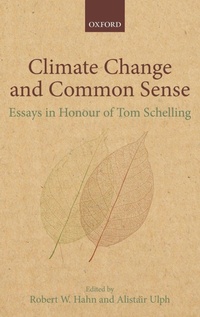
Climate Change and Common Sense
Essays in Honour of Tom Schelling
1st Edition
Published on 26. January 2012
Book
Hardback
294 pages
978-0-19-969287-3 (ISBN)
Description
There is widespread agreement that climate change is a serious problem. If we fail to regulate greenhouse gases that contribute to global warming, or use alternative strategies for addressing the problem, the damages could be significant, and perhaps catastrophic.
After several international meetings in which nation-states have tried unsuccessfully to address the climate change problem, there is a sense of frustration and urgency: frustration at the slow pace at which countries are moving toward an international agreement to reduce greenhouse gas emissions; urgency because of the growing evidence that climate change is a serious problem that should be addressed globally and quickly.
This book takes a close look at the fundamental political and economic processes driving climate change policy. It identifies institutional arrangements and policies that are needed to design more effective climate change policy. It also examines ethical and distributional arguments that are critical in understanding and framing the climate debate. The book is built around a conference honouring Tom Schelling that took place at the Sustainable Consumption Institute at The University of Manchester. Each chapter represents a significant contribution to the literature on the political economy of climate change.
After several international meetings in which nation-states have tried unsuccessfully to address the climate change problem, there is a sense of frustration and urgency: frustration at the slow pace at which countries are moving toward an international agreement to reduce greenhouse gas emissions; urgency because of the growing evidence that climate change is a serious problem that should be addressed globally and quickly.
This book takes a close look at the fundamental political and economic processes driving climate change policy. It identifies institutional arrangements and policies that are needed to design more effective climate change policy. It also examines ethical and distributional arguments that are critical in understanding and framing the climate debate. The book is built around a conference honouring Tom Schelling that took place at the Sustainable Consumption Institute at The University of Manchester. Each chapter represents a significant contribution to the literature on the political economy of climate change.
Reviews / Votes
Climate Change and Common Sense showcases the latest insights of many of the world's leading economists working on climate change policy... it advances a rich foundation for future scholarship that can promote better climate-change policy. * Joseph E. Aldy, Journal of Regional Science *More details
Language
English
Place of publication
Oxford
United Kingdom
Target group
College/higher education
Professional and scholarly
Academics, researchers and students in politics, economics, environmental and climate studies. NGOs and policymakers
Illustrations
18 Figures, 14 Tables
18 Figures, 14 Tables
Dimensions
Height: 240 mm
Width: 161 mm
Thickness: 20 mm
Weight
608 gr
ISBN-13
978-0-19-969287-3 (9780199692873)
Copyright in bibliographic data and cover images is held by Nielsen Book Services Limited or by the publishers or by their respective licensors: all rights reserved.
Schweitzer Classification
Persons
From 1999 to 2008, Professor Hahn served as the director of the AEI-Brookings Joint Center, a leader in policy research in law and economics, regulation, and antitrust. Previously, he worked for the US President's Council of Economic Advisers, where he helped design the market-based cap-and-trade system for limiting smokestack sulfur emissions at minimum cost to industry. He also served on the faculties of Harvard University and Carnegie Mellon University. Professor Hahn is a frequent contributor to leading scholarly journals including the American Economic Review, Science, and the Yale Law Journal, as well as to general-interest periodicals including the New York Times and Forbes.com. He is also the co-founder of Regulation2point0.org.
Following employment at the Oxford Centre for Management Studies, Stirling University and Australian National University, Professor Ulph spent 25 years (1979-2004) at the University of Southampton, the last 20 of these as Professor of Economics, with spells as Visiting Professor at the University of British Columbia (1985), Australian National University (2002), and University of California Santa Barbara (2002). He was appointed Economic Assessor for the Hinkley Point C Public Inquiry (1989-90) and elected President of European Association of Environmental and Resource Economists (2000-2001) and Fellow of the Royal Society of Arts (2000-). Between April 2004 and 2010 he held the post of Vice-President and Dean of the Faculty of Humanities at The University of Manchester. He has published 6 books and over 100 refereed papers.
Following employment at the Oxford Centre for Management Studies, Stirling University and Australian National University, Professor Ulph spent 25 years (1979-2004) at the University of Southampton, the last 20 of these as Professor of Economics, with spells as Visiting Professor at the University of British Columbia (1985), Australian National University (2002), and University of California Santa Barbara (2002). He was appointed Economic Assessor for the Hinkley Point C Public Inquiry (1989-90) and elected President of European Association of Environmental and Resource Economists (2000-2001) and Fellow of the Royal Society of Arts (2000-). Between April 2004 and 2010 he held the post of Vice-President and Dean of the Faculty of Humanities at The University of Manchester. He has published 6 books and over 100 refereed papers.
Content
INTRODUCTION AND OVERVIEW ; 1. Thinking through the Climate Change Challenge ; PART I: GETTING NATIONS TO WORK TOGETHER ; 2. Norms, Conventions, and Institutions to Cope with Climate Change ; 3. Credible Commitments, Focal Points, and Tipping: The Strategy of Climate Treaty Design ; 4. Tipping Climate Negotiations ; 5. Bridging Reality and the Theory of International Environmental Agreements ; 6. The Cost of Ambiguity and Robustness in International Pollution Control ; PART II: ETHICAL AND DISTRIBUTIONAL CONCERNS ; 7. Time and the Generations ; 8. Discounting While Treating Generations Equally ; 9. Emerging Markets and Climate Change: Mexican Standoff or Low-carbon Race? ; PART III: APPROACHES TO DESIGNING MORE EFFICIENT POLICIES ; 10. Moving US Climate Policy Forward: Are Carbon Taxes the Only Good Alternative? ; 11. Carbon Taxes and the Green Paradox ; 12. Derivative Markets for Pollution Permits and Incentives to Innovate ; 13. Development and Climate Adaptation ; 14. Schelling's Conjecture on Climate and Development: A Test