

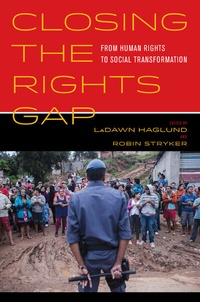
Closing the Rights Gap
From Human Rights to Social Transformation
1st Edition
Published on 21. March 2015
Book
Hardback
392 pages
978-0-520-28309-1 (ISBN)
Description
Do "human rights" as embodied in constitutions, national laws, and international agreements foster improvements in the lives of the poor or otherwise marginalized populations? When, where, how, and under what conditions? Closing the Rights Gap: From Human Rights to Social Transformation systematically compares a range of case studies from around the world in order to clarify the conditions under which and institutions through which economic, social, and cultural rights are progressively realized in practice. It concludes with testable hypotheses regarding how significant transformative change might occur, as well as an agenda for future research to facilitate rights realization worldwide.
More details
Edition
First Edition
Language
English
Place of publication
Berkerley
United States
Target group
College/higher education
Product notice
Cloth over boards
Illustrations
13 Tables, 7 Maps, 15 Charts-F
Dimensions
Height: 229 mm
Width: 152 mm
Thickness: 30 mm
Weight
680 gr
ISBN-13
978-0-520-28309-1 (9780520283091)
Copyright in bibliographic data and cover images is held by Nielsen Book Services Limited or by the publishers or by their respective licensors: all rights reserved.
Schweitzer Classification
Other editions
Additional editions
E-Book
03/2015
1st Edition
University of California Press
€73.49
Available for download
Persons
LaDawn Haglund is Associate Professor of Justice and Social Inquiry at Arizona State University and author of Limiting Resources: Market-Led Reform and the Transformation of Public Goods. Robin Stryker is Professor of Sociology, Affiliated Professor of Law, Affiliated Professor of Government and Public Policy, and Research Director, National Institute for Civil Discourse, at the University of Arizona. She publishes regularly in journals including American Journal of Sociology, American Sociological Review, Law & Social Inquiry, Sociological Methods and Research, Socio-Economic Review, Research in the Sociology of Organizations, and Social Politics.
Content
List of Figures List of Maps List of Tables and Boxes List of Contributors Preface Introduction: Making Sense of the Multiple and Complex Pathways by which Human Rights Are Realized (LaDawn Haglund and Robin Stryker) PART ONE: PROMISES AND CHALLENGES OF ECONOMIC, SOCIAL, AND CULTURAL RIGHTS (ESCR) REALIZATION AT THE INTERNATIONAL LEVEL 1. Do Non--Human Rights Regimes Undermine the Achievement of Economic and Social Rights? (M. Rodwan Abouharb, David L. Cingranelli, and Mikhail Filippov) 2. Linking Law and Economics: Translating Economic and Social Human Rights Norms into Public Policy (William F. Felice) 3. Advances and Ongoing Challenges in the Protection of Indigenous Peoples' Rights within the Inter-American System and the United Nations Special Procedures System (Leonardo J. Alvarado) PART TWO: THE ROLE OF DOMESTIC LAW AND COURTS IN ESCR REALIZATION 4. The Impact of Legal Strategies for Claiming Economic and Social Rights (Varun Gauri and Daniel Brinks) 5. The Role of Human Rights Law in Protecting Environmental Rights in South Asia (Sumudu Atapattu) 6. The Morality of Law: The Case against Deportation of Settled Immigrants (Doris Marie Provine) PART THREE: BEYOND JUDICIAL MECHANISMS AS MEANS TO ESCR REALIZATION 7. Social Movements and the Expansion of Economic and Social Human Rights Advocacy among International NGOs (Paul J. Nelson) 8. The Challenge of Ensuring Food Security: Global Perspectives and Evidence from India (Shareen Hertel and Susan Randolph) 9. Achieving Rights to Land, Water, and Health in Post-Apartheid South Africa (Heinz Klug) 10. Social Accountability in the World Bank: How Does It Overlap with Human Rights? (Hans-Otto Sano) PART FOUR: MEASURING ESCR REALIZATION 11. Making the Principle of Progressive Realization Operational: Economic and Social Rights Obligations (Sakiko Fukuda-Parr, Terra Lawson-Remer, and Susan Randolph) 12. Deepening Our Understanding of Rights Realization through Disaggregation and Mapping: Integrating Census Data and Participatory GIS (Rimjhim Aggarwal and LaDawn Haglund) 13. Studying Courts in Context: The Role of Nonjudicial Institutional and Socio-Political Realities (Siri Gloppen) Conclusion: Emerging Possibilities for Social Transformation (Robin Stryker and LaDawn Haglund) Index