

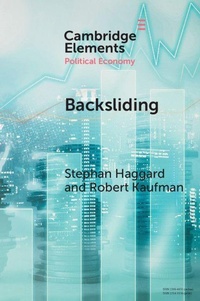
Backsliding
Democratic Regress in the Contemporary World
Published on 11. February 2021
Book
Paperback/Softback
75 pages
978-1-108-95840-0 (ISBN)
Description
Assaults on democracy are increasingly coming from the actions of duly elected governments, rather than coups. Backsliding examines the processes through which elected rulers weaken checks on executive power, curtail political and civil liberties, and undermine the integrity of the electoral system. Drawing on detailed case studies, including the United States and countries in Latin America, Eastern Europe, and Africa, the book focuses on three, inter-related causal mechanisms: the pernicious effects of polarization; realignments of party systems that enable elected autocrats to gain legislative power; and the incremental nature of derogations, which divides oppositions and keeps them off balance. A concluding chapter looks at the international context of backsliding and the role of new technologies in these processes. An online appendix provides detailed accounts of backsliding in 16 countries, which can be found at www.cambridge.org/backsliding.
Reviews / Votes
'... Stephan Haggard and Robert Kaufman offer some clarity through a theoretical framework designed to help explain this political phenomenon.' Democracy ParadoxMore details
Series
Language
English
Place of publication
Cambridge
United Kingdom
Target group
Professional and scholarly
Product notice
Paperback (trade)
Illustrations
Worked examples or Exercises
Dimensions
Height: 225 mm
Width: 149 mm
Thickness: 7 mm
Weight
150 gr
ISBN-13
978-1-108-95840-0 (9781108958400)
Copyright in bibliographic data and cover images is held by Nielsen Book Services Limited or by the publishers or by their respective licensors: all rights reserved.
Schweitzer Classification
Other editions
Additional editions
E-Book
02/2021
Cambridge University Press
€15.49
Available for download
E-Book
02/2021
Cambridge University Press
€14.49
Available for download
Content
1. Backsliding: Concept, Mechanisms, Measurement; 2. Social and Political Origins of Backsliding: The Role of Polarization; 3. Constitutions in the Balance: Parties, Legislatures and the Collapse of the Separation of Powers; 4. The Backsliding Process; 5. Conclusion.