

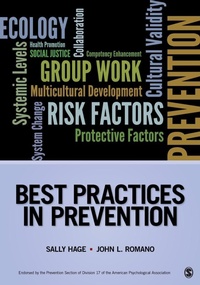
Best Practices in Prevention
1st Edition
Published on 12. February 2013
Book
Paperback/Softback
72 pages
978-1-4522-5797-6 (ISBN)
Description
This second book in the Prevention Practice Kit provides counselors, psychologists, and other mental health workers with practical steps that need to be considered by prevention practitioners as they engage with others in developing and delivering prevention projects. A context for engaging in prevention practice is provided, including discussion of how prevention fits with traditional models of psychology, descriptions of theoretical models for doing prevention practice, and examples of empirically-supported prevention interventions.
The reader will learn about a new set of Prevention Guidelines being proposed to the American Psychological Association, and why these recommendations are important to consider. The book highlights the essential aspects of collaboration, cultural relevance, social justice, and program dissemination, and addresses knotty ethical issues surrounding confidentiality in prevention and health promotion efforts. In addition, the book provides information on funding and readily available resources for prevention. Finally, examples and activities are provided throughout the book-accompanied by a set of learning exercises-to help readers apply what they learn.
This book is part of the Prevention Practice Kit: Action Guides for Mental Health, a collection of eight books each authored by scholars in the specific field of prevention and edited by Dr. Robert K. Conyne and Dr. Arthur M. Horne. The books in the collection conform to the editors' outline to promote a consistent reading experience. Designed to provide human services practitioners, counselors, psychologists, social workers, instructors, and students with concrete direction for spreading and improving the practice of prevention, the series provides thorough coverage of prevention application including a general overview of prevention, best practices, diversity and cultural relevance, psychoeducational groups, consultation, program development and evaluation, evidence base, and public policy.
This book is endorsed by the Prevention Section of the Society of Counseling Psychology of the American Psychological Association. Fifty percent of all royalties are donated to Division 17 of the APA.
The reader will learn about a new set of Prevention Guidelines being proposed to the American Psychological Association, and why these recommendations are important to consider. The book highlights the essential aspects of collaboration, cultural relevance, social justice, and program dissemination, and addresses knotty ethical issues surrounding confidentiality in prevention and health promotion efforts. In addition, the book provides information on funding and readily available resources for prevention. Finally, examples and activities are provided throughout the book-accompanied by a set of learning exercises-to help readers apply what they learn.
This book is part of the Prevention Practice Kit: Action Guides for Mental Health, a collection of eight books each authored by scholars in the specific field of prevention and edited by Dr. Robert K. Conyne and Dr. Arthur M. Horne. The books in the collection conform to the editors' outline to promote a consistent reading experience. Designed to provide human services practitioners, counselors, psychologists, social workers, instructors, and students with concrete direction for spreading and improving the practice of prevention, the series provides thorough coverage of prevention application including a general overview of prevention, best practices, diversity and cultural relevance, psychoeducational groups, consultation, program development and evaluation, evidence base, and public policy.
This book is endorsed by the Prevention Section of the Society of Counseling Psychology of the American Psychological Association. Fifty percent of all royalties are donated to Division 17 of the APA.
More details
Series
Language
English
Place of publication
Thousand Oaks
United States
Target group
Professional and scholarly
Dimensions
Height: 254 mm
Width: 178 mm
Thickness: 4 mm
Weight
155 gr
ISBN-13
978-1-4522-5797-6 (9781452257976)
Copyright in bibliographic data and cover images is held by Nielsen Book Services Limited or by the publishers or by their respective licensors: all rights reserved.
Schweitzer Classification
Persons
Arthur M. Horne is currently Dean of the College of Education and Distinguished Research Professor at the University of Georgia, Athens. He obtained his PhD in counseling and Educational Psychology from Southern Illinois university, and his masters and bachelor's from the University of Florida, Gainesville. He is widely known in the area of bullying, working with youth, boys, and prevention. Robert K. Conyne is Professor Emeritus from the University of Cincinnati, is a licensed psychologist, clinical counselor and fellow of the Association for Specialists in Group work (ASGW) and the American Psychological Association. He has 36 years of professional experience as a University professor and department head, psychologist, counselor, administrator, consultant and trainer. Current work finds him volunteering as an American Red Cross disaster mental health specialist and service as a military family life consultant. He has received many awards, including Eminent Career Award from AGSW, Lifetime achievement award in Prevention from APA, Distinguished Alumni Award of Distinction from Purdue University and is designated a Soros International Scholar. He is 2008 President of APA's division of Group Psychology and Group Psychotherapy. With over 200 scholarly publications and presentations, including 1 0 books in his areas of expertise (group work, prevention, and ecological counseling).
Content
Chapter 1. Why Practice Prevention? Why now? - Sally Hage, John Romano
Chapter 2. Four Theories and Perspectives to Support Prevention Interventions
Chapter 3. Guidelines for Prevention Practice, Research, Education, and Public Policy
Chapter 4. Research Informed Prevention Practice: Learning from the Wisdom of Science
Chapter 5. Empirically Supported Prevention Applications
Chapter 6. Ethical and Professional Issues in Prevention
Chapter 7. Applying Prevention Learning: Five Learning Exercises
Chapter 2. Four Theories and Perspectives to Support Prevention Interventions
Chapter 3. Guidelines for Prevention Practice, Research, Education, and Public Policy
Chapter 4. Research Informed Prevention Practice: Learning from the Wisdom of Science
Chapter 5. Empirically Supported Prevention Applications
Chapter 6. Ethical and Professional Issues in Prevention
Chapter 7. Applying Prevention Learning: Five Learning Exercises