

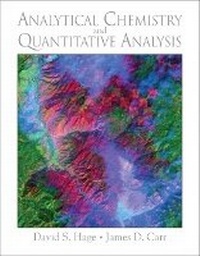
Analytical Chemistry and Quantitative Analysis
United States Edition
Published on 9. March 2010
Book
Hardback
720 pages
978-0-321-59694-9 (ISBN)
Description
Analytical Chemistry and Quantitative Analysis presents concepts and procedures in a manner that reflects the practice and applications of these methods in today's analytical laboratories. These methods are illustrated by using current examples from fields that include forensics, environmental analysis, medicine, biotechnology, food science, pharmaceutical science, materials analysis, and basic research. The fundamental principles of laboratory techniques for chemical analysis are introduced, along with issues to consider in the appropriate selection and use of these methods-including the proper use and maintenance of balances, laboratory glassware, and notebooks, as well as mathematical tools for the evaluation and comparison of experimental results.
Basic topics in chemical equilibria are reviewed and used to help demonstrate the principles and proper use of classical methods of analysis like gravimetry and titrations. Common instrumental techniques are also introduced, such as spectroscopy, chromatography and electrochemical methods. Sideboxes discuss other methods, including mass spectrometry and NMR spectroscopy, throughout the text.
Basic topics in chemical equilibria are reviewed and used to help demonstrate the principles and proper use of classical methods of analysis like gravimetry and titrations. Common instrumental techniques are also introduced, such as spectroscopy, chromatography and electrochemical methods. Sideboxes discuss other methods, including mass spectrometry and NMR spectroscopy, throughout the text.
More details
Other editions
New editions
Book
03/2010
Pearson
€194.35
Article is exhausted; no reprint
Persons
David S. Hage is a professor of analytical and bioanalytical chemistry in the
Department of Chemistry at the University of Nebraska, Lincoln. He received his
B.S. in chemistry and biology from the University of Wisconsin, La Crosse, his Ph.D.
in analytical chemistry from Iowa State University, and he was a postdoctoral fellow
in clinical chemistry at the Mayo Clinic. He is a full professor at the University
of Nebraska, Lincoln.
Dr. Hage is the author of over 145 research publications, reviews and book
chapters. He recently edited a book entitled the Handbook of Affinity
Chromatography (Taylor Francis) and is a coauthor on the textbook Chemistry: An
Industry-Based Introduction (CRC Press). He received the 1995 Young
Investigator Award from the American Association for Clinical Chemistry and
the 2005 Excellence in Graduate Education Award from the University of
Nebraska, Lincoln. He was made a Bessey Professor of Chemistry in 2006 at the
University of Nebraska.
James D. Carr is a professor of analytical chemistry in the Department of
Chemistry at the University of Nebraska, Lincoln. He received his B.S. in chemistry
from Iowa State University and his Ph.D. in chemistry from Purdue
University. He was then a postdoctoral fellow at the University of North Carolina,
Chapel Hill. He is a full professor at the University of Nebraska, Lincoln.
Dr. Carr is the author of approximately 50 research publications and articles.
He is the coauthor of Chemistry: A World of Choices (McGraw-Hill), a liberal arts
general chemistry textbook. He is also the author or coauthor of several versions
of general chemistry and quantitative analysis lab manuals and study guides (gen
chem only). He has won several teaching awards, including the University of
Nebraska Distinguished Teaching Award in 1981; University of Nebraska
Recognition Awards for Contributions to Students in 1992, 1993, 1994, 1995, and
2000; and the University of Nebraska Outstanding Teaching and Instructional
Creativity Award in 1996. He is a member of the University of Nebraska, Lincoln
Academy of Distinguished Teachers and received the Distinguished Teacher
Award from the Nebraska Teaching Improvement Council in 2001.
Department of Chemistry at the University of Nebraska, Lincoln. He received his
B.S. in chemistry and biology from the University of Wisconsin, La Crosse, his Ph.D.
in analytical chemistry from Iowa State University, and he was a postdoctoral fellow
in clinical chemistry at the Mayo Clinic. He is a full professor at the University
of Nebraska, Lincoln.
Dr. Hage is the author of over 145 research publications, reviews and book
chapters. He recently edited a book entitled the Handbook of Affinity
Chromatography (Taylor Francis) and is a coauthor on the textbook Chemistry: An
Industry-Based Introduction (CRC Press). He received the 1995 Young
Investigator Award from the American Association for Clinical Chemistry and
the 2005 Excellence in Graduate Education Award from the University of
Nebraska, Lincoln. He was made a Bessey Professor of Chemistry in 2006 at the
University of Nebraska.
James D. Carr is a professor of analytical chemistry in the Department of
Chemistry at the University of Nebraska, Lincoln. He received his B.S. in chemistry
from Iowa State University and his Ph.D. in chemistry from Purdue
University. He was then a postdoctoral fellow at the University of North Carolina,
Chapel Hill. He is a full professor at the University of Nebraska, Lincoln.
Dr. Carr is the author of approximately 50 research publications and articles.
He is the coauthor of Chemistry: A World of Choices (McGraw-Hill), a liberal arts
general chemistry textbook. He is also the author or coauthor of several versions
of general chemistry and quantitative analysis lab manuals and study guides (gen
chem only). He has won several teaching awards, including the University of
Nebraska Distinguished Teaching Award in 1981; University of Nebraska
Recognition Awards for Contributions to Students in 1992, 1993, 1994, 1995, and
2000; and the University of Nebraska Outstanding Teaching and Instructional
Creativity Award in 1996. He is a member of the University of Nebraska, Lincoln
Academy of Distinguished Teachers and received the Distinguished Teacher
Award from the Nebraska Teaching Improvement Council in 2001.
Content
THE BASIC TOOLS OF ANALYTICAL CHEMISTRY
Chapter 1 An Overview of Analytical Chemistry
Chapter 2 Good Laboratory Practices
Chapter 3 Mass and Volume Measurements
Chapter 4 Making Decisions with Data
Chapter 5 Characterization & Selection of Analytical Methods
CHEMICAL REACTIONS AND EQUILIBRIA
Chapter 6 Chemical Activity & Chemical Equilibrium
Chapter 7 Chemical Solubility & Precipitation
Chapter 8 Acid-Base Reactions
Chapter 9 Complex Formation
Chapter 10 Oxidation-Reduction Reactions
CLASSICAL METHODS OF CHEMICAL ANALYSIS
Chapter 11 Gravimetric Methods
Chapter 12 Acid-Base Titrations
Chapter 13 Complexometric & Precipitation Titrations
ELECTROCHEMICAL METHODS
Chapter 14 An Introduction to Electroanalytical Chemistry
Chapter 15 Redox Titrations
Chapter 16 Coulometry, Voltammetry & Related Methods
SPECTROPHOTOMETRIC METHODS OF ANALYSIS
Chapter 17 An Introduction to Spectroscopy
Chapter 18 Molecular Spectroscopy
Chapter 19 Atomic Spectroscopy
ANALYTICAL SEPARATIONS
Chapter 20 An Introduction to Chemical Separations
Chapter 21 Gas Chromatography
Chapter 22 Liquid Chromatography
Chapter 23 Electrophoresis
APPENDICES
Appendix A Supplemental Information & Derivation of Key Equations
Appendix B Physical & Chemical Constants
Appendix C Using Spreadsheets for Chemical Analysis
GLOSSARY
INDEX
Chapter 1 An Overview of Analytical Chemistry
Chapter 2 Good Laboratory Practices
Chapter 3 Mass and Volume Measurements
Chapter 4 Making Decisions with Data
Chapter 5 Characterization & Selection of Analytical Methods
CHEMICAL REACTIONS AND EQUILIBRIA
Chapter 6 Chemical Activity & Chemical Equilibrium
Chapter 7 Chemical Solubility & Precipitation
Chapter 8 Acid-Base Reactions
Chapter 9 Complex Formation
Chapter 10 Oxidation-Reduction Reactions
CLASSICAL METHODS OF CHEMICAL ANALYSIS
Chapter 11 Gravimetric Methods
Chapter 12 Acid-Base Titrations
Chapter 13 Complexometric & Precipitation Titrations
ELECTROCHEMICAL METHODS
Chapter 14 An Introduction to Electroanalytical Chemistry
Chapter 15 Redox Titrations
Chapter 16 Coulometry, Voltammetry & Related Methods
SPECTROPHOTOMETRIC METHODS OF ANALYSIS
Chapter 17 An Introduction to Spectroscopy
Chapter 18 Molecular Spectroscopy
Chapter 19 Atomic Spectroscopy
ANALYTICAL SEPARATIONS
Chapter 20 An Introduction to Chemical Separations
Chapter 21 Gas Chromatography
Chapter 22 Liquid Chromatography
Chapter 23 Electrophoresis
APPENDICES
Appendix A Supplemental Information & Derivation of Key Equations
Appendix B Physical & Chemical Constants
Appendix C Using Spreadsheets for Chemical Analysis
GLOSSARY
INDEX