

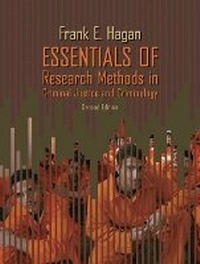
Essentials of Research Methods for Criminal Justice
2nd Edition
Published on 22. November 2006
Book
Paperback/Softback
416 pages
978-0-205-50755-9 (ISBN)
Description
Adapted from Frank Hagan's best-selling Research Methods in Criminal Justice and Criminology. This new text offers a complete introduction to qualitative and quantitative research for criminal justice, in a manageable and reader-friendly format. The text emphasizes sources and resources of classic and contemporary research in the field. Also, the text uses criminological and criminal justice studies to illustrate research methods, so students can become familiar with examples of research in the field and learn fundamental research skills.
More details
Edition
2nd edition
Language
English
Place of publication
United States
Publishing group
Pearson Education (US)
Target group
Professional and scholarly
Dimensions
Height: 178 mm
Width: 236 mm
Thickness: 16 mm
Weight
565 gr
ISBN-13
978-0-205-50755-9 (9780205507559)
Copyright in bibliographic data and cover images is held by Nielsen Book Services Limited or by the publishers or by their respective licensors: all rights reserved.
Schweitzer Classification
Other editions
New editions
Frank Hagan | Frank E. Hagan
Essentials of Research Methods for Criminal Justice
Book
02/2011
3rd Edition
Pearson
€163.99
Shipment within 15-20 days
Previous edition
Book
05/2004
Pearson
€76.94
Article exhausted; check for reprint
Person
Frank E. Hagan, Ph.D. is the Dean of Graduate Studies at Mercyhurst College and Director of the Graduate Program in the Administration of Justice. He is the author of seven books plus the first edition of Essentials of Research Methods (1st edition). These are Deviance and the Family ( with Marvin B. Sussman),Introduction to Criminology (5th edition), Research Methods in Criminal Justice and Criminology (7th edition), Political Crime, White Collar Deviance (with David Simon) and The Language of Research (with Pamela Tontodonato).
He is also the author or coauthor of many journal articles and articles in edited volumes. A recipient of the Academy of Criminal Justice Sciences Fellow Award (2000), he was also awarded The Teacher's Excellent Award by MercyhurstCollege (2006). His major interests are research methods, criminology and organized crime, white collar crime and political crime and terrorism.
He is also the author or coauthor of many journal articles and articles in edited volumes. A recipient of the Academy of Criminal Justice Sciences Fellow Award (2000), he was also awarded The Teacher's Excellent Award by MercyhurstCollege (2006). His major interests are research methods, criminology and organized crime, white collar crime and political crime and terrorism.
Content
Each chapter concludes with "Summary," "Key Concepts," and "Review Questions."
1. Introduction to Criminal Justice Research Methods: Theory and Method.
2. Ethics in Criminal Justice Research.
3. Research Design: The Experimental Model and Its Variations.
4. An Introduction to Alternative Data-Gathering Strategies and the Special Case of Uniform Crime Reports.
5. Sampling and Survey Research: Questionnaires.
6. Survey Research: Interviews and Telephone Surveys.
7. Participant Observation and Case Studies.
8. Unobtrusive Measures, Secondary Analysis, and the Uses of Official Statistics.
9. Validity, Reliability, and Triangulated Strategies.
10. Scaling and Index Construction.
11. Policy Analysis and Evaluation Research
References.
Glossary.
Name Index.
Subject Index.
1. Introduction to Criminal Justice Research Methods: Theory and Method.
2. Ethics in Criminal Justice Research.
3. Research Design: The Experimental Model and Its Variations.
4. An Introduction to Alternative Data-Gathering Strategies and the Special Case of Uniform Crime Reports.
5. Sampling and Survey Research: Questionnaires.
6. Survey Research: Interviews and Telephone Surveys.
7. Participant Observation and Case Studies.
8. Unobtrusive Measures, Secondary Analysis, and the Uses of Official Statistics.
9. Validity, Reliability, and Triangulated Strategies.
10. Scaling and Index Construction.
11. Policy Analysis and Evaluation Research
References.
Glossary.
Name Index.
Subject Index.