

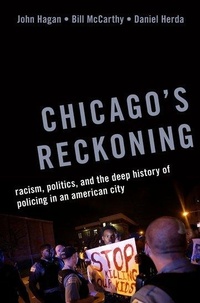
Chicago's Reckoning
Racism, Politics, and the Deep History of Policing in an American City
Published on 16. August 2022
Book
Hardback
248 pages
978-0-19-762786-0 (ISBN)
Description
A searing examination of the long history of police misconduct and political corruption in Chicago that produced the city's current racial reckoning
Chicago faces a racial reckoning. For over 50 years, Chicago Mayors Richard J. and Richard M. Daley were at the helm of a law-and-order dynasty that disadvantaged predominantly Black and Brown neighborhoods and covered up heinous crimes against Black men. During his 1980-2012 tenure as State's Attorney and Mayor, Richard M. Daley (son of Richard J. Daley) led a law enforcement bureaucracy which permitted police detective John Burge to supervise the torture of over 100 Black men on Chicago's South and West Sides. Misguided policies on "gangs, guns, and drugs," support for a racialized code of silence and police misconduct, and a lack of meaningful punishment, have ensured that these leaders' effects on Chicago are still sorely felt.
In this book, John Hagan, Bill McCarthy, and Daniel Herda confront the complicated history of race, politics, and policing in Chicago to explain how crime works from the top-down through urban political machines and the elite figures who dominate them. The authors argue that the Daleys' law enforcement system worked largely to benefit and protect White residential areas and business districts while excluding Black and Brown Chicagoans and concentrating them in highly segregated neighborhoods. The stark contradiction between the promise "to serve and protect" and the realities of hyper-segregation and mass incarceration created widespread cynicism about policing that remains one of the most persistent problems of contemporary Chicago law enforcement.
By holding a sociological lens up to the history of this quintessential American city, Chicago's Reckoning reveals new insights into the politics of crime and how, until we come to terms with our history and the racial and economic divisions it created, these dynamics will continue to shape our national life.
Chicago faces a racial reckoning. For over 50 years, Chicago Mayors Richard J. and Richard M. Daley were at the helm of a law-and-order dynasty that disadvantaged predominantly Black and Brown neighborhoods and covered up heinous crimes against Black men. During his 1980-2012 tenure as State's Attorney and Mayor, Richard M. Daley (son of Richard J. Daley) led a law enforcement bureaucracy which permitted police detective John Burge to supervise the torture of over 100 Black men on Chicago's South and West Sides. Misguided policies on "gangs, guns, and drugs," support for a racialized code of silence and police misconduct, and a lack of meaningful punishment, have ensured that these leaders' effects on Chicago are still sorely felt.
In this book, John Hagan, Bill McCarthy, and Daniel Herda confront the complicated history of race, politics, and policing in Chicago to explain how crime works from the top-down through urban political machines and the elite figures who dominate them. The authors argue that the Daleys' law enforcement system worked largely to benefit and protect White residential areas and business districts while excluding Black and Brown Chicagoans and concentrating them in highly segregated neighborhoods. The stark contradiction between the promise "to serve and protect" and the realities of hyper-segregation and mass incarceration created widespread cynicism about policing that remains one of the most persistent problems of contemporary Chicago law enforcement.
By holding a sociological lens up to the history of this quintessential American city, Chicago's Reckoning reveals new insights into the politics of crime and how, until we come to terms with our history and the racial and economic divisions it created, these dynamics will continue to shape our national life.
Reviews / Votes
Chicago's Reckoning expertly lays bare the disturbing reality that America's racialized politics of policing and crime are rooted in the continued segregation of African Americans, not only in Chicago but in ghettoized cities throughout the nation. Its masterful analysis trenchantly explains how segregation underlies a tightly coupled system of racial exclusion and containment to sustain mass incarceration and entangle Blacks and Whites within a dysfunctional culture of legal cynicism that benefits neither group and poisons all of American society. * Douglas Massey, Henry G. Bryant Professor of Sociology and Public Affairs, Princeton University * Chicago's Reckoning provides a searing account of police brutality, political cover-up, and the deep disappointment of Black and Brown communities in a system that fails to provide for their safety. Everyday abuse and misconduct by police, concealed and denied by Chicago's political leaders, unfolded in a segregated city that left many young Black men unprotected and fending for themselves. Hagan, McCarthy, and Herda's urgent analysis shows that justice will depend not just on transforming the police, but also the political establishment and racial inequality in which it is embedded. * Bruce Western, Chair, Department of Sociology, Columbia University * Chicago's Reckoning is impressive. I have rarely seen any scholarship that weaves together historical, political, quantitative, cultural, and cognitive analysis in such a thorough and convincing way. * Stephen Vaisey, Professor of Sociology & Political Science, Duke University * Chicago's Reckoning rewrites our sociological understanding of power, corruption, crime, and culture. The authors weave together an unprecedented range of data with Studs Turkel-like storytelling to reveal how Chicago's political machine brutally leveraged criminal law to simultaneously advance the agenda of the White political elites while also excluding and containing Black neighborhoods. Understanding a neighborhood's history of exclusion and containment, the authors argue, should be a central explanatory mechanism in any theory of urban inequality. * Andrew V. Papachristos, Professor of Sociology, Northwestern University *More details
Language
English
Place of publication
New York
United States
Product notice
sewn/stitched
Cloth over boards
Dimensions
Height: 251 mm
Width: 165 mm
Thickness: 25 mm
Weight
522 gr
ISBN-13
978-0-19-762786-0 (9780197627860)
Copyright in bibliographic data and cover images is held by Nielsen Book Services Limited or by the publishers or by their respective licensors: all rights reserved.
Schweitzer Classification
Other editions
Additional editions
John Hagan | Bill McCarthy | Daniel Herda
Chicago's Reckoning
Racism, Politics, and the Deep History of Policing in an American City
E-Book
01/2022
OUP eBook
€9.99
Available for download
John Hagan | Bill McCarthy | Daniel Herda
Chicago's Reckoning
Racism, Politics, and the Deep History of Policing in an American City
E-Book
01/2022
OUP eBook
€9.99
Available for download
Persons
John Hagan is John D. MacArthur Professor of Sociology and Law at Northwestern University and the American Bar Foundation and author of numerous books including Iraq and the Crimes of Aggressive War, Reclaiming Justice, and Who Are the Criminals?
Bill McCarthy is the Dean of Rutgers Newark School of Criminal Justice and Professor Emeritus of Sociology at the University of California Davis. He is co-editor of The Oxford Handbook of Gender, Sex, and Crime, with Rosemary Gartner, and co-author with John Hagan of Mean Streets: Youth Crime and Homelessness.
Daniel Herda is Associate Professor and Chair of Sociology at Merrimack College and author of papers in Social Forces, Social Science Research, and Ethnic and Racial Studies.
Bill McCarthy is the Dean of Rutgers Newark School of Criminal Justice and Professor Emeritus of Sociology at the University of California Davis. He is co-editor of The Oxford Handbook of Gender, Sex, and Crime, with Rosemary Gartner, and co-author with John Hagan of Mean Streets: Youth Crime and Homelessness.
Daniel Herda is Associate Professor and Chair of Sociology at Merrimack College and author of papers in Social Forces, Social Science Research, and Ethnic and Racial Studies.
Author
John D. MacArthur Professor of Sociology and LawJohn D. MacArthur Professor of Sociology and Law, Northwestern University
Dean of Rutgers Newark School of Criminal Justice and Professor Emeritus of SociologyDean of Rutgers Newark School of Criminal Justice and Professor Emeritus of Sociology, UC Davis
Associate Professor and Chair of SociologyAssociate Professor and Chair of Sociology, Merrimack College
Content
- Prologue: Scandals in Black and White
- Chapter One: Two Mayors and "The Midnight Crew"
- Chapter Two: Politics and Punishment Chicago-Style
- Chapter Three: Two Mothers/Two Sons
- With Carla Shedd and Paul Hirschfield
- Chapter Four: Shut Out, Locked Up, and Foreclosed
- With Andrea Cann Chandrasekher
- Chapter Five: History is Not the Past
- Chapter Six: Prolonging the Thirty-Year Cover-Up
- Chapter Seven: Call it by its Name
- Epilogue: 16 Shots-Front and Back
- Appendix: Data Sources and Measures
- Tables
- References
- Index