

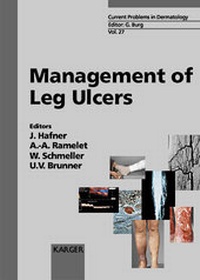
Management of Leg Ulcers
"Current Problems in Dermatology", Vol 27.
Published in 1999
Book
Hardback
VIII, 294 pages
978-3-8055-6654-4 (ISBN)
Description
Chronic leg ulcers affect approximalety 1% of the adult population in industrial countries. They cause major disability and their enormous socioeconomic impact is still underestimated. This volume provides comprehensive information on the assessment and treatment of leg ulcers. Different aspects of venous leg ulcers like epidemiology, examination with Doppler and duplex sonography, venography, functional assessments as well as the most common modern classifications are recapitulated. Also, conservative treatment methods such as compression therapy, mobilization of the ankle joint and lymph drainage or different surgical techniques for recalcitrant venous ulcers are discussed. The chapters dealing with diabetic foot ulcers give a general outlook including patient instruction, orthopedic footwear and podiatric care along with management of the diabetic foot infection, and the indications for orthopedic and vascular interventions. General practitioners, internists, surgeons, dermatologists, as well as nurses, podiatrists, and physiotherapists will find this publication an indispensable summary on the state of the art in the management of chronic leg ulcers.
More details
Content
Introduction - management of leg ulcers. Part I Wound healing: molecular biology of chronic wounds; cytokines in progressing stages of chronic venous insufficiency; bacteriology of leg ulcers; synthetic dressings; therapy with growth factors; cultured keratinocyte grafts. Part II Venous leg ulcers: epidemiology of leg ulcers; postthrombbtic syndrome; classification of chronic venous insufficiency; venous mapping with Doppler and duplex sonography; duplex ultrasound for the assessment of venous reflux; phlebography; magnetic resonance imaging and computed tomography in advanced chronic venous insufficiency; plethysmography; micoangiopathy in the pathogenesis of chronci venous insufficiency; compression therapy of venous ulcers; physical therapy of the ankle joint in patients with chronic venous imcompetence and arthrogenic congestive syndrome; manual lymph drainage; adjuvant systemic drug therapy in venous leg ulcers; chronic leg ulcers and eczema; complications in the treatment of leg ulcers; surgical management of varicose veins in advanced chronic venous insufficiency; paratibial fasciootomy and crural fasciectomy; subfascial and edcoscopic perforator surgery; shave therapy for recalcitrant venous ulcers. Part III Arterial leg ulcers: assessment of peripheral arterial occulsive disease; management of arterial leg ulcers and of combined (mixed) venous-arterial leg ulcers; percutaneous transulminal angioplasty in the mangement of arterial leg ulcers; reconstructive arterial surgery. Part IV Conservative therapy of diabetic foot: orthopaedic aspects in diabetic neuropathic osteoarthropathy; diabetic foot infection. Part V Leg ulcers of different origins: differential diagnosis of leg ulcers; management of leg ulcers in rheumatoid arthritis and in systemic sclerosis; management of vasculitic leg ulcers and pyoderma gangrenosum; conclusions.