

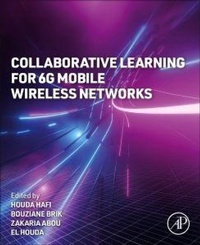
Collaborative Learning for 6G Mobile Wireless Networks
Published on 8. June 2026
Book
Paperback/Softback
278 pages
978-0-443-40570-9 (ISBN)
Description
Collaborative Learning for 6G Mobile Wireless Networks gives a comprehensive introduction to the topic and its potential role in the development of 6G by explaining principles and presenting methods, algorithms, and uses cases. To achieve 6G's vision of intelligent and autonomous networks capable of self-optimization, self-healing, and context-aware adaptation, there is a need to develop advanced algorithms and frameworks to enable network elements to perceive, reason, and act autonomously in dynamic and unpredictable environments. However, traditional machine learning methods rely on centralized data collection and processing, making it a limitation for large-scale applications.
Collaborative learning, as an emerging distributed approach, offers a powerful framework for harnessing the collective intelligence of distributed data sources while addressing key challenges such as privacy and security.
Collaborative learning, as an emerging distributed approach, offers a powerful framework for harnessing the collective intelligence of distributed data sources while addressing key challenges such as privacy and security.
More details
Language
English
Place of publication
San Diego
United States
Publishing group
Elsevier Science Publishing Co Inc
Target group
Professional and scholarly
Product notice
Paperback (trade)
Unsewn / adhesive bound
Dimensions
Height: 235 mm
Width: 191 mm
Weight
449 gr
ISBN-13
978-0-443-40570-9 (9780443405709)
Copyright in bibliographic data and cover images is held by Nielsen Book Services Limited or by the publishers or by their respective licensors: all rights reserved.
Schweitzer Classification
Other editions
Additional editions
MSc Hafi BSc | MSc Brik BSc | MSc Houda BSc
Collaborative Learning for 6G Mobile Wireless Networks
E-Book
06/2026
Elsevier
€153.99
Available for download
Persons
Dr. Houda HAFI pursued her Ph.D. studies in computer science at the University of Abdelhamid Mehri, Constantine, Algeria, and the Engineering School Polytech (Ex-ESIREM), Dijon, France. She received her Ph.D. in 2019. She is currently an Associate Professor at the Faculty of New Information and Communication Technologies at the University of Abdelhamid Mehri. Her research and teaching have been consistently focused on the field of networking, encompassing areas such as network engineering, communication networks, and related subjects. Her ongoing research centers on wireless communications, vehicular and mobile networks, and the application of AI, machine learning, and distributed learning techniques in networking domain. Dr. Bouziane Brik, received his Engineer degree (Ranked First) in computer science, MSc degree and Ph.D from Laghouat University, Algeria. He is currently working as Assistant Professor in Computer Science ,department of Computing and Informatics College, at Sharjah university, UAE. He has worked as assistant professor at DRIVE department of Bourgogne university in France as well as a post-doc at university of Troyes, CESI school, and Eurecom research institute, in France. He researches resources management and security challenges of 5G network slicing in the context of H2020 European projects including MonB5G, 5GDrones, InDiD, and 5G-INSIGHT. His research interests also include 5G and Beyond networks, Explainable AI, and machine/deep learning for wireless networks.
Dr. Zakaria Abou El Houda received the Ph.D. degree in computer science from the University of Montreal, Montreal, QC, Canada, and the Ph.D. degree in computer engineering from the University of Technology of Troyes, Troyes, France. He is currently a professor with the Energy, Materials, and Telecommunications Center of the National Institute of Scientific Research (INRS), Canada. I am also a member of the INRS-UQO Joint Research Unit in Cybersecurity. Prior to joining INRS, He served as a research scientist in various institutions, contributing to significant research projects on the application of machine learning for intrusion detection systems, and studying the explainability and robustness of these systems. His current research interests include applied AI for intrusion detection systems, security in distributed/federated machine learning, and Blockchain for network security.
Dr. Zakaria Abou El Houda received the Ph.D. degree in computer science from the University of Montreal, Montreal, QC, Canada, and the Ph.D. degree in computer engineering from the University of Technology of Troyes, Troyes, France. He is currently a professor with the Energy, Materials, and Telecommunications Center of the National Institute of Scientific Research (INRS), Canada. I am also a member of the INRS-UQO Joint Research Unit in Cybersecurity. Prior to joining INRS, He served as a research scientist in various institutions, contributing to significant research projects on the application of machine learning for intrusion detection systems, and studying the explainability and robustness of these systems. His current research interests include applied AI for intrusion detection systems, security in distributed/federated machine learning, and Blockchain for network security.
Content
1. Introduction
2. Fundamentals of 6G Communications and Networking
3. Federated Learning as a Collaborative Learning Algorithm
4. Split Learning: A Cooperative Framework for Resource-Limited 6G Environments
5. Split Federated Learning: An Enhanced Collaborative Learning Algorithm for Resource-Limited 6G Contexts
6. Application of Collaborative Learning in Resource Management for 6G Networks
7. Advanced 6G-enabled Healthcare Solutions with Collaborative Learning
8. Security and Robustness of Collaborative Learning in the Context of 6G
9. Potential of 6G Immersive Technologies through Collaborative Learning
10. Edge Intelligence and Collaborative Learning in 6G Networks
11. Blockchain-powered Collaborative Learning in 6G Wireless Networks
12. Explainable Collaborative Learning in 6G Wireless Networks
13. Open Issues and Concluding Remarks
2. Fundamentals of 6G Communications and Networking
3. Federated Learning as a Collaborative Learning Algorithm
4. Split Learning: A Cooperative Framework for Resource-Limited 6G Environments
5. Split Federated Learning: An Enhanced Collaborative Learning Algorithm for Resource-Limited 6G Contexts
6. Application of Collaborative Learning in Resource Management for 6G Networks
7. Advanced 6G-enabled Healthcare Solutions with Collaborative Learning
8. Security and Robustness of Collaborative Learning in the Context of 6G
9. Potential of 6G Immersive Technologies through Collaborative Learning
10. Edge Intelligence and Collaborative Learning in 6G Networks
11. Blockchain-powered Collaborative Learning in 6G Wireless Networks
12. Explainable Collaborative Learning in 6G Wireless Networks
13. Open Issues and Concluding Remarks