

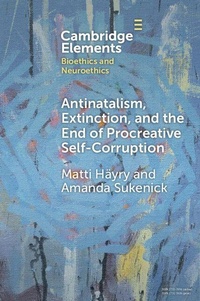
Antinatalism, Extinction, and the End of Procreative Self-Corruption
Published on 14. March 2024
Book
Paperback/Softback
84 pages
978-1-009-45530-5 (ISBN)
Description
This Element provides an exploration of antinatalism, the view that assigns a negative value to reproduction. First, the history of Western philosophy as a two-and-a-half millennia reaction to antinatalist sentiments. Human life has no obvious meaning and philosophers have been forced to build elaborate theories to invent imaginary purposes. Second, analysis of the concept of antinatalism in the light of human extinction. If people stop having children, the species will cease to exist, and this prospect has prompted attempts to find alternatives and excuses. Third, outlines a normative view defending antinatalism both theoretically and practically. If it is wrong to bring about suffering in the absence of redeeming meaning and if it is possible to create meaning only by imposing a pronatalist mentality upon children before they can make up their own minds, parents morally corrupt themselves by procreating. This title is also available as Open Access on Cambridge Core.
More details
Series
Language
English
Place of publication
Cambridge
United Kingdom
Product notice
Paperback (trade)
Illustrations
Worked examples or Exercises
Dimensions
Height: 225 mm
Width: 149 mm
Thickness: 6 mm
Weight
136 gr
ISBN-13
978-1-009-45530-5 (9781009455305)
Copyright in bibliographic data and cover images is held by Nielsen Book Services Limited or by the publishers or by their respective licensors: all rights reserved.
Schweitzer Classification
Other editions
Additional editions
Matti Haeyry | Amanda Sukenick
Antinatalism, Extinction, and the End of Procreative Self-Corruption
Book
03/2024
Cambridge University Press
€78.00
Shipment within 15-20 days
Persons
Content
1. Introduction; 2. Western philosophy as a struggle against antinatalism; 3. Antinatalism and extinction; 4. Procreative self-corruption; References.