

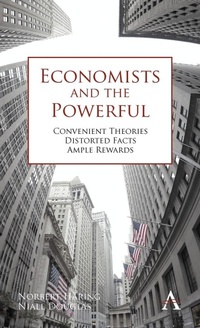
Economists and the Powerful
Convenient Theories, Distorted Facts, Ample Rewards
Published on 1. October 2012
Book
Hardback
260 pages
978-0-85728-546-1 (ISBN)
Description
"Economists and the Powerful: Convenient Theories, Distorted Facts, Ample Rewards" explores the workings of the modern global economy - an economy in which competition has been corrupted and power has a ubiquitous influence upon economic behavior. Based on empirical and theoretical studies by distinguished economists from both the past and present day, this book argues that the true workings of capitalism are very different from the popular myths voiced in mainstream economics. Offering a closer look at the history of economic doctrines - as well as how economists are incentivized - "Economists and the Powerful" exposes how, when and why the theme of power was erased from the radar screens of mainstream economic analysis - and the influence this subversive removal has had upon the modern financial world.
Reviews / Votes
"I strongly recommend this book. It is exactly what is needed as supplementary (but required!) reading in introductory economics courses everywhere." -John Weeks, "Science and Society" "Haering and Douglas's book is praiseworthy in many ways [...] [I]ts spirit is quintessentially institutionalist, for the authors' focus is set squarely upon those real-world socio-political, cultural and, to some extent, biological structures that determine actual economic activities. In particular, Haering and Douglas are keen on reintroducing the notion of power within the economic discourse, thus recovering it from the other social sciences, where mainstream economists have been confining it for too many decades." - Giorgio Baruchello, "Economics, Management, and Financial Markets" "Haering and Douglas's book is praiseworthy in many ways [...] [I]ts spirit is quintessentially institutionalist, for the authors' focus is set squarely upon those real-world socio-political, cultural and, to some extent, biological structures that determine actual economic activities. In particular, Haering and Douglas are keen on reintroducing the notion of power within the economic discourse, thus recovering it from the other social sciences, where mainstream economists have been confining it for too many decades." - Giorgio Baruchello, "Economics, Management, and Financial Markets" "There's no lack of books on the shortcomings of mainstream economics. 'Economists and the Powerful,' by Norbert Haering, a German financial journalist, and Niall Douglas, an Irish IT consultant, stands out from the crowd." -Olaf Storbeck, "Reuters BreakingViews" "Best economics read of 2012: Economists and the Powerful by Norbert Haering and Niall Douglas went with me to Majorca and it was a rewarding and enjoyable mistake [...] it is an important book for understanding the times in which we live. For both works, the role of power in the economy and the successful efforts of the ultra-powerful and their minions to keep their doings off society's radar is the central theme." -Edward Fullbrook, "Best economics read of 2012," Real-World Economics Review Blog "'Economists and the Powerful: Convenient Theories, Distorted Facts, Ample Rewards' by Norbert Haring and Niall Douglas nails one central fact with impeccable and uncompromising clarity: the concentration of power in the hands of a very few has ensured that the rewards at the top of the finance and business pyramids are increasingly disproportionate in relation to the economic contribution they make." -"Cambridge Business" "In their new book, 'Economists and the Powerful,' Norbert Haering and Niall Douglas trace how the most powerful of all the social sciences became a doctrine for helping the rich - with the aid of huge sums from business. You may be familiar with a version of this critique, thanks to the film Inside Job, which described how some of the best-known economists practising today are in the pay of Wall Street. But the history unearthed by Haering and Douglas is far more disturbing - because they argue that vested interests have slanted some of economics' most fundamental ideas." -Aditya Chakrabortty, "Big business has corrupted economics," "Guardian" "[Haering and Douglas] provide a wealth of references tracing how economics was turned into a propaganda exercise for financiers, landlords, monopolists, insiders, fraudsters and other rent-seeking predators whom classical economists sought to tax and regulate out of existence. This state of affairs reflects the century-long drive of these free lunchers to fight back against classical economics by sponsoring self-serving fictions that depict them as earning their fortunes not in predatory and extractive ways, but by contributing to output as 'job creators.'" -Michael Hudson, counterpunch.orgMore details
Series
Language
English
Place of publication
London
United Kingdom
Target group
Professional and scholarly
Dimensions
Height: 222 mm
Width: 145 mm
Thickness: 19 mm
Weight
505 gr
ISBN-13
978-0-85728-546-1 (9780857285461)
Copyright in bibliographic data and cover images is held by Nielsen Book Services Limited or by the publishers or by their respective licensors: all rights reserved.
Schweitzer Classification
Other editions
Additional editions
Norbert Haering | Niall Douglas
Economists and the Powerful
Convenient Theories, Distorted Facts, Ample Rewards
E-Book
10/2012
1st Edition
Anthem Press
€23.49
Available for download
Persons
Norbert Haering is the co-founder and director of the World Economics Association, editor of the "World Economic Review," and a correspondent for "Handelsblatt," the leading German business newspaper.
Niall Douglas is the Social Networking Coordinator of the World Economics Association, operates an expert IT consultancy firm and serves on international engineering standards committees within the ISO and IEEE.
Niall Douglas is the Social Networking Coordinator of the World Economics Association, operates an expert IT consultancy firm and serves on international engineering standards committees within the ISO and IEEE.
Content
Introduction; Chapter 1. The Economics of the Powerful; Chapter 2. Money is Power; Chapter 3. The Power of the Corporate Elite; Chapter 4. Market Power; Chapter 5. Power at Work; Chapter 6. The Power to Set the Rules of the Game; Afterword; References; Index