

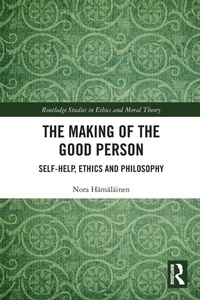
The Making of the Good Person
Self-Help, Ethics and Philosophy
1st Edition
Published on 7. October 2024
Book
Paperback/Softback
252 pages
978-1-032-39011-6 (ISBN)
Description
This book provides a philosophical assessment of the idea of personhood advanced in popular self-help literature. It also traces, within academic philosophy and philosophical scholarship, a self-help culture where the self is brought forth as an object of improvement and a key to meaning, progress, and profundity.
Unlike other academic treatments of the topic of self-help, this book is not primarily concerned with providing a critique of popular self-help and self-transformative practices. Rather, it is concerned with how they work to shape contemporary forms and ideals of moral personhood and are conducive to moral renegotiation and change. The book consists of two parts with somewhat different argumentative strategies. Part 1 consists of an overview and reassessment of popular self-help literature and its sociological and journalistic critics, written from a moral philosophical perspective. Part 2 opens with discussion of the current attraction, among a range of philosophers, to self-transformative themes. The chapters assess the strand of self-transformative philosophy found in the work of Ludwig Wittgenstein, Michel Foucault, Pierre Hadot, Stanley Cavell, and Iris Murdoch. Finally, the book concludes with a discussion of the theme of social change and moral renegotiation in contemporary societies, which is a central but underestimated undercurrent in discussions on contemporary self-transformative practices. The book's dual perspective-on both popular self-help and self-transformative currents in philosophy-enables a cultural and moral philosophical analysis of contemporary ethical ideals of personhood, as well as reflection on the literatures available for its development.
The Making of the Good Person will be of interest to scholars and advanced students working in moral philosophy, history of philosophy, psychology, sociology, and literary studies.
Unlike other academic treatments of the topic of self-help, this book is not primarily concerned with providing a critique of popular self-help and self-transformative practices. Rather, it is concerned with how they work to shape contemporary forms and ideals of moral personhood and are conducive to moral renegotiation and change. The book consists of two parts with somewhat different argumentative strategies. Part 1 consists of an overview and reassessment of popular self-help literature and its sociological and journalistic critics, written from a moral philosophical perspective. Part 2 opens with discussion of the current attraction, among a range of philosophers, to self-transformative themes. The chapters assess the strand of self-transformative philosophy found in the work of Ludwig Wittgenstein, Michel Foucault, Pierre Hadot, Stanley Cavell, and Iris Murdoch. Finally, the book concludes with a discussion of the theme of social change and moral renegotiation in contemporary societies, which is a central but underestimated undercurrent in discussions on contemporary self-transformative practices. The book's dual perspective-on both popular self-help and self-transformative currents in philosophy-enables a cultural and moral philosophical analysis of contemporary ethical ideals of personhood, as well as reflection on the literatures available for its development.
The Making of the Good Person will be of interest to scholars and advanced students working in moral philosophy, history of philosophy, psychology, sociology, and literary studies.
Reviews / Votes
"Haemaelaeinen's book is unique in bringing out how popular self-help literature not only reflects but also shapes contemporary forms and ideals of moral personhood, being a place of constant moral renegotiation; an insight bought in dialogue with her clear analysis of philosophical concerns with self-transformation."Anne-Marie S. Christensen, University of Southern Denmark
More details
Series
Language
English
Place of publication
London
United Kingdom
Publishing group
Taylor & Francis Ltd
Target group
College/higher education
Professional and scholarly
Academic, Postgraduate, and Undergraduate Advanced
Dimensions
Height: 229 mm
Width: 152 mm
Thickness: 15 mm
Weight
393 gr
ISBN-13
978-1-032-39011-6 (9781032390116)
Copyright in bibliographic data and cover images is held by Nielsen Book Services Limited or by the publishers or by their respective licensors: all rights reserved.
Schweitzer Classification
Other editions
Additional editions
E-Book
04/2023
1st Edition
Routledge
€55.49
Available for download
E-Book
04/2023
1st Edition
Routledge
€55.49
Available for download
Book
04/2023
1st Edition
Routledge
€196.40
Shipment within 10-20 days
Person
Nora Haemaelaeinen is Docent and University Researcher at the University of Helsinki, Finland. She is the author of Descriptive Ethics: What Does Moral Philosophy Know about Morality? (2016) and Literature and Moral Theory (2015).
Content
1. Introduction Part 1: Reading the Self-help Culture 2. What is Self-help? 3. Plural Histories of Self-help 4. Self-help and Governmentality 5. We Have Always Been Governed Part 2: Philosophy as a Self-transformative Practice 6. Transformative Hopes in Philosophy 7. Pierre Hadot - Philosophy as a Spiritual Practice 8. Foucault's Two Faces? 9. Murdoch's Platonic Ascent 10. Wittgenstein's Therapy 11. Cavell's Ethics of Becoming 12. Ways Forward