

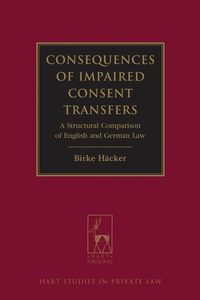
Consequences of Impaired Consent Transfers
A Structural Comparison of English and German Law
1st Edition
Published on 25. November 2013
Book
Hardback
408 pages
978-1-84946-565-6 (ISBN)
Description
Legal rules and principles do not exist in isolation, but form part of a system. In this structural comparison between English and German law, Birke Haecker explores the rules and principles governing impaired consent transfers of movable property and their reversal in two- and three-party situations.
This book is a re-publication of a work first published by Mohr Siebeck in Germany.
This book is a re-publication of a work first published by Mohr Siebeck in Germany.
More details
Series
Language
English
Place of publication
Oxford
United Kingdom
Publishing group
Bloomsbury Publishing PLC
Target group
College/higher education
Product notice
Hardback (stationery)
Dimensions
Height: 240 mm
Width: 161 mm
Thickness: 27 mm
Weight
778 gr
ISBN-13
978-1-84946-565-6 (9781849465656)
Copyright in bibliographic data and cover images is held by Nielsen Book Services Limited or by the publishers or by their respective licensors: all rights reserved.
Schweitzer Classification
Other editions
Additional editions
Birke Haecker
Consequences of Impaired Consent Transfers
A Structural Comparison of English and German Law
E-Book
11/2013
1st Edition
Hart Publishing
€105.99
Available for download
Person
Birke Haecker is Professor of Comparative Law at the University of Oxford, Director of the Institute of European and Comparative Law, and a Professorial Fellow of Brasenose College, Oxford.
Content
Part One: Setting the Scene
Chapter I: Introduction
A. Aim of Project and Methodology
B. Scope of Inquiry
C. Structure of Book and Main Theses
Chapter II: Basic Principles Compared and Contrasted
A. Introduction
B. Basic Principles of Contract Law
C. Basic Principles of the Law Relating to Unjust(ified) Enrichment
D. Basic Principles of Property Law
E. No Conclusion
Part Two: Two-Party Situations
Chapter III: German Law and the Consequences of Abstraction
A. Introduction
B. Relationship between Contract and Conveyance
C. Contract Void, but Conveyance Valid
D. Invalidity of both Contract and Conveyance
E. Competing Wrongs-Based Claims
F. Summary
Chapter IV: Personal and Proprietary Restitution under English Law
A. Introduction
B. Operation of the Unjust Factor Regime
C. Relationship between Personal Claims to Restitution
for Unjust Enrichment and (Vested) Property Rights
D. Availability and Form of Proprietary Restitution
E. Competing Wrongs-Based Claims
F. Summary
Chapter V: Comparative Observations on Two-Party Cases
A. Introduction
B. Scope of Recovery
C. Separation and Abstraction in English Law
D. Reflections on 'Proprietary Restitution'
E. Summary
Part Three: Three-Party Situations
Chapter VI: The Position of Third Party Purchasers
A. Introduction
B. Extensive Proprietary Protection of Third Parties in German Law
C. The Relatively Weak Position of Third Parties in English Law
D. Comparative Observations on the Position of Third Party Purchasers
E. Summary
Chapter VII: The English Third Party Rights Bar to Rescission
A. Introduction
B. Background
C. The Third Party Rights Bar in Operation
D. Abolition of the Third Party Rights Bar
E. Summary
Chapter VIII: Claiming Substitute Assets from the Transferee (and Third Parties)
A. Introduction
B. Tracing and Disgorgement Damages in English Law
C. Limited Personal Rights to Substitutes under German Law
D. Comparative Observations on Claims to Substitute Assets
E. Summary
Part Four: Summing Up
Chapter IX: Conclusion
Chapter I: Introduction
A. Aim of Project and Methodology
B. Scope of Inquiry
C. Structure of Book and Main Theses
Chapter II: Basic Principles Compared and Contrasted
A. Introduction
B. Basic Principles of Contract Law
C. Basic Principles of the Law Relating to Unjust(ified) Enrichment
D. Basic Principles of Property Law
E. No Conclusion
Part Two: Two-Party Situations
Chapter III: German Law and the Consequences of Abstraction
A. Introduction
B. Relationship between Contract and Conveyance
C. Contract Void, but Conveyance Valid
D. Invalidity of both Contract and Conveyance
E. Competing Wrongs-Based Claims
F. Summary
Chapter IV: Personal and Proprietary Restitution under English Law
A. Introduction
B. Operation of the Unjust Factor Regime
C. Relationship between Personal Claims to Restitution
for Unjust Enrichment and (Vested) Property Rights
D. Availability and Form of Proprietary Restitution
E. Competing Wrongs-Based Claims
F. Summary
Chapter V: Comparative Observations on Two-Party Cases
A. Introduction
B. Scope of Recovery
C. Separation and Abstraction in English Law
D. Reflections on 'Proprietary Restitution'
E. Summary
Part Three: Three-Party Situations
Chapter VI: The Position of Third Party Purchasers
A. Introduction
B. Extensive Proprietary Protection of Third Parties in German Law
C. The Relatively Weak Position of Third Parties in English Law
D. Comparative Observations on the Position of Third Party Purchasers
E. Summary
Chapter VII: The English Third Party Rights Bar to Rescission
A. Introduction
B. Background
C. The Third Party Rights Bar in Operation
D. Abolition of the Third Party Rights Bar
E. Summary
Chapter VIII: Claiming Substitute Assets from the Transferee (and Third Parties)
A. Introduction
B. Tracing and Disgorgement Damages in English Law
C. Limited Personal Rights to Substitutes under German Law
D. Comparative Observations on Claims to Substitute Assets
E. Summary
Part Four: Summing Up
Chapter IX: Conclusion