

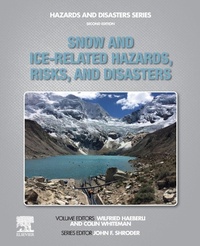
Snow and Ice-Related Hazards, Risks, and Disasters
2nd Edition
Published on 17. February 2021
Book
Paperback/Softback
784 pages
978-0-12-817129-5 (ISBN)
Description
Snow and Ice-Related Hazards, Risks, and Disasters, Second Edition, provides you with the latest scientific developments in sea level rise, permafrost degradation, rock/ice avalanches, glacier surges, glacial lake outburst floods, ice shelf collapses, climate change implications, causality, impacts, preparedness and mitigation. The book takes a geo-scientific approach to the topic while also covering current thinking about directly related social scientific issues that can affect ecosystems and global economies. Special emphasis is placed on the rapidly progressing effects from global warming on the cryosphere, perspectives for the future and latest scientific advances, and technological developments.
More details
Edition
2nd edition
Language
English
Place of publication
United States
Target group
Professional and scholarly
Geoscientists, including glaciologists, oceanographers, climatologists, environmental scientists, geologists, geophysicists geomorphologists, atmospheric scientists, and seismologists
Product notice
Paperback (trade)
Illustrations
Approx. 300 illustrations (100 in full color)
Dimensions
Height: 236 mm
Width: 192 mm
Thickness: 42 mm
Weight
1599 gr
ISBN-13
978-0-12-817129-5 (9780128171295)
Copyright in bibliographic data and cover images is held by Nielsen Book Services Limited or by the publishers or by their respective licensors: all rights reserved.
Schweitzer Classification
Other editions
Additional editions
Wilfried Haeberli | Colin Whiteman
Snow and Ice-Related Hazards, Risks, and Disasters
E-Book
02/2021
2nd Edition
Elsevier
€160.00
Available for download
Previous edition
Book
10/2018
Academic Press
€97.80
The article will not be published
Persons
Dr. John (Jack) F. Shroder received his bachelor's degree in geology from Union College in 1961; his masters in geology from the University of Massachusetts - Amherst in 1963, and his Ph.D. in geology at the University of Utah in 1967. He has been actively pursuing research on landforms and natural resources in the high mountain environments of the Rocky Mountains, the Afghanistan Hindu Kush, and the Karakoram Himalaya of Pakistan for over a half century. His teaching specialties have been primarily geomorphology, but also physical and historical geology and several other courses at the University of Nebraska at Omaha where he was the founding professor of the Geology major. While there he was instrumental in founding the Center for Afghanistan Studies in 1972, and he was the lead geologist for the Bethsaida Archaeological Project in Israel in the 1990s. He taught geology as an NSF-, USAID, and Fulbright-sponsored professor at Kabul University in 1977-78, as well as a Fulbright award to Peshawar University in 1983-84. He has some 63 written or edited books to his credit and more than 200 professional papers, with emphases on landslides, glaciers, flooding, and mineral resources in Afghanistan. He is a Fellow of the Geological Society of America and the American Association for the Advancement of Science and has received Distinguished Career awards from both the Mountain and the Geomorphology Specialty Groups of the Association of American Geographers. In the recent decade as an Emeritus Professor, he served as a Trustee of the Geological Society of America Foundation where he set up a research scholarship, the Shroder Mass Movement award for masters and doctoral candidates. For the past two decades, he has been the Editor-in-Chief for the Developments in Earth Surface Processes book series of Elsevier Publishing, as well as the 10-volumes of the Treatise on Geomorphology, and the Hazards, Risks, and Disasters book series, both in second editions. Recently, Dr. Shroder was ranked among the top 2 percent of researchers worldwide by the October study conducted by Stanford University. Wilfried Haeberli is professor emeritus at the Geography Department, University of Zurich, Switzerland. His research focuses on high mountains, impacts from climate change, glacier and permafrost monitoring, natural hazards and ice-age paleoglaciology. He obtained his PhD in Geography at the University of Basel (1974) and his habilitation in glaciology and geomorphology at ETH Zurich (1985). From 1989 to 1995 he led the Glaciology Section at the Laboratory of Hydraulics, Hydrology and Glaciology of ETH Zurich, from 1995 to 2013 he was full professor of Physical Geography at the University of Zurich, from 1986 to 2010 he was the first director of the World Glacier Monitoring Service (WGMS) of IACS/ICSU, UNEP, UNESCO and WMO and from1998 - 2003 he served as a vice president of the International Permafrost Association (IPA). As a member of the Terrestrial Observation Panel for Climate (TOP-C) from 1996 to 2009 he was responsible for the integration of cryosphere components as Essential Climate Variables into the terrestrial part (Global Terrestrial Observing System; GTOS) of the Global Climate Observing System (GCOS). He has been actively involved in various functions with the second to the fifth IPCC assessments and works as an expert and consultant concerning high-mountain hazards and climate-change impacts in various countries of South America, Asia and Europe Colin Whiteman was Principal Lecturer in Physical Geography in the School of Environment and Technology at the University of Brighton. He obtained his PhD in Pleistocene Stratigraphy at the University of London (1990). As Course Leader for the BSc. Physical Geography degree at Brighton, he taught a range of associated subjects, introducing the first course on climate change and, in particular, one on Cold Region Hazards. The latter topic was subsequently developed into a student text book, "Cold Regions Hazards and Risks?. He has led student studies in Norway and Iceland and carried out published geomorphological and stratigraphical research in these countries and in Arctic Canada
Content
1. Snow and Ice-Related Hazards, Risks, and Disasters: A General Framework
2. Physical, Thermal, and Mechanical Properties of Snow, Ice, and Permafrost
3. Snow and Ice in the Climate System
4. Snow and Ice in the Hydrosphere
5. Snow, Ice, and the Biosphere
6. Ice and Snow as Land-Forming Agents
7. Mountains, Lowlands, and Coasts: the Physiography of Cold Landscapes
8. Integrated Approaches to Adaptation and Disaster Risk Reduction in Dynamic Socio-cryospheric Systems
9. Integrative Risk Management: The Example of Snow Avalanches
10. Permafrost Degradation
11. Radioactive Waste Under Conditions of Future Ice Ages
12. Snow Avalanches
13. Glacier Surges
14. Glacier-Related Outburst Floods
15. Ice Loss and Slope Stability in High-Mountain Regions
16. Catastrophic Mass Flows in the Mountain Glacial Environment
17. Hazards at Ice-Clad Volcanoes: Phenomena, Processes, and Examples From Mexico, Colombia, Ecuador, and Chile
18. Floating Ice and Ice Pressure Challenge to Ships
19. Retreat Instability of Tidewater Glaciers and Marine Ice Sheets
20. Ice Sheets, Glaciers, and Sea Level
2. Physical, Thermal, and Mechanical Properties of Snow, Ice, and Permafrost
3. Snow and Ice in the Climate System
4. Snow and Ice in the Hydrosphere
5. Snow, Ice, and the Biosphere
6. Ice and Snow as Land-Forming Agents
7. Mountains, Lowlands, and Coasts: the Physiography of Cold Landscapes
8. Integrated Approaches to Adaptation and Disaster Risk Reduction in Dynamic Socio-cryospheric Systems
9. Integrative Risk Management: The Example of Snow Avalanches
10. Permafrost Degradation
11. Radioactive Waste Under Conditions of Future Ice Ages
12. Snow Avalanches
13. Glacier Surges
14. Glacier-Related Outburst Floods
15. Ice Loss and Slope Stability in High-Mountain Regions
16. Catastrophic Mass Flows in the Mountain Glacial Environment
17. Hazards at Ice-Clad Volcanoes: Phenomena, Processes, and Examples From Mexico, Colombia, Ecuador, and Chile
18. Floating Ice and Ice Pressure Challenge to Ships
19. Retreat Instability of Tidewater Glaciers and Marine Ice Sheets
20. Ice Sheets, Glaciers, and Sea Level