

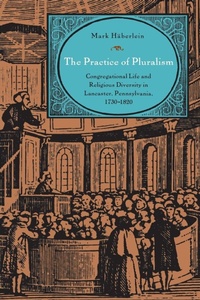
The Practice of Pluralism
Congregational Life and Religious Diversity in Lancaster, Pennsylvania, 1730-1820
Will be published approx. on 15. April 2016
Book
Paperback/Softback
288 pages
978-0-271-07483-2 (ISBN)
Description
The clash of modernity and an Amish buggy might be the first image that comes to one's mind when imagining Lancaster, Pennsylvania, today. But in the early to mid-eighteenth century, Lancaster stood apart as an active and religiously diverse, ethnically complex, and bustling city. On the eve of the American Revolution, Lancaster's population had risen to nearly three thousand inhabitants; it stood as a center of commerce, industry, and trade. While the German-speaking population-Anabaptists as well as German Lutherans, Moravians, and German Calvinists-made up the majority, about one-third were English-speaking Anglicans, Catholics, Presbyterians, Quakers, Calvinists, and other Christian groups. A small group of Jewish families also lived in Lancaster, though they had no synagogue. Carefully mining historical records and documents, from tax records to church membership rolls, Mark Haeberlein confirms that religion in Lancaster was neither on the decline nor rapidly changing; rather, steady and deliberate growth marked a diverse religious population.
Reviews / Votes
"Thorough and persuasive. The people of Lancaster come across as devoted and essentially conservative, supporting their churches and attached to their ways of worship, even if individuals among them occasionally changed their minds. Haeberlein persuasively shows that the laity provided the true continuity of the church."-Ned Landsmann, Stony Brook University "No other recent scholarly study provides as thorough an account of the diversity of religious practice in a single community in eighteenth- and early nineteenth-century America."
-Scott Paul Gordon Journal of Moravian History "One of the book's major strengths is its research. Haeberlein has meticulously assembled biographic and economic data on a large portion of the pastors, deacons, elders, vestrymen, and other lay leaders in Lancaster during this period. This excellent book adds much to the understanding of religion in the early mid-Atlantic and the maturation of backcountry American society."
-Steve Longenecker The Catholic Historical Review "This meticulously researched book explores the complex religious landscape of Lancaster, Pennsylvania, during the long eighteenth century."
-S. E. Imhoff Choice
More details
Series
Language
English
Place of publication
University Park
United States
Target group
Professional and scholarly
Product notice
Paperback (trade)
Illustrations
0 Illustrations
Dimensions
Height: 229 mm
Width: 152 mm
Thickness: 17 mm
Weight
474 gr
ISBN-13
978-0-271-07483-2 (9780271074832)
Copyright in bibliographic data and cover images is held by Nielsen Book Services Limited or by the publishers or by their respective licensors: all rights reserved.
Schweitzer Classification
Person
Mark Haeberlein is Professor of Early Modern History at the University of Bamberg, Germany.
Content
PREFACE AND ACKNOWLEDGMENTS
INTRODUCTION
1
A Quest for Order:
The German Reformed Congregation, 1733-1775
2
Growth and Disruption: Lutherans and Moravians
3
The English Churches of Colonial Lancaster
4
Religious Pluralism in an Eighteenth-Century Town
5
Lancaster's Churches in the New Republic
6
The Transformation of Charity, 1750-1820
Conclusion
BIBLIOGRAPHY
INDEX
INTRODUCTION
1
A Quest for Order:
The German Reformed Congregation, 1733-1775
2
Growth and Disruption: Lutherans and Moravians
3
The English Churches of Colonial Lancaster
4
Religious Pluralism in an Eighteenth-Century Town
5
Lancaster's Churches in the New Republic
6
The Transformation of Charity, 1750-1820
Conclusion
BIBLIOGRAPHY
INDEX