

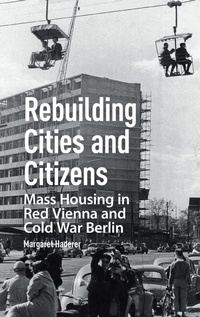
Rebuilding Cities and Citizens
Mass Housing in Red Vienna and Cold War Berlin
Published on 16. June 2023
Book
Hardback
196 pages
978-94-6372-494-4 (ISBN)
Description
In Vienna after WWI and Berlin after WWII, the provision of mass housing not only was a response to a dire social need but also served as a key lever for building variants of socialism and liberalism. Zooming into the interplay between political ideologies and the production of space, this book shows that ideologies, understood as political beliefs that underpin everyday life, are never simply 'written' into space but that their meaning is made and re-made, negotiated and contested, and sometimes cunningly subverted in and through space. How people live was - and continues to be - a profoundly political question that involves negotiations of, and decisions on, norms and ideals of citizenship, freedom, equality, property, democracy, gender, and family life - negotiations and decisions that come with legacies that shape the present.
Reviews / Votes
"Margaret Haderer's book is a political archeology of housing utopias and impressively shows that there are alternatives to capitalist market logic. Her critical examination of ideologies reminds us that housing is not only determined by 'housing policies', but can be instrumentalized as 'politics of dwelling'."- Dr. Andrej Holm, Housing Researcher at Humboldt University Berlin
"A work both of urban history and housing theory, Rebuilding Cities and Citizens explores the making of urban and residential space as a political project. It will become a touchstone for scholars of housing in Vienna and Berlin as well as anyone interested in the relationship between politics, ideology and the city."
- David Madden, Associate Professor of Sociology at the London School of Economics and Political Science
More details
Language
English
Place of publication
Oxford
Netherlands
Target group
Professional and scholarly
Academic
Illustrations
21 s/w Abbildungen
21 Illustrations, black and white
Dimensions
Height: 240 mm
Width: 161 mm
Thickness: 15 mm
Weight
464 gr
ISBN-13
978-94-6372-494-4 (9789463724944)
Copyright in bibliographic data and cover images is held by Nielsen Book Services Limited or by the publishers or by their respective licensors: all rights reserved.
Schweitzer Classification
Other editions
Additional editions
Book
approx. 12/2025
1st Edition
Routledge
€68.50
Not yet published
E-Book
10/2025
Routledge
€60.49
Available for download
E-Book
10/2025
Routledge
€60.49
Available for download
Person
Margarete Haderer obtained her PhD in political science from the University of Toronto. She works as a researcher and lecturer at the Faculty of Architecture and Planning at Technical University Vienna.
Content
1 Introduction: The Making and Remaking of Ideologies through Space
2 Municipal Socialism and Housing in Red Vienna (1919-1934)
2.1 Whose City? Appropriating the City, Creating Proletarian Spaces
2.2 For a 'Slow Revolution': Austro-Marxist Theory and Housing Policies
2.3 Building for 'New Men': Two Approaches to Social Emancipation
2.4 The Lures of the Past in the New Socialist Dwelling Culture
2.5 Red Vienna turning Black
2.6 References
3 Short-Lived Great Berlin: Tabula Rasa and the Reinvention of Nature (1945-1949)
3.1 The Bombing of Cities as 'History's Auto-Correction'
3.2 The Metropolis, a Moloch
3.3 Great Berlin: A New Beginning through Greening the City
3.4 References
4 Divided City I: East Berlin and the Construction of Socialism (1949-1970)
4.1 Back to the Future: 'Socialism in One Country' and the 'Beautiful German City'
4.2 Constructing Socialism with Taylor, Defending it with Tanks
4.3 'Living Better, Dwelling More Beautifully': Toward a Socialist Dwelling Culture?
4.4 From the Workers' Palace back to the Dwelling Machine
4.5 Creative Destruction: The Double Legacy of the Platte
4.6 The Allotment Garden as the Platte's Antidote?
4.7 References
5 Divided City II: West Berlin and the Reconstruction of Liberalism (1949-1970)
5.1 Interbau '57: Proclaiming the City of Tomorrow, Exhibiting the City of Yesterday
5.2 'Economic Policies are the Best Social Policies': West German Ordo-Liberalism
5.3 Standardized Dwelling, Normalized Living
5.4 Spanners in the Works of Dwelling Machines: Two Experiments in Counter-Culture
5.4.1 The Maerkische Viertel: Contesting Abstract Space
5.4.2 Kommune 1: From Minimum to Maximum Existence
5.5 References
6 Conclusion and Postcards from the Past
6.1 References
7 References
8 List of Images
9 Index
2 Municipal Socialism and Housing in Red Vienna (1919-1934)
2.1 Whose City? Appropriating the City, Creating Proletarian Spaces
2.2 For a 'Slow Revolution': Austro-Marxist Theory and Housing Policies
2.3 Building for 'New Men': Two Approaches to Social Emancipation
2.4 The Lures of the Past in the New Socialist Dwelling Culture
2.5 Red Vienna turning Black
2.6 References
3 Short-Lived Great Berlin: Tabula Rasa and the Reinvention of Nature (1945-1949)
3.1 The Bombing of Cities as 'History's Auto-Correction'
3.2 The Metropolis, a Moloch
3.3 Great Berlin: A New Beginning through Greening the City
3.4 References
4 Divided City I: East Berlin and the Construction of Socialism (1949-1970)
4.1 Back to the Future: 'Socialism in One Country' and the 'Beautiful German City'
4.2 Constructing Socialism with Taylor, Defending it with Tanks
4.3 'Living Better, Dwelling More Beautifully': Toward a Socialist Dwelling Culture?
4.4 From the Workers' Palace back to the Dwelling Machine
4.5 Creative Destruction: The Double Legacy of the Platte
4.6 The Allotment Garden as the Platte's Antidote?
4.7 References
5 Divided City II: West Berlin and the Reconstruction of Liberalism (1949-1970)
5.1 Interbau '57: Proclaiming the City of Tomorrow, Exhibiting the City of Yesterday
5.2 'Economic Policies are the Best Social Policies': West German Ordo-Liberalism
5.3 Standardized Dwelling, Normalized Living
5.4 Spanners in the Works of Dwelling Machines: Two Experiments in Counter-Culture
5.4.1 The Maerkische Viertel: Contesting Abstract Space
5.4.2 Kommune 1: From Minimum to Maximum Existence
5.5 References
6 Conclusion and Postcards from the Past
6.1 References
7 References
8 List of Images
9 Index