

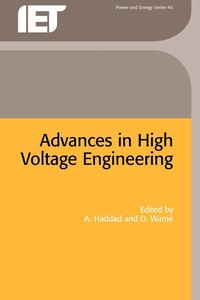
Advances in High Voltage Engineering
Published on 22. October 2004
Book
Paperback/Softback
668 pages
978-1-84919-038-1 (ISBN)
Description
It is several years since any book has attempted to cover the range of issues in high voltage research and development. The area continues to be full of challenge and scope and this book focuses on developments in experimental methods, theory, modelling and HV technology through the past decade. The coverage includes advances in basic understanding and capability, for instance in earthing, numerical analysis, optical methods, the physics of air breakdown and partial discharge. It also addresses technological developments in key areas such as SF6 insulation systems, polymeric insulators and power cables, ZnO surge arrestors, and pulsed power. The unique blend of reputable contributors and comprehensive subject coverage makes this book an ideal reference source for engineers and researchers in the field for many years to come.
Reviews / Votes
'By providing a review of many recent advances in high-voltage technology in one source, many readers would find this book to be of great interest, especially those working with high-voltage systems for power transmission and related measurements.' -- John J. Shea * Electrical Insulation Magazine *More details
Series
Language
English
Place of publication
Stevenage
United Kingdom
Target group
College/higher education
Professional and scholarly
Dimensions
Height: 234 mm
Width: 156 mm
Thickness: 35 mm
Weight
998 gr
ISBN-13
978-1-84919-038-1 (9781849190381)
Copyright in bibliographic data and cover images is held by Nielsen Book Services Limited or by the publishers or by their respective licensors: all rights reserved.
Schweitzer Classification
Other editions
Additional editions
A. Haddad | D.F. Warne
Advances in High Voltage Engineering
E-Book
11/2008
1st Edition
Institution of Engineering and Technology
€349.99
Available for download
Persons
Dr A. Haddad obtained the degree of Ingenieur d'Etat in Electrical Engineering, followed by a Ph.D. in High Voltage Engineering in 1990. In 1995 he was appointed as a Lecturer and then Senior Lecturer in electrical engineering at Cardiff University, with responsibility for the High Voltage Research Group and lecturing duties in high voltage engineering, power systems, electromagnetics and electrical circuits.
Doug Warne graduated from Imperial College with an apprenticeship at AEI Heavy Plant Division in Rugby. At the Electrical Research Association he took responsibility for the short-circuit testing station and the HV laboratory, and also the development and management of ERA's wind energy research. Since 1990 Doug has acted as an independent consultant. He also runs the independent NETCORDE syndicate for better industry-university collaboration in electrical engineering and he co-ordinates the ESR (Electricity Supply Research) Network.
Doug Warne graduated from Imperial College with an apprenticeship at AEI Heavy Plant Division in Rugby. At the Electrical Research Association he took responsibility for the short-circuit testing station and the HV laboratory, and also the development and management of ERA's wind energy research. Since 1990 Doug has acted as an independent consultant. He also runs the independent NETCORDE syndicate for better industry-university collaboration in electrical engineering and he co-ordinates the ESR (Electricity Supply Research) Network.
Content
Chapter 1: Mechanisms of air breakdown
Chapter 2: SF6 insulation systems and their monitoring
Chapter 3: Lightning phenomena and protection systems
Chapter 4: Partial discharges and their measurement
Chapter 5: ZnO surge arresters
Chapter 6: Insulators for outdoor applications
Chapter 7: Overvoltages and insulation coordination on transmission networks
Chapter 8: Earthing
Chapter 9: Circuit breakers and interruption
Chapter 10: Polymer insulated power cable
Chapter 11: Numerical analysis of electrical fields in high voltage equipment
Chapter 12: Optical measurements and monitoring in high voltage environments
Chapter 13: Pulsed power - principles and applications
Chapter 2: SF6 insulation systems and their monitoring
Chapter 3: Lightning phenomena and protection systems
Chapter 4: Partial discharges and their measurement
Chapter 5: ZnO surge arresters
Chapter 6: Insulators for outdoor applications
Chapter 7: Overvoltages and insulation coordination on transmission networks
Chapter 8: Earthing
Chapter 9: Circuit breakers and interruption
Chapter 10: Polymer insulated power cable
Chapter 11: Numerical analysis of electrical fields in high voltage equipment
Chapter 12: Optical measurements and monitoring in high voltage environments
Chapter 13: Pulsed power - principles and applications