

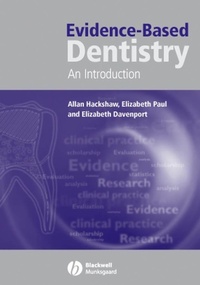
Evidence-Based Dentistry
An Introduction
1st Edition
Published on 2. August 2006
Book
Paperback/Softback
240 pages
978-1-4051-2496-6 (ISBN)
Description
This introduction to Evidence-Based Dentistry provides a much-needed orientation in the subject for students and professionals alike. It is a ground-level book for those seeking to understand evidence-based dentistry and its significance for clinical practice. The book is anchored in the dental literature: the majority of the chapters offer guidance on interpreting a full published paper; where both the subject of the paper and the study design is of relevance to the field of dentistry.
Each chapter is organised in a similar way, providing a structured approach to reading and understanding research articles or commercial product information. In this respect, Evidence-Based Dentistry is designed as an introduction to understanding published research and its implications for the dental surgery; rather than as a guide on undertaking research.
Incorporates topical published papers in order to rpovide worked examples
Explains the most6 common forms of research used in dentistry
Unlocks basic statistical and epidemiological concepts, along with key terms
Enables the reader to identify the research question, assess aspects of study design, evaluate the strengths and weaknesses of papers and understand their clinical relevance
Tables, boxes and figures are used extensively to present core information. Useful templates are also provided, which readers may use/adapt for analysis, including study clubs.
Each chapter is organised in a similar way, providing a structured approach to reading and understanding research articles or commercial product information. In this respect, Evidence-Based Dentistry is designed as an introduction to understanding published research and its implications for the dental surgery; rather than as a guide on undertaking research.
Incorporates topical published papers in order to rpovide worked examples
Explains the most6 common forms of research used in dentistry
Unlocks basic statistical and epidemiological concepts, along with key terms
Enables the reader to identify the research question, assess aspects of study design, evaluate the strengths and weaknesses of papers and understand their clinical relevance
Tables, boxes and figures are used extensively to present core information. Useful templates are also provided, which readers may use/adapt for analysis, including study clubs.
Reviews / Votes
"Suitable for both undergraduates and professional dentists with years of practice under their belts alike, this 200-page paperback aims to provide a basic understanding of research in dentistry and how it is conducted and reportedThis book provides an invaluable insight into how scientific findings in dentistry are researched and reported."
bdanews, December 2006
More details
Language
English
Place of publication
Hoboken
United Kingdom
Publishing group
John Wiley and Sons Ltd
Target group
Professional and scholarly
Product notice
Paperback (trade)
Unsewn / adhesive bound
Dimensions
Height: 246 mm
Width: 191 mm
Thickness: 15 mm
Weight
448 gr
ISBN-13
978-1-4051-2496-6 (9781405124966)
Copyright in bibliographic data and cover images is held by Nielsen Book Services Limited or by the publishers or by their respective licensors: all rights reserved.
Schweitzer Classification
Persons
Allan Hackshaw established and led the course on evidence-based dentistry at Barts & the London School of Dentistry and is now deputy-director of the cancer trials centre at University College London.
Elizabeth Paul is a Lecturer at the UCL cancer trials centre.
Elizabeth Davenport is Professor of Dental Education, Barts & the London School of Dentistry.
Elizabeth Paul is a Lecturer at the UCL cancer trials centre.
Elizabeth Davenport is Professor of Dental Education, Barts & the London School of Dentistry.
Content
Foreword viii
Preface ix
Acknowledgements xii
1 Evidence-based dentistry: what it is and how to practice it 1
What is evidence-based dentistry? 1
Why do we need evidence-based dentistry? 2
How to practice evidence-based dentistry 3
2 Counting people: understanding percentages and proportions 10
What is the aim of the study? 10
How was the study conducted? 11
What are the main results? 12
The implications of conducting a study based on a sample of people 15
How good is the evidence? 19
What does the study contribute to dental practice? 23
3 Taking measurements on people 31
What is the aim of the study? 31
How was the study conducted? 32
What are the main results? 35
Normal distribution 35
Interpreting the results from non-symmetric data 40
4 Comparing groups of people and examining associations 44
Comparing two percentages (or proportions) 44
Comparing two means 51
Examining associations 55
5 Assessing the effectiveness of treatments 68
Main design elements of randomised clinical trials 69
A clinical trial based on counting people 71
A clinical trial based on taking measurements on people 89
Appendix I. Guidelines for the appraisal of a clinical trial 99
6 Determining risk factors for and causes of disease 115
Association, causality and confounding 116
Cohort studies 119
An example of a cohort study 121
Case-control studies 131
An example of a case-control study 132
Appendix I. Guidelines for the appraisal of an observational study 141
Appendix II. Calculation of odds, risk, odds ratio and relative risk 143
7 Detecting disease 154
Conditions for a worthwhile screening programme 156
8 Study design issues 172
Types of study 172
Selecting the sample 172
Sample size 173
More observational studies 177
Bias 178
Confounding 180
More on clinical trials 182
What is the strength of evidence for causality from different study types? 183
9 Reviewing all the evidence 186
Searching for information 186
Conflicts of interests in published research 188
Systematic reviews 189
10 Summary of statistical concepts 205
Suggested answers 209
Further reading 219
Index 222
Preface ix
Acknowledgements xii
1 Evidence-based dentistry: what it is and how to practice it 1
What is evidence-based dentistry? 1
Why do we need evidence-based dentistry? 2
How to practice evidence-based dentistry 3
2 Counting people: understanding percentages and proportions 10
What is the aim of the study? 10
How was the study conducted? 11
What are the main results? 12
The implications of conducting a study based on a sample of people 15
How good is the evidence? 19
What does the study contribute to dental practice? 23
3 Taking measurements on people 31
What is the aim of the study? 31
How was the study conducted? 32
What are the main results? 35
Normal distribution 35
Interpreting the results from non-symmetric data 40
4 Comparing groups of people and examining associations 44
Comparing two percentages (or proportions) 44
Comparing two means 51
Examining associations 55
5 Assessing the effectiveness of treatments 68
Main design elements of randomised clinical trials 69
A clinical trial based on counting people 71
A clinical trial based on taking measurements on people 89
Appendix I. Guidelines for the appraisal of a clinical trial 99
6 Determining risk factors for and causes of disease 115
Association, causality and confounding 116
Cohort studies 119
An example of a cohort study 121
Case-control studies 131
An example of a case-control study 132
Appendix I. Guidelines for the appraisal of an observational study 141
Appendix II. Calculation of odds, risk, odds ratio and relative risk 143
7 Detecting disease 154
Conditions for a worthwhile screening programme 156
8 Study design issues 172
Types of study 172
Selecting the sample 172
Sample size 173
More observational studies 177
Bias 178
Confounding 180
More on clinical trials 182
What is the strength of evidence for causality from different study types? 183
9 Reviewing all the evidence 186
Searching for information 186
Conflicts of interests in published research 188
Systematic reviews 189
10 Summary of statistical concepts 205
Suggested answers 209
Further reading 219
Index 222