

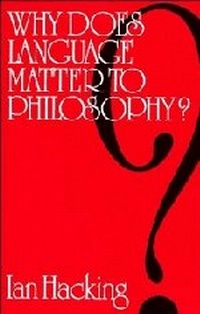
Why Does Language Matter to Philosophy?
Published on 26. September 1975
Book
Hardback
180 pages
978-0-521-20923-6 (ISBN)
Description
Many people find themselves dissatisfied with recent linguistic philosophy, and yet know that language has always mattered deeply to philosophy and must in some sense continue to do so. Ian Hacking considers here some dozen case studies in the history of philosophy to show the different ways in which language has been important, and the consequences for the development of the subject. There are chapters on, among others, Hobbes, Berkeley, Russell, Ayer, Wittgenstein, Chomsky, Feyerabend and Davidson. Dr Hacking ends by speculating about the directions in which philosophy and the study of language seem likely to go. The book will provide students with a stimulating, broad survey of problems in the theory of meaning and the development of philosophy, particularly in this century. The topics treated in the philosophy of language are among the central, current concerns of philosophers, and the historical framework makes it possible to introduce concretely and intelligibly all the main theoretical issues.
More details
Language
English
Place of publication
Cambridge
United Kingdom
Target group
College/higher education
Professional and scholarly
Dimensions
Height: 200 mm
Width: 100 mm
Thickness: 20 mm
Weight
310 gr
ISBN-13
978-0-521-20923-6 (9780521209236)
Copyright in bibliographic data and cover images is held by Nielsen Book Services Limited or by the publishers or by their respective licensors: all rights reserved.
Schweitzer Classification
Other editions
New editions
Ian Hacking
Why Does Language Matter to Philosophy?
Book
09/1975
Cambridge University Press
€32.10
Shipment within 15-20 days
Additional editions
Ian Hacking
Why Does Language Matter to Philosophy?
Book
09/1975
Cambridge University Press
€32.10
Shipment within 15-20 days
Content
Preface; 1. Strategy; Part I. The Heyday of Ideas: 2. Thomas Hobbes' mental discourse; 3. Port Royal's ideas; 4. Bishop Berkeley's abstractions; 5. Nobody's theory of meaning; Part II. The Heyday of Meanings: 6. Noam Chomsky's innatism; 7. Bertrand Russell's acquaintance; 8. Ludwig Wittgenstein's articulation; 9. A. J. Ayer's verification; 10. Norman Malcolm's dreams; Part III. The Heyday of Sentences: 11. Paul Feyerabend's theories; 12. Donald Davidson's truth; 13. Why does language matter to philosophy?; Bibliography; Index.