

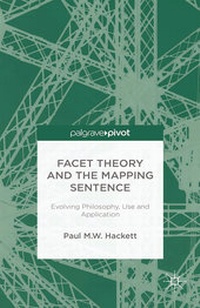
Facet Theory and the Mapping Sentence
Evolving Philosophy, Use and Application
Published on 1. January 2014
Book
Paperback/Softback
X, 113 pages
978-1-349-46673-3 (ISBN)
Description
How do we think about the worlds we live in? The formation of categories of events and objects seems to be a fundamental orientation procedure. Facet theory and its main tool, the mapping sentence, deal with categories of behavior and experience, their interrelationship, and their unification as our worldviews. In this book Hackett reviews philosophical writing along with neuroscientific research and information form other disciplines to provide a context for facet theory and the qualitative developments in this approach. With a variety of examples, the author proposes mapping sentences as a new way of understanding and defining complex behavior.
More details
Edition
1st ed. 2014
Language
English
Place of publication
London
United Kingdom
Publishing group
Palgrave Macmillan
Target group
Professional and scholarly
Illustrations
X, 113 p.
Dimensions
Height: 21.6 cm
Width: 14 cm
ISBN-13
978-1-349-46673-3 (9781349466733)
DOI
10.1057/9781137345929
Schweitzer Classification
Other editions
Additional editions
Book
06/2014
Palgrave Pivot
€58.84
Article exhausted; check for reprint
Person
Paul M.W. Hackett is a Professor in Research Methods, Statistics and Consumer Behavior, and Executive in Residence in the Department of Marketing Communication at Emerson College, MA, USA. He has published in numerous journals and is an artist whose work has shown in Europe and the US. He has doctorates in both psychology and fine art.
Content
1. Introduction 2. Ontological Categorisation and Mereology 3. Facet Theory and Thinking about Human Behavior 4. Evolving Facet Theory Applications Conclusions: Future Directions