

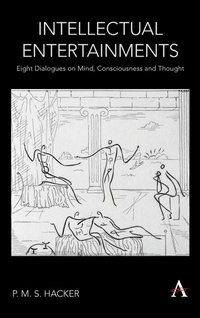
Intellectual Entertainments
Eight Dialogues on Mind, Consciousness and Thought
Published on 28. October 2019
Book
Hardback
240 pages
978-1-78527-152-6 (ISBN)
Description
'Intellectual Entertainments' consists of eight philosophical dialogues, each with five participants, some living, some imaginary and some dead. The dialogues take place either in Elysium or in an imaginary Oxford Common Room. Each historical figure speaks in his own idiom with a distinctive turn of phrase. The imaginary figures speak in the accent and idiom of their respective countries (English, Scottish, American, Australian). The themes are the nature of the mind and the relation between mind and body; the nature of consciousness and its demystification; the nature of thought and its relation to speech; and the objectivity or subjectivity of perceptual qualities such as colour, sound, smell, taste and warmth. Each participant presents a different point of view and defends his position against the arguments of the others. No philosophical knowledge is presupposed.
Reviews / Votes
'No one interested in philosophy should miss this exceptional opportunity to enter the philosophical fray through dialogues spiced with humour, and achieve clarity on the most difficult and controversial philosophical questions such as the nature of the mind; how it relates to the body and differs from the brain; whether consciousness exists; the nature of thought and how it relates to language. This is a tour de force by the most eminent Wittgenstein scholar of our time.' - Daniele Moyal-Sharrock, Professor of Philosophy, University of Hertfordshire, UK, and President of the British Wittgenstein Society 'In these engaging dialogues Peter Hacker has distilled a lifetime's meticulous and insightful philosophical reflection on consciousness, thought and the nature of the mind, and the often misguided ways in which we talk and think about them.' - John Cottingham, Professor Emeritus of Philosophy, University of Reading, UK, and Professor of Philosophy, University of Roehampton, UKMore details
Series
Language
English
Place of publication
London
United Kingdom
Target group
Professional and scholarly
US School Grade: College Graduate Student
Dimensions
Height: 235 mm
Width: 157 mm
Thickness: 19 mm
Weight
549 gr
ISBN-13
978-1-78527-152-6 (9781785271526)
Copyright in bibliographic data and cover images is held by Nielsen Book Services Limited or by the publishers or by their respective licensors: all rights reserved.
Schweitzer Classification
Other editions
Additional editions
E-Book
10/2019
1st Edition
Anthem Press
€13.49
Available for download
E-Book
10/2019
1st Edition
Anthem Press
€13.49
Available for download
Person
P. M. S. Hacker is the leading authority on the philosophy of Wittgenstein, on which he has written ten books. He has also written extensively on the philosophy of language. His other area of specialization is philosophy and cognitive neuroscience, on which he has written three books together with the eminent neuroscientist, M. R. Bennett. For Philosophical Foundations of Neuroscience in particular, Hacker was appointed to an honorary UCL professorship in the Department of Neurology at University College London. Hacker has published three volumes of a tetralogy on human nature: The Categorial Framework, The Intellectual Powers and The Passions. The final volume will be The Moral Powers (forthcoming, 2020).
Content
Preface; Acknowledgements; Section 1 Two Dialogues on Mind and Body; Introduction; First Dialogue On the Nature of the Mind; Second Dialogue The Mind and the Body; Section 2 Two Dialogues on Consciousness; Introduction; Third Dialogue The Mystery of Consciousness; Fourth Dialogue Consciousness as Experience - Consciousness as Life Itself; Section 3 A Dialogue on the Objectivity or Subjectivity of Perceptual Qualities; Introduction; Fifth Dialogue On the Objectivity or Subjectivity of Perceptual Qualities; Section 4 Two Dialogues on Thought; Introduction; Sixth Dialogue Thought; Seventh Dialogue Thought and Language; Section 5 A Dialogue on Ownership of Pain; Introduction; Eighth Dialogue Can You Have My Pain? Can Different People Have the Same Pain?