


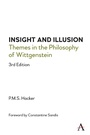
Insight and Illusion
Themes in the Philosophy of Wittgenstein, 3rd Edition
Published on 26. February 2021
Book
Paperback/Softback
366 pages
978-1-78527-686-6 (ISBN)
Description
Peter Hacker's Insight and Illusion is a thoroughly comprehensive examination of the evolution of Wittgenstein's thought from the Tractatus to his later 'mature' phase. This is a reprint of the revised and corrected 1989 edition, with a new foreword by Constantine Sandis. Hacker's book is now widely regarded as the best single volume study covering both the 'early' and the 'later' Wittgenstein. Until this third edition, the book had been out of print for 25 years.
Reviews / Votes
"To this day, the revised edition of Insight and Illusion is probably the best single book on Wittgenstein." -Professor Hans-Johnann Glock, University of Zurich "This book on Wittgenstein's early to late thought is invaluable for anyone wishing to understand the ideas of this great philosopher."-Professor Hanoch Ben-Yami, Central European UniversityMore details
Series
Language
English
Place of publication
London
United Kingdom
Target group
Professional and scholarly
US School Grade: College Graduate Student
Dimensions
Height: 216 mm
Width: 140 mm
Thickness: 22 mm
Weight
519 gr
ISBN-13
978-1-78527-686-6 (9781785276866)
Copyright in bibliographic data and cover images is held by Nielsen Book Services Limited or by the publishers or by their respective licensors: all rights reserved.
Schweitzer Classification
Other editions
Additional editions
E-Book
02/2021
1st Edition
Anthem Press
€38.99
Available for download
Persons
P.M.S. Hacker is the leading authority on the philosophy of Wittgenstein. He has specialized in philosophy and cognitive neuroscience. He has written a four-volume tetralogy on human nature of which three have been published.
Content
LIST OF ABBREVIATIONS; I. WITTGENSTEIN'S EARLY CONCEPTION OF PHILOSOPHY; 1. Background; 2. The 'Preliminary' on Philosophy; 3. Philosophy and Illusion 4. Philosophy as Critique and as Analysis; II. THE DIALOGUE WITH FREGE AND RUSSELL; 1. Agreements and Disagreements; 2. The Grundgedanke of the Tractatus; 3. The Laws of Logic; 4. A Prelude to Conventionalism; III. MEANING, METAPHYSICS, AND THE MIND; 1. The Picture Theory of Meaning; 2. The Metaphysics of the Tractatus; 3. Connecting Language with Reality: The Role of the Mind; IV. EMPIRICAL REALISM AND TRANSCENDENTAL SOLIPSISM; 1. The Self of Solipsism; 2. 'I Am My World'; 3. 'The Limits of Language Mean the Limits of My World'; 4. Later Years; V. DISINTEGRATION AND RECONSTRUCTION; 1. The Colour-Exclusion Problem; 2. Dismantling the Tractatus; 3. The Brouwer Lecture; 4. Moving off in Fresh Directions; 5. The Vienna Circle and Wittgenstein's Principle of Verification; VI. WITTGENSTEIN'S LATER CONCEPTION OF PHILOSOPHY; 1. A Kink in the Evolution of Philosophy; 2. A Cure for the Sickness of the Understanding; 3. Philosophy, Science, and Description; 4. Philosophy and Ordinary Language; 5. The Phenomenology and Sources of Philosophical Illusion; 6. Systematic Philosophy; VII. METAPHYSICS AS THE SHADOW OF GRAMMAR; 1. Grammar; 2. The Autonomy of Grammar; 3. Grammar and Metaphysics; 4. A Note on Kant and Wittgenstein; VIII. THE REFUTATION OF SOLIPSISM; 1. Introduction; 2. From Transcendental Solipsism to Methodological Solipsism; 3. The Solipsist's Predicament: A Restatement and Second Diagnosis; 4. The Refutation; IX. PRIVATE LINGUISTS AND PUBLIC SPEAKERS; 1. A Disease of the Intellect; 2. Following Rules; 3. Philosophical Investigations; 4. The Private Language; 5. The Epistemology of the Private Linguist; 6. Wittgenstein's Criticism of the Private Language; 7. 'Only I Know' and 'Only I have'; X. 'A CLOUD OF PHILOSOPHY CONDENSED INTO A DROP OF GRAMMAR'; 1. Can One Know That One Is in Pain?; 2. Self-Consciousness: the Overthrow of the Cartesian Picture; 3. The 'Inner' and the 'Outer'; 4. Experience and Its Natural Expression; 5. Avowals and Descriptions; 6. Objections and Deflections; XI. CRITERIA, REALISM, AND ANTI-REALISM; 1. The Origin of the Idea; 2. Plotting the Contour-lines; 3. Further Complications; 4. Red Herrings: Realism and Anti-Realism; INDEX.