

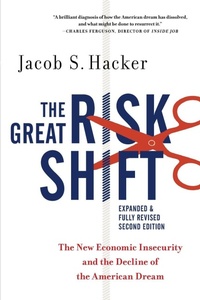
The Great Risk Shift
The New Economic Insecurity and the Decline of the American Dream, Second Edition
2nd Edition
Published on 2. May 2019
Book
Paperback/Softback
264 pages
978-0-19-084414-1 (ISBN)
Description
[Please note this is placeholder text from the previous edition] America's leaders say the economy is strong and getting stronger. But the safety net that once protected us is fast unraveling. With retirement plans in growing jeopardy while health coverage erodes, more and more economic risk is shifting from government and business onto the fragile shoulders of the American family.
In The Great Risk Shift, Jacob S. Hacker lays bare this unsettling new economic climate, showing how it has come about, what it is doing to our families, and how we can fight back. Behind this shift, he contends, is the Personal Responsibility Crusade, eagerly embraced by corporate leaders and Republican politicians who speak of a nirvana of economic empowerment, an "ownership society" in which Americans are free to choose. But as Hacker reveals, the result has been quite different: a harsh new world of economic insecurity, in which far too many Americans are free to lose.
The book documents how two great pillars of economic security--the family and the workplace--guarantee far less financial stability than they once did. The final leg of economic support--the public and private benefits that workers and families get when economic disaster strikes--has dangerously eroded as political leaders and corporations increasingly cut back protections of our health care, our income security, and our retirement pensions.
Blending powerful human stories, big-picture analysis, and compelling ideas for reform, this remarkable volume will hit a nerve, serving as a rallying point in the vital struggle for economic security in an increasingly uncertain world.
In The Great Risk Shift, Jacob S. Hacker lays bare this unsettling new economic climate, showing how it has come about, what it is doing to our families, and how we can fight back. Behind this shift, he contends, is the Personal Responsibility Crusade, eagerly embraced by corporate leaders and Republican politicians who speak of a nirvana of economic empowerment, an "ownership society" in which Americans are free to choose. But as Hacker reveals, the result has been quite different: a harsh new world of economic insecurity, in which far too many Americans are free to lose.
The book documents how two great pillars of economic security--the family and the workplace--guarantee far less financial stability than they once did. The final leg of economic support--the public and private benefits that workers and families get when economic disaster strikes--has dangerously eroded as political leaders and corporations increasingly cut back protections of our health care, our income security, and our retirement pensions.
Blending powerful human stories, big-picture analysis, and compelling ideas for reform, this remarkable volume will hit a nerve, serving as a rallying point in the vital struggle for economic security in an increasingly uncertain world.
Reviews / Votes
As Jacob Hacker argues persuasively in The Great Risk Shift, America's middle class finds itself living with far more risk and income volatility than it did a generation ago. * Chris Hayes, The Nation * The essential policy book of the year. * Washington Post * Provocative and worth reading. * New York Times * Hacker offers up a new foundation for economic security. This is an important book. * Robert B. Reich, former U.S. Secretary of Labor * Provides a fresh diagnosis of a familiar complex of problems from structural unemployment to the erosion of retirement plans you can retire on. * The Atlantic * [This] book deserves the widest possible audience, for having nailed the most powerful and underappreciated economic trend of our era, thereby inviting a discussion of the political opportunities. * Robert Kuttner, American Prospect * A brilliant diagnosis of how the American dream has dissolved, and what might be done to resurrect it.With cool intelligence but also great compassion, Jacob Hacker shows how both corporate and governmental safety nets have been systematically dismantled, leaving average Americans at the mercy of an increasingly risky global economy. * Charles Ferguson, Director of Inside Job *More details
Edition
2nd Revised edition
Language
English
Place of publication
New York
United States
Target group
Professional and scholarly
Edition type
Revised edition
Dimensions
Height: 234 mm
Width: 156 mm
Thickness: 14 mm
Weight
404 gr
ISBN-13
978-0-19-084414-1 (9780190844141)
Copyright in bibliographic data and cover images is held by Nielsen Book Services Limited or by the publishers or by their respective licensors: all rights reserved.
Schweitzer Classification
Other editions
Additional editions
Jacob S. Hacker
The Great Risk Shift
The New Economic Insecurity and the Decline of the American Dream, Second Edition
E-Book
02/2019
2nd Edition
OUP eBook
€7.49
Available for download
Jacob S. Hacker
The Great Risk Shift
The New Economic Insecurity and the Decline of the American Dream, Second Edition
E-Book
02/2019
2nd Edition
OUP eBook
€7.49
Available for download
Person
Jacob S. Hacker is Professor of Political Science at Yale University and Fellow at the New America Foundation. He is author of The Divided Welfare State and The Road to Nowhere and, and most recently, co-author of Off Center: The Republican Revolution and the Erosion of American Democracy. A frequent commentator on NPR, PBS, and CNN, Hacker has written for The New Republic, The Nation, The New York Times, The Los Angeles Times, The Washington Post, and other publications.
Content
Introduction: On the Edge
1. The New Economic Insecurity
2. Risking It All
3. Risky Jobs
4. Risky Families
5. Risky Retirement
6. Risky Health Care
Conclusion: Securing the Future
Acknowledgments
Notes
Index
1. The New Economic Insecurity
2. Risking It All
3. Risky Jobs
4. Risky Families
5. Risky Retirement
6. Risky Health Care
Conclusion: Securing the Future
Acknowledgments
Notes
Index