

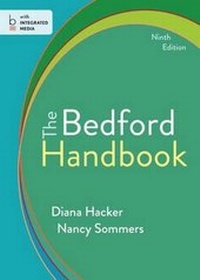
The Bedford Handbook
9th Edition
Published on 18. October 2013
Book
Paperback/Softback
912 pages
978-1-4576-0802-5 (ISBN)
Description
Good student writers are curious, engaged and reflective. They read critically. They write with purpose. They know credible evidence makes them credible researchers. The Bedford Handbook, based on surveys with more than 1,000 first-year students, fosters these habits and offers more support than ever before for college reading and writing.
Good student writers are curious, engaged and reflective. They read critically. They write with purpose. They know credible evidence makes them credible researchers. The Bedford Handbook, based on surveys with more than 1,000 first-year students, fosters these habits and offers more support than ever before for college reading and writing.
Reviews / Votes
"I encourage the use of The Bedford Handbook as a 'go to' resource for every step of the writing process and for every writing experience a student is facing, even beyond the English classroom." - Marsha Cline, Central New Mexico Community College, USA "Having integrated print and digital content will engage students." - Regina Dilgen, Palm Beach State College, USA "There is useful material in the handbook for all my courses, not just English. I'm a psychology major, and we use APA style, so I do expect to use the book throughout college." - Jacquethia Robinson, Student, Georgia Gwinnet College, USA"I encourage the use of The Bedford Handbook as a 'go to' resource for every step of the writing process and for every writing experience a student is facing, even beyond the English classroom." - Marsha Cline, Central New Mexico Community College, USA "Having integrated print and digital content will engage students." - Regina Dilgen, Palm Beach State College, USA "There is useful material in the handbook for all my courses, not just English. I'm a psychology major, and we use APA style, so I do expect to use the book throughout college." - Jacquethia Robinson, Student, Georgia Gwinnet College, USA
More details
Edition
9th ed. 2014
Language
English
Place of publication
New York
United States
Publishing group
Macmillan Learning
Target group
Adult education
Edition type
Revised edition
Illustrations
912 p.
Dimensions
Height: 235 mm
Width: 155 mm
ISBN-13
978-1-4576-0802-5 (9781457608025)
Copyright in bibliographic data and cover images is held by Nielsen Book Services Limited or by the publishers or by their respective licensors: all rights reserved.
Schweitzer Classification
Other editions
New editions
Diana Hacker | Nancy Sommers
The Bedford Handbook
Book
10/2016
10th Edition
Bedford/Saint Martin's
€65.26
Article exhausted; check for reprint
Persons
Diana Hacker was a member of the English faculty for over thirty-five years at Prince George's Community College in Maryland, USA.
Nancy Sommers, who has taught composition and directed composition programs for thirty years, now teaches writing and mentors new writing teachers at Harvard's Graduate School of Education, USA.
Diana Hacker was a member of the English faculty for over thirty-five years at Prince George's Community College in Maryland, USA.
Nancy Sommers, who has taught composition and directed composition programs for thirty years, now teaches writing and mentors new writing teachers at Harvard's Graduate School of Education, USA.
Nancy Sommers, who has taught composition and directed composition programs for thirty years, now teaches writing and mentors new writing teachers at Harvard's Graduate School of Education, USA.
Diana Hacker was a member of the English faculty for over thirty-five years at Prince George's Community College in Maryland, USA.
Nancy Sommers, who has taught composition and directed composition programs for thirty years, now teaches writing and mentors new writing teachers at Harvard's Graduate School of Education, USA.
Content
Preface for Instructors.- Introduction: Becoming a College Writer.- PART I: THE WRITING PROCESS.- 1. Exploring, Planning, and Drafting [e-Pages].- Becoming a College Writer: Choose Topics You Care About.- 2. Revising, Editing, and Reflecting [e-Pages].- Becoming a College Writer: Form a Community of Readers Around You.- 3. Building Effective Paragraphs [e-Pages].- PART II: ACADEMIC READING AND WRITING.- 4. Reading and Writing Critically [e-Pages].- Becoming a College Writer: Engage with the Texts You Read.- 5. Reading and Writing about Images and Multimodal Texts [e-Pages].- 6. Reading and Writing Arguments [e-Pages].- Becoming a College Writer.- 7. Reading and Writing about Literature [e-Pages].- PART III: CLEAR SENTENCES.- 8. Prefer Active Verbs [e-Pages, LC].- 9. Balance Parallel Ideas [e-Pages, LC].- 10. Add Needed Words.- 11. Untangle Mixed Constructions.- 12. Repair Misplaced and Dangling Modifiers [e-Pages].- 13. Eliminate Distracting Shifts [e-Pages, LC].- 14. Emphasize Key Ideas [e-Pages].- 15. Provide Some Variety [e-Pages].- PART IV: WORD CHOICE.- 16. Tighten Wordy Sentences [e-Pages, LC].- 17. Choose Appropriate Language [e-Pages, LC].- 18. Find the Exact Words [e-Pages, LC].- PART V: GRAMMATICAL SENTENCES.- 19. Repair Sentence Fragments [e-Pages, LC].- 20. Revise Run-on Sentences [e-Pages, LC].- 21. Make Subjects and Verbs Agree [e-Pages, LC].- 22. Make Pronouns and Antecedents Agree [e-Pages, LC].- 23. Make Pronoun References Clear [e-Pages, LC].- 24. Distinguish Between Pronouns such as I and Me [e-Pages].- 25. Distinguish Between Who and Whom [e-Pages].- 26. Choose Adjectives and Adverbs with Care [e-Pages].- 27. Choose Appropriate Verb Forms, Tenses, and Moods in Standard English [e-Pages, LC].- PART VI: MULTILINGUAL WRITERS AND ESL CHALLENGES.- 28. Verbs [e-Pages, LC].- 29. Articles [e-Pages, LC].- 30. Sentence Structure [e-Pages, LC].- 31. Prepositions and Idiomatic Expressions [e-Pages].- PART VII: PUNCTUATION.- 32. The Comma [e-Pages, LC].- 33. Unnecessary Commas [e-Pages].- 34. The Semicolon [e-Pages].- 35. The Colon [e-Pages].- 36. The Apostrophe [e-Pages, LC].- 37. Quotation Marks [e-Pages].- 38. End Punctuation.- 39. Other Punctuation Marks [e-Pages].- PART VIII: MECHANICS.- 40. Abbreviations [e-Pages].- 41. Numbers [e-Pages].- 42. Italics [e-Pages].- 43. Spelling.- 44. The Hyphen [e-Pages].- 45. Capitalization [e-Pages, LC].- PART IX: GRAMMAR BASICS.- 46. Parts of Speech [e-Pages, LC].- 47. Sentence Patterns [e-Pages].- 48. Subordinate Word Groups [e-Pages].- 49. Sentence Types [e-Pages].- PART X: RESEARCHED WRITING.- 50. Conducting Research [e-Pages].- Becoming a College Writer: Join a Research Conversation.- 51. Managing Information; Taking Notes Responsibly [e-Pages].- 52. Evaluating Sources [e-Pages].- 53. Supporting a Thesis [e-Pages].- 54. Citing Sources; Avoiding Plagiarism [e-Pages].- 55. Integrating Sources [e-Pages].- Becoming a College Writer: Provide Context for Sources.- 56. MLA Documentation Style [e-Pages].- 57. MLA Manuscript Format; Sample Research Paper.- 58. Supporting a Thesis [e-Pages].- 59. Citing Sources; Avoiding Plagiarism [e-Pages].- 60. Integrating Sources [e-Pages].- 61. APA Documentation Style [e-Pages].- 62. APA Manuscript Format; Sample Research Paper.- 63. Chicago Papers [e-Pages].- PART XI: WRITING IN THE DISCIPLINES.- 64. Learning to Write in a Discipline.- 65. Approaching Writing Assignments in the Disciplines.- Appendix: A Document Design Gallery.