


The Semantics of Word Formation and Lexicalization
Published on 17. November 2013
Book
Hardback
272 pages
978-0-7486-8960-6 (ISBN)
Description
In the study of word formation, the focus has often been on generating the form. In this book, the semantic aspect of the formation of new words is central. It is viewed from the perspectives of word formation rules and of lexicalization.
Each chapter concentrates on a specific question about a theoretical concept or a word formation process in a particular language and adopts a theoretical framework that is appropriate to the study of this question. From general theoretical concepts of productivity and lexicalization, the focus moves to terminology, compounding, and derivation. The theoretical frameworks that are used include Jackendoff's Conceptual Structure, Langacker's Cognitive Grammar, Lieber's lexical semantic approach to word formation, Pustejovsky's Generative Lexicon, Beard's Lexeme-Morpheme-Base Morphology, and the onomasiological approach to terminology and word formation. An extensive introduction gives a historical overview of the study of the semantics of word formation and lexicalization, explaining how the different theoretical frameworks used in the contributions relate to each other.
Each chapter concentrates on a specific question about a theoretical concept or a word formation process in a particular language and adopts a theoretical framework that is appropriate to the study of this question. From general theoretical concepts of productivity and lexicalization, the focus moves to terminology, compounding, and derivation. The theoretical frameworks that are used include Jackendoff's Conceptual Structure, Langacker's Cognitive Grammar, Lieber's lexical semantic approach to word formation, Pustejovsky's Generative Lexicon, Beard's Lexeme-Morpheme-Base Morphology, and the onomasiological approach to terminology and word formation. An extensive introduction gives a historical overview of the study of the semantics of word formation and lexicalization, explaining how the different theoretical frameworks used in the contributions relate to each other.
More details
Language
English
Place of publication
Edinburgh
United Kingdom
Target group
College/higher education
Product notice
sewn/stitched
Cloth over boards
Dimensions
Height: 236 mm
Width: 155 mm
Thickness: 25 mm
Weight
703 gr
ISBN-13
978-0-7486-8960-6 (9780748689606)
Copyright in bibliographic data and cover images is held by Nielsen Book Services Limited or by the publishers or by their respective licensors: all rights reserved.
Schweitzer Classification
Other editions
Additional editions
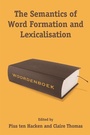
Pius Ten Hacken | Claire Thomas
Semantics of Word Formation and Lexicalization
E-Book
11/2013
Edinburgh University Press
€0.00
Available for download
Persons
Pius ten Hacken is a Professor of Translation Studies at the University of Innsbruck. His research focuses on word formation, terminology and the mental lexicon. His latest monograph is Word Formation in Parallel Architecture (2019). Together with Maria Koliopoulou, he was guest editor for a special issue on New Words and Linguistic Purism of the International Journal of Lexicography (2020). His latest edited volume, co-edited with Renata Panocova, is The Interaction of Borrowing and Word Formation (Edinburgh University Press, 2020). Claire Thomas studied French and Language Studies at Swansea University and an MA in Language and Communication Research at Cardiff University. She has recently completed her PhD in Translation at Swansea University.
Content
1. Word Formation, Meaning and Lexicalization; 2. Semiproductivity and the Place of Word Formation in Grammar; 3. Lexicalization in Generative Morphology and Conceptual Structure; 4. Term formation in a special language: How do words specify scientific concepts?; 5. Nominal Compounds as Naming Devices: A comparison of English and Polish land surveying terminology; 6. Semantic And Formal Structure: A Corpus-Based Study of Swedish NN Compounds and their French Counterparts; 7. The semantics of lexical modification: Meaning and meaning relations in German A+N compounds; 8. Semantic Transparency and Anaphoric Islands; 9. Semantic coindexation: evidence from Portuguese derivation and compounding; 10. Deverbal nominalizations in English: An LMBM approach; 11. Degrees of lexicalization in Ancient Greek deverbal nouns; 12. How many factors influence the meaning of denominal and deadjectival verbs? The case of modern Greek verbs in -(?)???; 13. Analysing en- and its Romance Equivalents in Jackendoff's Conceptual Structure; 14. Semantics of diminutivization: Evidence from Russian Renata Panocova.