

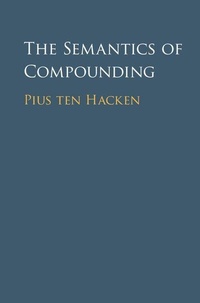
The Semantics of Compounding
Published on 21. April 2016
Book
Hardback
266 pages
978-1-107-09970-8 (ISBN)
Description
The question of how to determine the meaning of compounds was prominent in early generative morphology, but lost importance after the late 1970s. In the past decade, it has been revived by the emergence of a number of frameworks that are better suited to studying this question than earlier ones. In this book, three frameworks for studying the semantics of compounding are presented by their initiators: Jackendoff's Parallel Architecture, Lieber's theory of lexical semantics, and Stekauer's onomasiological theory. Common to these presentations is a focus on English noun-noun compounds. In the following chapters, these theories are then applied to different types of compounding (phrasal, A+N, neoclassical) and other languages (French, German, Swedish, Greek). Finally, a comparison highlights how each framework offers particular insight into the meaning of compounds. An exciting new contribution to the field, this book will be of interest to morphologists, semanticists and cognitive linguists.
More details
Language
English
Place of publication
Cambridge
United Kingdom
Target group
Professional and scholarly
Illustrations
10 Tables, black and white; 6 Line drawings, unspecified
Dimensions
Height: 235 mm
Width: 157 mm
Thickness: 19 mm
Weight
540 gr
ISBN-13
978-1-107-09970-8 (9781107099708)
Copyright in bibliographic data and cover images is held by Nielsen Book Services Limited or by the publishers or by their respective licensors: all rights reserved.
Schweitzer Classification
Other editions
Additional editions
Pius Ten Hacken
The Semantics of Compounding
E-Book
05/2016
Cambridge University Press
€91.99
Available for download
Pius Ten Hacken
Semantics of Compounding
E-Book
04/2016
Cambridge University Press
€76.49
Available for download
Person
Pius ten Hacken studied French and general linguistics in Utrecht and has worked for the machine translation project Eurotra and at universities in Basel (computer science and general linguistics), Swansea (French and translation studies), and Innsbruck (translation studies). His research interests focus on word formation, terminology, lexicography and the nature of language as an object of linguistic study. He is the author of Defining Morphology (1994) and Chomskyan Linguistics and its Competitors (2007), the editor of Terminology, Computing and Translation (2006), and co-editor of The Semantics of Word Formation and Lexicalization (2013).
Content
1. Introduction: compounds and their meaning Pius ten Hacken; Part I. Frameworks: 2. English noun-noun compounds in conceptual semantics Ray Jackendoff; 3. Compounding in the lexical semantic framework Rochelle Lieber; 4. Compounding from an onomasiological perspective Pavol Stekauer; Part II. Noun-Noun Compounds: 5. Categorizing the modification relations in French relational subordinate [NN]N compounds Pierre J. L. Arnaud; 6. The semantics of NN combinations in Greek Zoe Gavriilidou; 7. The semantics of compounds in Swedish child language Ingmarie Mellenius and Maria Rosenberg; 8. The semantics of primary NN compounds: from form to meaning, and from meaning to form Jesus Fernandez-Dominguez; Part III. Other Compound Types: 9. An analysis of phrasal compounds in the model of parallel architecture Carola Trips; 10. Adjective-noun compounding in parallel architecture Barbara Schluecker; 11. Neoclassical compounds in the onomasiological approach Renata Panocova; 12. Three analyses of compounding: a comparison Pius ten Hacken.