

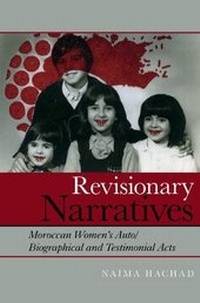
Revisionary Narratives
Moroccan Women's Auto/Biographical and Testimonial Acts
Will be published approx. on 26. September 2019
Book
Hardback
272 pages
978-1-78962-022-1 (ISBN)
Description
Revisionary Narratives examines the historical and formal evolutions of Moroccan women's auto/biography in the last four decades, particularly its conflation with testimony and its expansion beyond literary texts. The book analyzes life narratives in Arabic, colloquial Moroccan Darija, French, and English in the fields of prison narratives, visual arts, theater, and digital media. The various case studies highlight narrative strategies women use to relate their experiences of political violence, migration, displacement, and globalization, while engaging patriarchal and (neo)imperial norms and practices. Using a transdisciplinary interpretative lens, the analyses focus on how women authors, artists, and activists collapse the boundaries between autobiography, biography, testimony, and sociopolitical commentary to revise dominant conventions of authorship, transgress oppressive definitions of gender roles and relations, and envision change.
Revisionary Narratives marks auto/biography and testimony as a specific field of inquiry within the study of women's postcolonial cultural productions in the Moroccan and, more broadly, the Maghrebi and Middle Eastern contexts.
Revisionary Narratives marks auto/biography and testimony as a specific field of inquiry within the study of women's postcolonial cultural productions in the Moroccan and, more broadly, the Maghrebi and Middle Eastern contexts.
Reviews / Votes
Reviews'This work presents an original study and critique of current cultural production by Moroccan women as a response to the repressive Years of Lead ...The qualities of the work are exceptional and it will add a dimension to the studies on Moroccan women's cultural production that has not been addressed before.'Valerie K. Orlando, University of Maryland 'This book's central focus on auto/biography and testimony in works of cultural production by women of Morocco makes a valuable contribution to recent scholarship in life writing/life narratives critically departing from the mostly male-centred repertoire of the sovereign subject. By including photographic and accompanying artistic practices, Hachad extends the field of auto/biographical studies beyond the preoccupation with writing.'
Norman Saadi Nikro, University of Potsdam
More details
Series
Language
English
Place of publication
Liverpool
United Kingdom
Illustrations
7 Illustrations, black and white
Dimensions
Height: 239 mm
Width: 163 mm
ISBN-13
978-1-78962-022-1 (9781789620221)
Copyright in bibliographic data and cover images is held by Nielsen Book Services Limited or by the publishers or by their respective licensors: all rights reserved.
Schweitzer Classification
Person
Naima Hachad is an Assistant Professor of French and Francophone Studies at American University.
Content
Introduction: Moroccan Women's Auto/biographical and Testimonial Acts in Context
Chapter 1: The Rise of a Feminist Consciousness in Saida Menebhi's Prison Writings
Chapter 2: (Re)writing the Woman Resister: Violence, Gender, and Legitimacy in Fatna El Bouih and Malika Oufkir's Testimonies
Chapter 3: Speaking for the Voiceless: Political and Ethical Considerations of Moroccan Women's 'Collective Testimonial Self'
Chapter 4: Visual, Cultural, and Geopolitical Thresholds in Lalla Essaydi's Depiction of Moroccan Women
Chapter 5: Carolle Benitah's Photo-Embroidery: Remembering, Reframing, Disfiguring, and Embellishing the Past
Chapter 6: Modes of Feminine Resistance and Testimony in the Wake of the Mudawana reform and the Arab Uprisings: Contemporary Discourses of Contestation in Naima Zitan's play Daily and Fedwa Misk's Webzine Qandisha
Conclusion: The Future of Moroccan Women's Auto/biography and Testimony
Bibliography
Chapter 1: The Rise of a Feminist Consciousness in Saida Menebhi's Prison Writings
Chapter 2: (Re)writing the Woman Resister: Violence, Gender, and Legitimacy in Fatna El Bouih and Malika Oufkir's Testimonies
Chapter 3: Speaking for the Voiceless: Political and Ethical Considerations of Moroccan Women's 'Collective Testimonial Self'
Chapter 4: Visual, Cultural, and Geopolitical Thresholds in Lalla Essaydi's Depiction of Moroccan Women
Chapter 5: Carolle Benitah's Photo-Embroidery: Remembering, Reframing, Disfiguring, and Embellishing the Past
Chapter 6: Modes of Feminine Resistance and Testimony in the Wake of the Mudawana reform and the Arab Uprisings: Contemporary Discourses of Contestation in Naima Zitan's play Daily and Fedwa Misk's Webzine Qandisha
Conclusion: The Future of Moroccan Women's Auto/biography and Testimony
Bibliography