

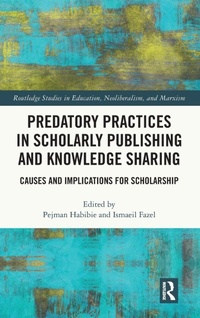
Predatory Practices in Scholarly Publishing and Knowledge Sharing
Causes and Implications for Scholarship
1st Edition
Published on 18. August 2023
Book
Hardback
254 pages
978-0-367-77302-1 (ISBN)
Description
This volume offers comprehensive examination of "predatory" practices in scholarly publishing, and highlights emergent issues around predatory journals, Open Access (OA), and scam conferences.
Chapters engage multiple methodologies, including corpus, discourse, and genre analysis, as well as historical and autoethnographic approaches to offer in-depth, empirical analyses of the causes, practices, and implications of predatory practices for scholars. Contributors span a broad range of disciplines and geolocations, presenting a diverse range of perspectives. The volume also outlines effective initiatives for the identification of predatory practices and considers steps to increase understanding of viable publishing options.
Providing a needed exploration of predatory research practices, this book will appeal to scholars and researchers with interests in higher education, publishing, and communication ethics.
Chapters engage multiple methodologies, including corpus, discourse, and genre analysis, as well as historical and autoethnographic approaches to offer in-depth, empirical analyses of the causes, practices, and implications of predatory practices for scholars. Contributors span a broad range of disciplines and geolocations, presenting a diverse range of perspectives. The volume also outlines effective initiatives for the identification of predatory practices and considers steps to increase understanding of viable publishing options.
Providing a needed exploration of predatory research practices, this book will appeal to scholars and researchers with interests in higher education, publishing, and communication ethics.
Reviews / Votes
"In this timely collection, Habibie and Fazel assemble cutting-edge research on various aspects of this growing phenomenon, from its history and circumstances to discoursal features and attributes of English-medium predatory publishing. Different chapters explore how predators exploit weaknesses in the current evaluation system, who and why falls prey to their practices, and how predatory publications and conferences exacerbate inequalities in knowledge production and distribution of socioeconomic resources across the world. Several chapters in the volume propose strategies for how to respond to, and deal with, the malpractice. The volume offers new insights into this increasingly complex phenomenon and provides recommendations for policy and practice. It is a must read for early-career researchers, university policymakers, and academic writing instructors." - Maria Kuteeva, Professor of English Linguistics, Stockholm University, Sweden"This timely collection explores one of the most bewildering and pressing topics of contemporary academia: predatory publishing. Competently led by Habibie and Fazel, contributors shed light on this duplicitous practice, while offering practical tips on how to recognize and avoid it. With novice and marginalized scholars particularly at risk of falling prey to exploitation, the book's attention to the wider context of metrics-driven research evaluation regimes makes this essential reading for all academics." - Anna Kristina Hultgren, Professor of Sociolinguistics and Applied Linguistics and UKRI Future Leaders Fellow, The Open University, UK "In this timely collection, Habibie and Fazel assemble cutting-edge research on various aspects of this growing phenomenon, from its history and circumstances to discoursal features and attributes of English-medium predatory publishing. Different chapters explore how predators exploit weaknesses in the current evaluation system, who and why falls prey to their practices, and how predatory publications and conferences exacerbate inequalities in knowledge production and distribution of socioeconomic resources across the world. Several chapters in the volume propose strategies for how to respond to, and deal with, the malpractice. The volume offers new insights into this increasingly complex phenomenon and provides recommendations for policy and practice. It is a must read for early-career researchers, university policymakers, and academic writing instructors."
Maria Kuteeva, Professor of English Linguistics, Stockholm University, Sweden
"This timely collection explores one of the most bewildering and pressing topics of contemporary academia: predatory publishing. Competently led by Habibie and Fazel, contributors shed light on this duplicitous practice, while offering practical tips on how to recognize and avoid it. With novice and marginalized scholars particularly at risk of falling prey to exploitation, the book's attention to the wider context of metrics-driven research evaluation regimes makes this essential reading for all academics."
Anna Kristina Hultgren, Professor of Sociolinguistics and Applied Linguistics and UKRI Future Leaders Fellow, The Open University, UK
More details
Series
Language
English
Place of publication
London
United Kingdom
Publishing group
Taylor & Francis Ltd
Target group
College/higher education
Postgraduate
Illustrations
12 s/w Abbildungen, 12 s/w Zeichnungen, 17 s/w Tabellen
17 Tables, black and white; 12 Line drawings, black and white; 12 Illustrations, black and white
Dimensions
Height: 235 mm
Width: 157 mm
Thickness: 19 mm
Weight
554 gr
ISBN-13
978-0-367-77302-1 (9780367773021)
Copyright in bibliographic data and cover images is held by Nielsen Book Services Limited or by the publishers or by their respective licensors: all rights reserved.
Schweitzer Classification
Other editions
Additional editions
Pejman Habibie | Ismaeil Fazel
Predatory Practices in Scholarly Publishing and Knowledge Sharing
Causes and Implications for Scholarship
Book
12/2024
1st Edition
Routledge
€61.50
Shipment within 15-20 days
Pejman Habibie | Ismaeil Fazel
Predatory Practices in Scholarly Publishing and Knowledge Sharing
Causes and Implications for Scholarship
E-Book
08/2023
1st Edition
Routledge
€53.99
Available for download
Pejman Habibie | Ismaeil Fazel
Predatory Practices in Scholarly Publishing and Knowledge Sharing
Causes and Implications for Scholarship
E-Book
08/2023
1st Edition
Routledge
€53.99
Available for download
Persons
Pejman Habibie is Assistant Professor of Applied Linguistics & TESOL at Western University, Canada.
Ismaeil Fazel is Lecturer in the Faculty of Education at the University of British Columbia, Canada.
Ismaeil Fazel is Lecturer in the Faculty of Education at the University of British Columbia, Canada.
Content
1. New Knowledge Economy and Predatory Practices Section 1: History, Roots, and Circumstances 2. Predatory Publishers' Spam Emails as a Symptom of the Multiple Vulnerabilities in Academia 3. Exploring the Effects and Roots of Predatory Practices in Science 4. Fake It till You Make It: Predatory Publishing Realties in the Arab World 5. A Victim's Tale: An Auto-ethnographic Account of a Deceived Conference Delegate Section 2. Discourses, Allures, and Attributes 6. Discourse Analysis of Presumed 'Predatory' and 'Legitimate' Calls for Submissions 7. Spamvitations: Examining Invitations to Submit Scholarly Work 8. Flattery, Flexibility, and Font: How Predatory Journals Solicit Legitimate Scholarship Through Direct Email 9. Who Is Hurt by Predatory Conferences? Section 3. Strategies, Pedagogies, and Responses 10. What Those Responsible for Open Infrastructure in Scholarly Communication Can Do about Possibly Predatory Practices 11. No More Excuses. Stop the Ridiculous and Humiliating Predatory Publishing Farce Now 12. Supporting Graduate Students to Avoid Predatory Publishing and Questionable Conferences 13. Promoting Awareness, Reflection and Dialogue to Deter Students' Predatory Publishing 14. Academic Librarians and Pedagogical Approaches to Deterring Predatory Publishing Conclusion 15. Predatory Practices and Scholarly Communication: Future Directions and Orientations