

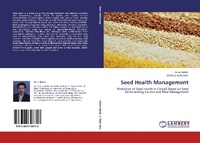
Seed Health Management
Prediction of Seed Health in Cereals Based on Seed Deteriorating Factors and Their Management
Published on 24. January 2012
Book
Paperback/Softback
176 pages
978-3-8473-2872-8 (ISBN)
Description
Seed grain is a living tissue and storage condition like moisture contents and temperature, directly affects its quality and viability. Fungal contamination of three stored cereals varied with type of host, storage duration and conditions. The fungi isolated from different seed sources of three hosts through blotter paper, agar plate and deep freezing methods. Both pathogenic fungi including species of Alternaria, Bipolaris, Fusarium, Helminthosporium, Macrophomina, Drechslera, Pyricularia and Nigrospora and saprophytic fungi like species of Aspergillus,Mucor Curvularia, Epicoccum, Monilia, Penicillium and Rhizopus were predominant.These seed borne pathogens, present externally or internally or associated with seed as contaminants, may cause seed abortion, seed rot and seed necrosis, reduction of germination capacity as well as seedling damage and enzymes released from the fungi degrade seed proteins and mycotoxin production.Certain limitations and environmental disadvantages have been associated with the use of chemical fungicides. Efficacy of various plant extracts from garlic, neem leaf, ginger and some oils like soybean, caster bean proved to be effective as seed treatment.
More details
Language
English
Place of publication
Germany
Target group
Children/juvenile
Product notice
Paperback (trade)
Unsewn / adhesive bound
Dimensions
Height: 220 mm
Width: 150 mm
Thickness: 11 mm
Weight
280 gr
ISBN-13
978-3-8473-2872-8 (9783847328728)
Copyright in bibliographic data and cover images is held by Nielsen Book Services Limited or by the publishers or by their respective licensors: all rights reserved.
Schweitzer Classification
Persons
Dr. Amer Habib currently working in Department of Plant Pathology at University of Agriculture Faisalabad, Pakistan. He completed his Ph.D during 2011 in specialization of seed pathology. His research interests focused on seed associated mycoflora, biochemical variation in seeds during storage and bio-management of seed health and mycotoxins.