

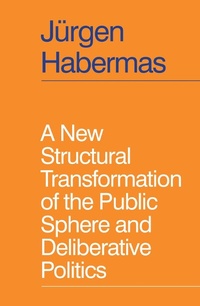
A New Structural Transformation of the Public Sphere and Deliberative Politics
Published on 13. October 2023
Book
Hardback
122 pages
978-1-5095-5893-3 (ISBN)
Description
Juergen Habermas's book The Structural Transformation of the Public Sphere, first published in 1962, has long been recognized as one of the most important works of 20th century social thought. Blending together philosophy and social history, he outlined a theory of the public sphere as a domain situated between civil society and the state, a domain in which citizens could scrutinize the activities of public officials and debate matters of common concern. In his later works, Habermas would repeatedly question the role played by the public sphere in the safeguarding of democratic community. Now, in view of the crisis of democracy and the digital revolution, he returns to the same theme.
The central concern of this new book is new media and their platform structure, which are increasingly relegating traditional mass media - significant drivers of the 'old' structural transformation - to the background. Habermas argues that the forms of communication associated with new media harm the self-awareness of the political public sphere, inducing a new structural transformation with grave consequences for deliberative democracy, the construction of public opinion and will formation.
Juergen Habermas's book The Structural Transformation of the Public Sphere, first published in 1962, has long been recognized as one of the most important works of 20th century social thought. Blending together philosophy and social history, he outlined a theory of the public sphere as a domain situated between civil society and the state, a domain in which citizens could scrutinize the activities of public officials and debate matters of common concern. In his later works, Habermas would repeatedly question the role played by the public sphere in the safeguarding of democratic community. Now, in view of the crisis of democracy and the digital revolution, he returns to the same theme.
The central concern of this new book is new media and their platform structure, which are increasingly relegating traditional mass media - significant drivers of the 'old' structural transformation - to the background. Habermas argues that the forms of communication associated with new media harm the self-awareness of the political public sphere, inducing a new structural transformation with grave consequences for deliberative democracy, the construction of public opinion and will formation.
The central concern of this new book is new media and their platform structure, which are increasingly relegating traditional mass media - significant drivers of the 'old' structural transformation - to the background. Habermas argues that the forms of communication associated with new media harm the self-awareness of the political public sphere, inducing a new structural transformation with grave consequences for deliberative democracy, the construction of public opinion and will formation.
Juergen Habermas's book The Structural Transformation of the Public Sphere, first published in 1962, has long been recognized as one of the most important works of 20th century social thought. Blending together philosophy and social history, he outlined a theory of the public sphere as a domain situated between civil society and the state, a domain in which citizens could scrutinize the activities of public officials and debate matters of common concern. In his later works, Habermas would repeatedly question the role played by the public sphere in the safeguarding of democratic community. Now, in view of the crisis of democracy and the digital revolution, he returns to the same theme.
The central concern of this new book is new media and their platform structure, which are increasingly relegating traditional mass media - significant drivers of the 'old' structural transformation - to the background. Habermas argues that the forms of communication associated with new media harm the self-awareness of the political public sphere, inducing a new structural transformation with grave consequences for deliberative democracy, the construction of public opinion and will formation.
More details
Edition
1
Language
English
Place of publication
Oxford
United Kingdom
Publishing group
John Wiley and Sons Ltd
Dimensions
Height: 193 mm
Width: 124 mm
Thickness: 13 mm
Weight
218 gr
ISBN-13
978-1-5095-5893-3 (9781509558933)
Copyright in bibliographic data and cover images is held by Nielsen Book Services Limited or by the publishers or by their respective licensors: all rights reserved.
Schweitzer Classification
Other editions
Additional editions
Book
10/2023
Polity Press
€13.00
Shipment within 15-20 days
E-Book
10/2023
1st Edition
Wiley
from
€9.99
Available for download
Persons
Juergen Habermas is Emeritus Professor of Philosophy at the Johann Wolfgang Goethe University of Frankfurt and one of the leading philosophers and social and political thinkers in the world today.
<b>Juergen Habermas</b> is Emeritus Professor of Philosophy at the Johann Wolfgang Goethe University of Frankfurt and one of the leading philosophers and social and political thinkers in the world today.
<b>Juergen Habermas</b> is Emeritus Professor of Philosophy at the Johann Wolfgang Goethe University of Frankfurt and one of the leading philosophers and social and political thinkers in the world today.
Content
Preface
Reflections and Hypotheses on a Further Structural Transformation of the Political Public Sphere
Deliberative Democracy. An Interview
What is Meant by 'Deliberative Democracy'? Objections and Misunderstandings
Reflections and Hypotheses on a Further Structural Transformation of the Political Public Sphere
Deliberative Democracy. An Interview
What is Meant by 'Deliberative Democracy'? Objections and Misunderstandings