

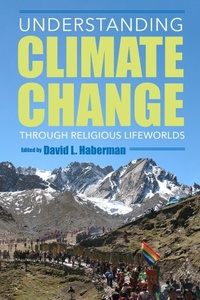
Understanding Climate Change Through Religious Lifeworlds
Published on 4. May 2021
Book
Hardback
330 pages
978-0-253-05605-4 (ISBN)
Description
How can religion help to understand and contend with the challenges of climate change?
Understanding Climate Change through Religious Lifeworld, edited by David Haberman, presents a unique collection of essays that detail how the effects of human-related climate change are actively reshaping religious ideas and practices, even as religious groups and communities endeavor to bring their traditions to bear on mounting climate challenges.
People of faith from the low-lying islands of the South Pacific to the glacial regions of the Himalayas are influencing how their communities understand earthly problems and develop meaningful responses to them. This collection focuses on a variety of different aspects of this critical interaction, including the role of religion in ongoing debates about climate change, religious sources of environmental knowledge and how this knowledge informs community responses to climate change, and the ways that climate change is in turn driving religious change.
Understanding Climate Change through Religious Lifeworlds offers a transnational view of how religion reconciles the concepts of the global and the local and influences the challenges of climate change.
Understanding Climate Change through Religious Lifeworld, edited by David Haberman, presents a unique collection of essays that detail how the effects of human-related climate change are actively reshaping religious ideas and practices, even as religious groups and communities endeavor to bring their traditions to bear on mounting climate challenges.
People of faith from the low-lying islands of the South Pacific to the glacial regions of the Himalayas are influencing how their communities understand earthly problems and develop meaningful responses to them. This collection focuses on a variety of different aspects of this critical interaction, including the role of religion in ongoing debates about climate change, religious sources of environmental knowledge and how this knowledge informs community responses to climate change, and the ways that climate change is in turn driving religious change.
Understanding Climate Change through Religious Lifeworlds offers a transnational view of how religion reconciles the concepts of the global and the local and influences the challenges of climate change.
Reviews / Votes
This anthology will be valuable for scholars interested in religion, climate communication, and Indigenous cultures. The book, or selected chapters from it, would be appropriate for upper-level undergraduate or graduate courses in anthropology, area studies, environmental studies, and religion.- Cybelle Shattuck - Western Michigan University (H-Environment)
More details
Language
English
Place of publication
Bloomington, IN
United States
Target group
Professional and scholarly
Product notice
Paper over boards
Illustrations
11 b&w photos - 11 Halftones, black and white
Dimensions
Height: 229 mm
Width: 152 mm
Thickness: 22 mm
Weight
655 gr
ISBN-13
978-0-253-05605-4 (9780253056054)
Copyright in bibliographic data and cover images is held by Nielsen Book Services Limited or by the publishers or by their respective licensors: all rights reserved.
Schweitzer Classification
Persons
David Haberman is Professor of Religious Studies at Indiana University. He is author of River of Love in an Age of Pollution and People Trees: Worship of Trees in Northern India.
Content
Preface
Introduction: Multiple Perspectives on an Increasingly Uncertain World
Recombinant Responses
1. Climate Change Never Travels Alone
2. Climate Change, Moral Meteorology and Local Measures at Quyllurit'i, a High Andean Shrine
3. Religious Explanations for Coastal Erosion in Narikoso, Fiji
Local Knowledge
4. "Nature Can Heal Itself"
5. Maya Cosmology and Contesting Climate Change in Mesoamerica
6. Anthropogenic Climate Change, Anxiety, and the Sacred
Loss, Anxiety, and Doubt
7. The Vanishing of Father White Glacier
8. Loss and Recovery in the Himalayas
Religious Transformations
9. Angry Gods and Raging Rivers
10. Recasting the Sacred
Conclusion: Religion and Climate Change
List of Contributors
Index
Introduction: Multiple Perspectives on an Increasingly Uncertain World
Recombinant Responses
1. Climate Change Never Travels Alone
2. Climate Change, Moral Meteorology and Local Measures at Quyllurit'i, a High Andean Shrine
3. Religious Explanations for Coastal Erosion in Narikoso, Fiji
Local Knowledge
4. "Nature Can Heal Itself"
5. Maya Cosmology and Contesting Climate Change in Mesoamerica
6. Anthropogenic Climate Change, Anxiety, and the Sacred
Loss, Anxiety, and Doubt
7. The Vanishing of Father White Glacier
8. Loss and Recovery in the Himalayas
Religious Transformations
9. Angry Gods and Raging Rivers
10. Recasting the Sacred
Conclusion: Religion and Climate Change
List of Contributors
Index