

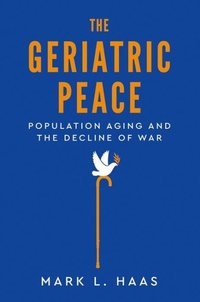
The Geriatric Peace
Population Aging and the Decline of War
Published on 17. September 2025
Book
Hardback
360 pages
978-0-19-751173-2 (ISBN)
Description
The vast majority of the world's countries are experiencing a demographic revolution: dramatic, sustained, and likely irreversible population aging. States' median ages are steadily increasing as the number of people ages 65 and older skyrockets. Analysts and policymakers frequently decry population aging's domestic costs, especially likely slowing economic growth and massive new public expenditures for elderly welfare. But aging has a major yet largely unrecognised international benefit: it significantly reduces the likelihood of international war. Although wars continue to rage in parts of the world, almost none involve aged countries. This book provides a comprehensive and groundbreaking argument why population aging will be a powerful force for peace.
Aging will significantly reduce states' military capabilities available for war while also boosting leaders' and citizens' preferences for peaceful foreign policies. At the same time, the effects of aging will help prevent the emergence of a power transition between the United States and China, which would be a development that is particularly likely to devolve into armed hostilities. If an aged country does initiate war, the effects of aging will create major barriers to military success. The more aging reduces the probability of victory, the greater the disincentives to aggressing. Detailed case studies show how aging has affected the capabilities and preferences in Japan, China, the United States, and Russia.
Aging will significantly reduce states' military capabilities available for war while also boosting leaders' and citizens' preferences for peaceful foreign policies. At the same time, the effects of aging will help prevent the emergence of a power transition between the United States and China, which would be a development that is particularly likely to devolve into armed hostilities. If an aged country does initiate war, the effects of aging will create major barriers to military success. The more aging reduces the probability of victory, the greater the disincentives to aggressing. Detailed case studies show how aging has affected the capabilities and preferences in Japan, China, the United States, and Russia.
Reviews / Votes
At a time of much hand-wringing over low fertility and population aging, Mark L. Haas makes a brilliant argument for a golden lining, showing in persuasive detail how these trends will make war less feasible and less desirable for all the great powers. Combining insights from economics, demography, and international relations, Haas shows how Russia, China, Japan and the U.S. will face increasing obstacles to successful war-making, while U.S. hegemony is likely to endure. A fascinating and provocative work. * Jack A. Goldstone, Hazel Professor of Public Policy, George Mason University * For over a decade and a half, Mark L. Haas has been pioneering research on 'geriatric peace' theory. Now that a geriatric world is almost upon us, this presentation of his thinking and findings seems especially timely. The key question of whether autocracies, andA not just democracies, fall under the sway of geriatric peace is a central concern of this study. Scholars and policymakers alike need to read his arguments. * Nicholas N. Eberstadt, Henry Wendt Chair in Political Economy, American Enterprise Institute * Will the fact that the populations of the world's main powers, including China and the United States, are aging increase the probability of long-term global peace? Read this book. Simply put, it is the definitive take on this critical subject. * Dale C. Copeland, Professor of International Affairs, University of Virginia * Mark L. Haas compellingly argues that declining birth rates and aging populations reduce the likelihood and appeal of war among major powers. By integrating economic, demographic, and international relations insights, Haas demonstrates how Russia, China, Japan, and the U.S. will face growing obstacles to warfare, potentially ensuring continued U.S. dominance. This insightful analysis of unprecedented low fertility and aging trends is a must-read for scholars and policymakers. * Monica Duffy Toft, Professor of International Politics and Director, Center for Strategic Studies, Tufts University *More details
Language
English
Place of publication
New York
United States
Target group
Professional and scholarly
Product notice
sewn/stitched
Cloth over boards
With dust jacket
Dimensions
Height: 234 mm
Width: 156 mm
Thickness: 24 mm
Weight
658 gr
ISBN-13
978-0-19-751173-2 (9780197511732)
Copyright in bibliographic data and cover images is held by Nielsen Book Services Limited or by the publishers or by their respective licensors: all rights reserved.
Schweitzer Classification
Other editions
Additional editions
E-Book
06/2025
OUP eBook
€21.99
Available for download
E-Book
06/2025
OUP eBook
€21.99
Available for download
Person
Mark L. Haas is the Duquesne Professor of Political Science at Duquesne University in Pittsburgh. He formerly was a National Security Fellow at the Olin Institute for Strategic Studies and an International Security Fellow at the Belfer Center for Science and International Affairs, both at Harvard University. Haas received his Ph.D. in political science from the University of Virginia and his B.A. in political science, economics, and history from Duke University.
Content
Dedication
Acknowledgements
List of Figures and Tables
Chapter 1. Population Aging: Inevitable, and a Force for Peace
Chapter 2. Population Aging and Reduced Capabilities for War
Chapter 3. Population Aging and Reduced Preferences for War
Chapter 4. Population Aging and Underbalancing in Japan
Chapter 5. Population Aging, the Decline of China's Power, and Preferences for Peace
Chapter 6. Population Aging in the United States: International Dominance and Domestic Polarization
Chapter 7. Population Aging in Russia: Old, Aggressive, and Power Handicapped
Chapter 8. Conclusion
Acknowledgements
List of Figures and Tables
Chapter 1. Population Aging: Inevitable, and a Force for Peace
Chapter 2. Population Aging and Reduced Capabilities for War
Chapter 3. Population Aging and Reduced Preferences for War
Chapter 4. Population Aging and Underbalancing in Japan
Chapter 5. Population Aging, the Decline of China's Power, and Preferences for Peace
Chapter 6. Population Aging in the United States: International Dominance and Domestic Polarization
Chapter 7. Population Aging in Russia: Old, Aggressive, and Power Handicapped
Chapter 8. Conclusion