

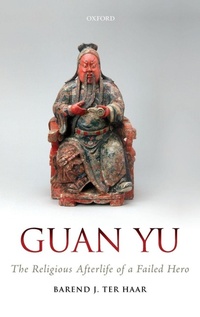
Guan Yu
The Religious Afterlife of a Failed Hero
Published on 12. October 2017
Book
Hardback
304 pages
978-0-19-880364-5 (ISBN)
Description
Guan Yu was a minor general in the early third century CE, who supported one of numerous claimants to the throne. He was captured and executed by enemy forces in 219. He eventually became one the most popular and influential deities of imperial China under the name Lord Guan or Emperor Guan, of the same importance as the Buddhist bodhisattva Guanyin. This is a study of his cult, but also of the tremendous power of oral culture in a world where writing became increasingly important.
In this study, we follow the rise of the deity through his earliest stage as a hungry ghost, his subsequent adoption by a prominent Buddhist monastery during the Tang (617-907) as its miraculous supporter, and his recruitment by Daoist ritual specialists during the Song dynasty (960-1276) as an exorcist general. He was subsequently known as a rain god, a protector against demons and barbarians, and, eventually, a moral paragon and almost messianic saviour. Throughout his divine life, the physical prowess of the deity, more specifically Lord Guan's ability to use violent action for doing good, remained an essential dimension of his image. Most research ascribes a decisive role in the rise of his cult to the literary traditions of the Three Kingdoms, best known from the famous novel by this name. This book argues that the cult arose from oral culture and spread first and foremost as an oral practice.
In this study, we follow the rise of the deity through his earliest stage as a hungry ghost, his subsequent adoption by a prominent Buddhist monastery during the Tang (617-907) as its miraculous supporter, and his recruitment by Daoist ritual specialists during the Song dynasty (960-1276) as an exorcist general. He was subsequently known as a rain god, a protector against demons and barbarians, and, eventually, a moral paragon and almost messianic saviour. Throughout his divine life, the physical prowess of the deity, more specifically Lord Guan's ability to use violent action for doing good, remained an essential dimension of his image. Most research ascribes a decisive role in the rise of his cult to the literary traditions of the Three Kingdoms, best known from the famous novel by this name. This book argues that the cult arose from oral culture and spread first and foremost as an oral practice.
Reviews / Votes
Rich in detail and methodologically rigorous, this landmark study provides a basis for multifaceted explorations of the Lord Guan cult. Ideally, it will also register a profounder point about the working of collective memory and the religious imagination in imperial China. * Daniel Burton-Rose, English Historical Review * Ter Haar's book is a magisterial survey of the development of the Lord Guan cult that is essential reading for all interested in the relationship between religion and violence in the Chinese tradition. * James Bonk, Journal of Religion and Violence * It is clear that this work aims to experiment in vivo with a new method that restores oral culture by exhuming writings and objects. Barend ter Haar believes in the independence of religious life from written sources, the influence of the latter on the former to be demonstrated each time. In a civilization where the written word is as old as the world, the challenge is great. [Tranlated from French] * Marianne Bujard, Bulletin de l'Ecole francaise d'Extreme-Orient *More details
Language
English
Place of publication
Oxford
United Kingdom
Target group
College/higher education
Professional and scholarly
Illustrations
19 black and white images, maps, and tables
Dimensions
Height: 240 mm
Width: 161 mm
Thickness: 21 mm
Weight
619 gr
ISBN-13
978-0-19-880364-5 (9780198803645)
Copyright in bibliographic data and cover images is held by Nielsen Book Services Limited or by the publishers or by their respective licensors: all rights reserved.
Schweitzer Classification
Other editions
Person
Barend J. ter Haar studied in Leiden, Shenyang, and Fukuoka. He obtained his doctoral degree in 1990 in Leiden, and worked in Leiden and Heidelberg before coming to Oxford in 2013. Ter Haar has published extensively on new religious groups, lay Buddhism, Triad ritual and mythology, the spread of rumours, religious culture and violence, local religious culture, and ethnicity. He is currently completing a book dealing with the social history of witchcraft fears and persecution in traditional China.
Content
1: Historical figure and divine being
2: Demon and monastic protector
3: The exorcism of the salt ponds at Xie
4: A deity's conquest of China
5: The divine presence
6: Bringing rain and protection
7: The educated deity
8: Martial keeper of morals
9: Summing up and looking forward
Bibliography
2: Demon and monastic protector
3: The exorcism of the salt ponds at Xie
4: A deity's conquest of China
5: The divine presence
6: Bringing rain and protection
7: The educated deity
8: Martial keeper of morals
9: Summing up and looking forward
Bibliography