

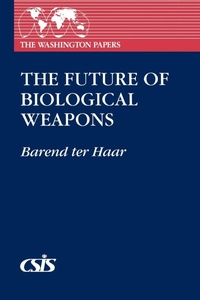
The Future of Biological Weapons
Published on 19. June 1991
Book
Paperback/Softback
216 pages
978-0-275-94101-7 (ISBN)
Description
The know-how and materials required to produce biological warfare agents are the same as those required for medical and veterinary products; biological warfare technology is quickly spreading across the globe. In this new study, Barend ter Haar argues that a policy of nonproliferation might slow down the current trend toward worldwide deployment of biological weapons, but it is ultimately doomed without a strengthened ban on them.
Ter Haar discusses the Biological Weapons Convention of 1972, which did not categorically prohibit activities leading to biological weapons and failed to provide confidence-building measures and allegation procedures. He evaluates the confidence measures added in the 1986 Second Review Conference, and demonstrates how they were neglected by some countries. Ter Haar concludes that the Convention measures are almost unverifiable and proposes a stronger, universal ban that includes improved procedures, regular consultative meetings, extended information exchange restrictions, routine verification, challenge inspections, and other measures. This study is an important resource for professionals, students, and scholars of diplomacy, disarmament, international relations, and the protection of the environment.
Ter Haar discusses the Biological Weapons Convention of 1972, which did not categorically prohibit activities leading to biological weapons and failed to provide confidence-building measures and allegation procedures. He evaluates the confidence measures added in the 1986 Second Review Conference, and demonstrates how they were neglected by some countries. Ter Haar concludes that the Convention measures are almost unverifiable and proposes a stronger, universal ban that includes improved procedures, regular consultative meetings, extended information exchange restrictions, routine verification, challenge inspections, and other measures. This study is an important resource for professionals, students, and scholars of diplomacy, disarmament, international relations, and the protection of the environment.
More details
Series
Language
English
Place of publication
United States
Publishing group
Bloomsbury Publishing Plc
Target group
College/higher education
Interest Age: From 7 to 17 years
Dimensions
Height: 234 mm
Width: 156 mm
Thickness: 12 mm
Weight
336 gr
ISBN-13
978-0-275-94101-7 (9780275941017)
Copyright in bibliographic data and cover images is held by Nielsen Book Services Limited or by the publishers or by their respective licensors: all rights reserved.
Schweitzer Classification
Person
BAREND ter HAAR is a diplomat with the Netherlands Ministry of Foreign Affairs and a member of the Netherlands delegation to NATO. He has written numerous articles on disarmament and arms control for the enforcement of international environmental agreements.
Content
Foreword
Summary
Introduction
A Short History of Biological Arms Control
The Current State of the Biological Weapons Convention
The Chemical Weapons Convention as a Model for the Biological Weapons Convention
What Can Be Done?
Appendixes
Index
Summary
Introduction
A Short History of Biological Arms Control
The Current State of the Biological Weapons Convention
The Chemical Weapons Convention as a Model for the Biological Weapons Convention
What Can Be Done?
Appendixes
Index