

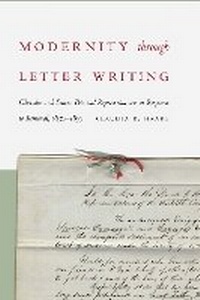
Modernity Through Letter Writing
Cherokee and Seneca Political Representations in Response to Removal, 1830-1857
Published on 1. September 2020
Book
Hardback
282 pages
978-1-4962-1567-3 (ISBN)
Description
In Modernity through Letter Writing Claudia B. Haake shows how the Cherokees and Senecas envisioned their political modernity in missives they sent to members of the federal government to negotiate their status. They not only used their letters, petitions, and memoranda to reject incorporation into the United States and to express their continuing adherence to their own laws and customs but also to mark areas where they were willing to compromise. As they found themselves increasingly unable to secure opportunities for face-to-face meetings with representatives of the federal government, Cherokees and Senecas relied more heavily on letter writing to conduct diplomatic relations with the U.S. government.
The amount of time and energy they expended on the missives demonstrates that authors from both tribes considered letters, memoranda, and petitions to be a crucial political strategy. Instead of merely observing Western written conventions, the Cherokees and Senecas incorporated oral writing and consciously insisted on elements of their own culture they wanted to preserve, seeking to convey to the government a vision of their continued political separateness as well as of their own modernity.
The amount of time and energy they expended on the missives demonstrates that authors from both tribes considered letters, memoranda, and petitions to be a crucial political strategy. Instead of merely observing Western written conventions, the Cherokees and Senecas incorporated oral writing and consciously insisted on elements of their own culture they wanted to preserve, seeking to convey to the government a vision of their continued political separateness as well as of their own modernity.
Reviews / Votes
"Claudia Haake's fine-grained study details an emerging world of early nineteenth-century American Indian letter writing, in which Native peoples reshaped familiar rhetoric and animated new forms of diplomacy to preserve their independence and control over land and culture. Modernity through Letter Writing makes a major contribution to studies of indigenous literary production and political consciousness."-Philip J. Deloria, coeditor of A Companion to American Indian History"What is especially important about this volume is the way Haake presents in historical context the urgent transition that indigenous nations, such as the Cherokees and Senecas, went through to adapt the English language into their political and cultural sovereignty at a time of crisis."-David MartInez, author of Life of the Indigenous Mind: Vine Deloria Jr. and the Birth of the Red Power Movement
"Extraordinary. . . . This is a sui generis study for all of us to rethink how American Indians shaped their histories."-Donald L. Fixico, author of Call for Change: The Medicine Way of American Indian History, Ethos, and Reality
More details
Language
English
Place of publication
Lincoln
United States
Target group
Professional and scholarly
Product notice
Cloth over boards
Illustrations
8 illustrations, 4 maps, index
Dimensions
Height: 229 mm
Width: 152 mm
ISBN-13
978-1-4962-1567-3 (9781496215673)
Copyright in bibliographic data and cover images is held by Nielsen Book Services Limited or by the publishers or by their respective licensors: all rights reserved.
Schweitzer Classification
Other editions
Additional editions
Claudia B. Haake
Modernity Through Letter Writing
Cherokee and Seneca Political Representations in Response to Removal, 1830-1857
E-Book
09/2020
1st Edition
University of Nebraska Press
€71.49
Available for download
Claudia B. Haake
Modernity Through Letter Writing
Cherokee and Seneca Political Representations in Response to Removal, 1830-1857
E-Book
09/2020
1st Edition
University of Nebraska Press
€79.99
Available for download
Person
Claudia B. Haake is a senior lecturer in history at La Trobe University. She is the author of The State, Removal and Indigenous Peoples in the United States and Mexico, 1620-2000 and coeditor (with Richard Bessel) of Removing Peoples: Forced Migration in the Modern World.