

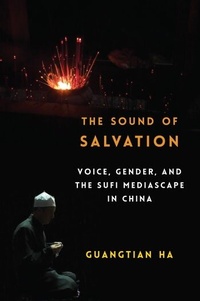
The Sound of Salvation
Voice, Gender, and the Sufi Mediascape in China
Published on 22. February 2022
Book
Paperback/Softback
312 pages
978-0-231-19807-3 (ISBN)
Description
Winner, 2023 Clifford Geertz Prize in Anthropology of Religion, Society for the Anthropology of Religion
The Jahriyya Sufis-a primarily Sinophone order of Naqshbandiyya Sufism in northwestern China-inhabit a unique religious soundscape. The hallmark of their spiritual practice is the "loud" (jahr) remembrance of God in liturgical rituals featuring distinctive melodic vocal chants.
The first ethnography of this order in any language, The Sound of Salvation draws on nearly a decade of fieldwork to reveal the intricacies and importance of Jahriyya vocal recitation. Guangtian Ha examines how the use of voice in liturgy helps the Jahriyya to sustain their faith and the ways it has enabled them to endure political persecution over the past two and a half centuries. He situates the Jahriyya in a global multilingual network of Sufis and shows how their characteristic soundscapes result from transcultural interactions among Middle Eastern, Central Asian, and Chinese Muslim communities. Ha argues that the resilience of Jahriyya Sufism stems from the diversity and multiplicity of liturgical practice, which he shows to be rooted in notions of Sufi sainthood. He considers the movement of Jahriyya vocal recitation to new media forms and foregrounds the gendered opposition of male voices and female silence that structures the group's rituals.
Spanning diverse disciplines-including anthropology, ethnomusicology, Islamic studies, sound studies, and media studies-and using Arabic, Persian, and Chinese sources, The Sound of Salvation offers new perspectives on the importance of sound to religious practice, the role of gender in Chinese Islam, and the links connecting Chinese Muslims to the broader Islamic world.
The Jahriyya Sufis-a primarily Sinophone order of Naqshbandiyya Sufism in northwestern China-inhabit a unique religious soundscape. The hallmark of their spiritual practice is the "loud" (jahr) remembrance of God in liturgical rituals featuring distinctive melodic vocal chants.
The first ethnography of this order in any language, The Sound of Salvation draws on nearly a decade of fieldwork to reveal the intricacies and importance of Jahriyya vocal recitation. Guangtian Ha examines how the use of voice in liturgy helps the Jahriyya to sustain their faith and the ways it has enabled them to endure political persecution over the past two and a half centuries. He situates the Jahriyya in a global multilingual network of Sufis and shows how their characteristic soundscapes result from transcultural interactions among Middle Eastern, Central Asian, and Chinese Muslim communities. Ha argues that the resilience of Jahriyya Sufism stems from the diversity and multiplicity of liturgical practice, which he shows to be rooted in notions of Sufi sainthood. He considers the movement of Jahriyya vocal recitation to new media forms and foregrounds the gendered opposition of male voices and female silence that structures the group's rituals.
Spanning diverse disciplines-including anthropology, ethnomusicology, Islamic studies, sound studies, and media studies-and using Arabic, Persian, and Chinese sources, The Sound of Salvation offers new perspectives on the importance of sound to religious practice, the role of gender in Chinese Islam, and the links connecting Chinese Muslims to the broader Islamic world.
Reviews / Votes
A stunning piece of work. The study of Islam in China has been crying out for works that do justice to the specificities of local traditions while maintaining a productive conversation with the wider field of Islamic studies. This book bridges that divide in a way that few pieces of scholarship have been able to up until now. It is an immensely valuable ethnography in its own right, but also one that is theoretically provocative and that offers scholars outside the immediate field of Islam in China a vantage point from which to rethink their views of Sufi practices and related forms of ritual. -- David Brophy, author of <i>Uyghur Nation: Reform and Revolution on the Russia-China Frontier</i> This beautifully written book takes us into the unknown sonic world of China's contemporary Sufi Muslims. Guangtian Ha's deep understanding of these people and their very possibly doomed tradition comes over on every page. This is a marvelous ethnography, rendered with subtlety, sophistication, and panache. -- Caroline Humphrey, coauthor of <i>A Monastery in Time: The Making of Mongolian Buddhism</i> This is a substantial, unpretentious, and compelling ethnographic study focused on Jahriyya liturgical recitation in northwest China. Marked by expository clarity and absence of jargon, it is a wide-ranging and thoughtful, even wise, book that evidences the author's impressive linguistic, historical, ethnographic, and theoretical sophistication. Whether exploring technical issues of multilanguage terminology, gender discrimination, or musicality and textual content of recitation, Ha always keeps larger questions about methodology and historical context, as well as the Jahriyya tradition (and its severely threatened survival), admirably in focus. -- William A. Graham, author of <i>Beyond the Written Word: Oral Aspects of Scripture in the History of Religion</i> Sensitive and illuminating work. * Inner Asia * Offers new perspectives on the importance of sound to religious practice, the role of gender in Chinese Islam, and the links connecting Chinese Muslims to the broader Islamic world. * Reading Religion * This volume undeniably offers a rare and fascinating insight into Sufism in China. * Religious Studies Review * A nuanced, sophisticated and provocative work that is a welcome contribution to the field of Chinese Islamic Studies. * Journal of Religious History * Thanks to Ha's elaborate and precise prose, which is peppered with sardonic humor, the book sustains readers' attention throughout the pages. * Journal of Asian Studies * This is a fascinating book that would deserve to be widely read no matter when it had been published. In the present moment, it is an essential tribute to the multiplicity of Sufism in China. * Journal of the American Academy of Religion *More details
Series
Language
English
Place of publication
New York
United States
Target group
Professional and scholarly
Product notice
Paperback (trade)
Illustrations
32 b&w illustrations
Dimensions
Height: 235 mm
Width: 156 mm
ISBN-13
978-0-231-19807-3 (9780231198073)
Copyright in bibliographic data and cover images is held by Nielsen Book Services Limited or by the publishers or by their respective licensors: all rights reserved.
Schweitzer Classification
Other editions
Additional editions
E-Book
04/2022
1st Edition
Columbia University Press
€33.99
Available for download
Person
Guangtian Ha is assistant professor of religion at Haverford College. He is coeditor of Ethnographies of Islam in China (2020) and The Contest of the Fruits (2021).
Content
Acknowledgments
Introduction
1. Archaeology of Sound
2. The Sacred Circle
3. Tempo of Time
4. His Master's Voice
5. Labor of Faith
Epilogue: Ethnography and the Future of the Jahriyya Sound
Notes
Bibliography
Index
Introduction
1. Archaeology of Sound
2. The Sacred Circle
3. Tempo of Time
4. His Master's Voice
5. Labor of Faith
Epilogue: Ethnography and the Future of the Jahriyya Sound
Notes
Bibliography
Index