

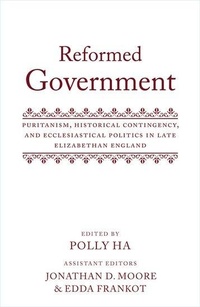
Reformed Government
Puritanism, Historical Contingency, and Ecclesiastical Politics in Late Elizabethan England
Published on 11. July 2022
Book
Hardback
264 pages
978-0-19-879810-1 (ISBN)
Description
The culmination of cultural and literary achievements in the final decade of Elizabeth I's reign coincided with some of Tudor England's worst years economically which were exacerbated by plague, successive harvest failure, and belligerence at home and abroad. This critical edition of the scribal publication 'Reformed Government' c. 1594 provides a unique point of entry into the 1590s. Recovering a pivotal moment in the history of puritan radicalism, it represents the most extensive reformed response to the onslaught of anti-puritan literature in the late sixteenth century, including Richard Hooker's ^iLaws of Ecclesiastical Polity^r. In addition to mounting an epistemological and ecclesiastical defence of reformed presbyterian government, it sheds light on new appropriations of Renaissance ideas about historical contingency, and introduces a dynamic reading of Christian antiquity.
The edition also provides a wider context for later developments in the seventeenth century. Exploiting the instability of the period, the 'Reformed Government' seized the opportunity to re-imagine society and even anticipated the idea of altering civil and religious constitutions which theorists later developed in Revolutionary Britain. By expanding and reconfiguring the relationship between civil and ecclesiastical government, it imaginatively stretched the implications of historical change to entertain new possibilities. This recovery of an alternative vision of a reformed society in the late sixteenth century offers an alternative model for reading church history. Based on maximal visions and proposals of reform, the 'Reformed Government' is essential reading for the study of ecclesiastical tradition alongside confessional documents and summative statements.
The edition also provides a wider context for later developments in the seventeenth century. Exploiting the instability of the period, the 'Reformed Government' seized the opportunity to re-imagine society and even anticipated the idea of altering civil and religious constitutions which theorists later developed in Revolutionary Britain. By expanding and reconfiguring the relationship between civil and ecclesiastical government, it imaginatively stretched the implications of historical change to entertain new possibilities. This recovery of an alternative vision of a reformed society in the late sixteenth century offers an alternative model for reading church history. Based on maximal visions and proposals of reform, the 'Reformed Government' is essential reading for the study of ecclesiastical tradition alongside confessional documents and summative statements.
Reviews / Votes
This edition of the late-Elizabethan manuscript Reformed Government is masterly in execution. * Torrance Kirby, Church History * Reformed Government is a model of how manuscripts of this kind should be edited and published. Scholars of early modern debates on ecclesiology and religious politics will find much of interest in this edition. * Elliot Vernon, Journal Of Ecclesiastical History * Through Reformed Government, Ha not only reiterates one of her key findings since the early 2010s,...but also persuasively presents a picture of 'civil war' rather than puritan resignation long before Charles and Parliament went into open military conflict in 1642. More widely, this fascinating piece of presbyterian propaganda confirms many scholars' observation that terms like the Elizabethan Settlement and post - Reformation are problematic...This volume is therefore a helpful extension of Ha's work on presbyterian persistence and indeed one of the most informative primary sources for the study of iure divino presbyterianism in early modern England. * Christy Wang, The Journal of Religion *More details
Language
English
Place of publication
Oxford
United Kingdom
Target group
College/higher education
Product notice
sewn/stitched
Cloth over boards
Dimensions
Height: 237 mm
Width: 162 mm
Thickness: 25 mm
Weight
540 gr
ISBN-13
978-0-19-879810-1 (9780198798101)
Copyright in bibliographic data and cover images is held by Nielsen Book Services Limited or by the publishers or by their respective licensors: all rights reserved.
Schweitzer Classification
Person
Polly Ha is Associate Professor of the History of Christianity at Duke Divinity School, a Fellow of the Royal Historical Society and a Life Member of Clare Hall, Cambridge. She is the author of English Presbyterianism, 1590-1640 (Stanford University Press, 2011), chief editor of The Puritans on Independence (Oxford University Press, 2017), and co-editor of The Reception of Continental Reformation in Britain (Oxford University Press, 2011). She formerly taught at the Universities of Cambridge, Southern California, and East Anglia, and has held Research Fellowships at the British Academy, The University of Cambridge, the American Antiquarian Society, The Huntington Library, and the Long Room Hub at Trinity College Dublin.
Jonathan D. Moore holds a PhD in historical theology and ecclesiastical history from the University of Cambridge and is the author of English Hypothetical Universalism (Eerdmans, 2007) and assistant editor of The Puritans on Independence (Oxford University Press). He is currently an Honorary Research Fellow of the University of East Anglia, and an Adjunct Lecturer & Research Associate at Union Theological College, Belfast.
Edda Frankot is Associate Professor at Nord University in Norway. She has been involved in several editing projects including the 1641 Depositions project (1641.tcd.ie) and Aberdeen Registers Online. She is the author of Medieval Maritime Law in Urban Northern Europe (EUP, 2012) and Banishment in the Late Medieval Eastern Netherlands (Palgrave Pivot, 2021), assistant editor of The Puritans on Independence (Oxford University Press, 2017), and co-editor of Cultures of Law in Urban Northern Europe: Scotland and its Neighbours, c. 1350- c. 1650 (Routledge, 2020).
Jonathan D. Moore holds a PhD in historical theology and ecclesiastical history from the University of Cambridge and is the author of English Hypothetical Universalism (Eerdmans, 2007) and assistant editor of The Puritans on Independence (Oxford University Press). He is currently an Honorary Research Fellow of the University of East Anglia, and an Adjunct Lecturer & Research Associate at Union Theological College, Belfast.
Edda Frankot is Associate Professor at Nord University in Norway. She has been involved in several editing projects including the 1641 Depositions project (1641.tcd.ie) and Aberdeen Registers Online. She is the author of Medieval Maritime Law in Urban Northern Europe (EUP, 2012) and Banishment in the Late Medieval Eastern Netherlands (Palgrave Pivot, 2021), assistant editor of The Puritans on Independence (Oxford University Press, 2017), and co-editor of Cultures of Law in Urban Northern Europe: Scotland and its Neighbours, c. 1350- c. 1650 (Routledge, 2020).
Content
Introductory Chapters
1: Rewriting the Elizabethan Civil Wars of Religion
2: Permissible Change: Richard Hooker, Machiavelli, and the 'Reformed Government'
3: Leveraging Historical Contingency: Christian Antiquity and Late Elizabethan Society
4: Reformed Monarchical Republicanism: A Scribal Reconstruction
5: The 'Reformed Government'
6: Reader Guide
Reformed Government
Preface to the Christian Reader
1: That the churchgovernment desired is the true, antient, primitive, catholick, & Apostolicall
2: Concerning the Circumstances of the Churchgovernment: and how it may stande united with the Civil governement and pollicy off this Kingdome with conveniency, and without any great alteration
3: That the Reformed Churchgovernment desyred, is farre from a Tyranny
4: That the Churchgovernment desired is possible
5: Of perpetuity of the desired Churchgovernment
The Conclusion to the Reader
1: Rewriting the Elizabethan Civil Wars of Religion
2: Permissible Change: Richard Hooker, Machiavelli, and the 'Reformed Government'
3: Leveraging Historical Contingency: Christian Antiquity and Late Elizabethan Society
4: Reformed Monarchical Republicanism: A Scribal Reconstruction
5: The 'Reformed Government'
6: Reader Guide
Reformed Government
Preface to the Christian Reader
1: That the churchgovernment desired is the true, antient, primitive, catholick, & Apostolicall
2: Concerning the Circumstances of the Churchgovernment: and how it may stande united with the Civil governement and pollicy off this Kingdome with conveniency, and without any great alteration
3: That the Reformed Churchgovernment desyred, is farre from a Tyranny
4: That the Churchgovernment desired is possible
5: Of perpetuity of the desired Churchgovernment
The Conclusion to the Reader