

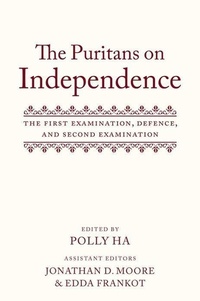
The Puritans on Independence
The First Examination, Defence, and Second Examination
Published on 12. October 2017
Book
Hardback
448 pages
978-0-19-966482-5 (ISBN)
Description
The Puritans on Independence sheds light on the rise of new claims by puritans to freedom as 'independence' several decades earlier than modern scholarship has assumed. This critical edition of long-lost English manuscripts provides access to a set of treatises which are the most significant hitherto unpublished texts for understanding puritan debate over this concept of liberty. Although once mis-catalogued as anti-separatist polemic, they in fact document the presbyterians' clandestine 'First Examination' of Henry Jacob's argument for 'independent' liberty and ecclesiology. It includes Jacob's 'Defence' of his early congregational experiment in response to the 'First Examination'. The volume concludes with the presbyterians' 'Second Examination' of Jacob's 'Defence' in 1620, written several years after the erection of Jacob's independent church in Southwark.
This work provides unprecedented insight into divisions among the godly in England before the public contentions over church government in the Westminster Assembly during the mid-seventeenth century. The introductory chapter traces the development of radical notions of liberty among puritans over the first half of the seventeenth century through to the English Revolution. All this had a lasting impact well beyond the British Isles and the early modern period. The edition will be of interest to early modern and modern scholars across many disciplines, from history and divinity to English literature and political science.
This work provides unprecedented insight into divisions among the godly in England before the public contentions over church government in the Westminster Assembly during the mid-seventeenth century. The introductory chapter traces the development of radical notions of liberty among puritans over the first half of the seventeenth century through to the English Revolution. All this had a lasting impact well beyond the British Isles and the early modern period. The edition will be of interest to early modern and modern scholars across many disciplines, from history and divinity to English literature and political science.
Reviews / Votes
Ha and her team have provided a great service in making these texts available to the scholarly community. The documents are transcribed with great care and accompanied by extensive footnotes and images of key passages from the original manuscripts, such as one in which Jacobs critics first use the term independency to highlight the novelty of his position...[This book] will doubtless long be embraced as a key resource for all those who wish to understand this period of intense theological and political upheaval. * Joseph P. Ward, Utah State University, Reading Religion * The texts themselves are well presented and thoroughly annotated ... In addition to commenting on the condition and layout of the manuscripts themselves, the editors' annotations de?ne archaic terms, provide references to sources mentioned in the text, explain obscure refer-ences and, in the main, help to make the dif?cult source material as readable and accessible as possible. * Matthew C. Bingham, Journal of Ecclesiastical History *More details
Language
English
Place of publication
Oxford
United Kingdom
Target group
College/higher education
Professional and scholarly
Product notice
sewn/stitched
Cloth over boards
Dimensions
Height: 236 mm
Width: 150 mm
Thickness: 33 mm
Weight
816 gr
ISBN-13
978-0-19-966482-5 (9780199664825)
Copyright in bibliographic data and cover images is held by Nielsen Book Services Limited or by the publishers or by their respective licensors: all rights reserved.
Schweitzer Classification
Persons
Polly Ha is a Reader in History at the University of East Anglia, a Fellow of the Royal Historical Society, and Life Member of Clare Hall, Cambridge. She is Director of The History of Independence Project and formerly taught at the Universities of Cambridge and Southern California.
Jonathan D. Moore holds a PhD in historical theology and ecclesiastical history from the University of Cambridge. He is currently an Honorary Research Fellow of the University of East Anglia.
Edda Frankot is currently an editorial research fellow at the University of Aberdeen, where she is editing a digital transcription of the medieval Aberdeen burgh records. She is also Associate Editor of The 1641 Depositions and was formerly a lecturer at the Erasmus University Rotterdam.
Jonathan D. Moore holds a PhD in historical theology and ecclesiastical history from the University of Cambridge. He is currently an Honorary Research Fellow of the University of East Anglia.
Edda Frankot is currently an editorial research fellow at the University of Aberdeen, where she is editing a digital transcription of the medieval Aberdeen burgh records. She is also Associate Editor of The 1641 Depositions and was formerly a lecturer at the Erasmus University Rotterdam.
Content
Introduction
I. I. Puritanism and revolution
II. Henry Jacob and puritan 'antipuritanism'
III. The Hampton Court Conference and necessity of independence
IV. The freedom of independence
V. The freedom of consent
VI. The freedom of association
VII. Royal supremacy and religious toleration
VIII. The reception of Jacob's independence in the English Revolution
Reader's guide
I. Texts
II. Abbreviations
III. Manuscripts
IV. Editorial Key
V. Marginal Notes
VI. Footnotes
VII. Transcription
Principal events in Henry Jacob's Life
Table of contents for 'First Examination'
Argument sequence
The First Examination
The Defence
The Second Examination
General index
Scripture index
I. I. Puritanism and revolution
II. Henry Jacob and puritan 'antipuritanism'
III. The Hampton Court Conference and necessity of independence
IV. The freedom of independence
V. The freedom of consent
VI. The freedom of association
VII. Royal supremacy and religious toleration
VIII. The reception of Jacob's independence in the English Revolution
Reader's guide
I. Texts
II. Abbreviations
III. Manuscripts
IV. Editorial Key
V. Marginal Notes
VI. Footnotes
VII. Transcription
Principal events in Henry Jacob's Life
Table of contents for 'First Examination'
Argument sequence
The First Examination
The Defence
The Second Examination
General index
Scripture index