

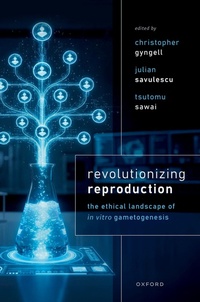
Revolutionizing Reproduction
The Ethical Landscape of In Vitro Gametogenesis
Published on 5. June 2026
Book
Hardback
288 pages
978-0-19-781037-8 (ISBN)
Description
Revolutionizing Reproduction explores the rapidly advancing field of in vitro gametogenesis (IVG)-the generation of sperm and eggs from somatic or stem cells in the laboratory-and its profound implications for science, ethics, and society. While IVG holds transformative potential for treating infertility, enabling same-sex reproduction, and expanding reproductive options, it also presents significant ethical, legal, and social challenges that demand urgent attention.
Bringing together leading experts from scientific, philosophical, legal, and sociological backgrounds, this collection grounds the ethical debate in the latest scientific developments. Chapters analyse the technical foundations of IVG, its potential to overcome evolutionary constraints on human reproduction, and the complex ethical questions surrounding its applications. These include enhancing reproductive autonomy, facilitating same-sex and solo reproduction, the possibility of multiplex parenting involving more than two genetic progenitors, and the implications for embryo selection, including concerns about eugenics and iterative selection processes. The volume critically examines core concepts such as reproductive liberty, the moral status of embryos, the definition of parenthood and genetic relatedness, and the potential commodification of human life. It also considers public attitudes, the influence of social norms, and the need for robust governance frameworks to guide the responsible development and implementation of IVG.
Bringing together leading experts from scientific, philosophical, legal, and sociological backgrounds, this collection grounds the ethical debate in the latest scientific developments. Chapters analyse the technical foundations of IVG, its potential to overcome evolutionary constraints on human reproduction, and the complex ethical questions surrounding its applications. These include enhancing reproductive autonomy, facilitating same-sex and solo reproduction, the possibility of multiplex parenting involving more than two genetic progenitors, and the implications for embryo selection, including concerns about eugenics and iterative selection processes. The volume critically examines core concepts such as reproductive liberty, the moral status of embryos, the definition of parenthood and genetic relatedness, and the potential commodification of human life. It also considers public attitudes, the influence of social norms, and the need for robust governance frameworks to guide the responsible development and implementation of IVG.
More details
Language
English
Place of publication
New York
United States
Target group
College/higher education
Product notice
sewn/stitched
Cloth over boards
Dimensions
Height: 234 mm
Width: 156 mm
Thickness: 21 mm
Weight
581 gr
ISBN-13
978-0-19-781037-8 (9780197810378)
Copyright in bibliographic data and cover images is held by Nielsen Book Services Limited or by the publishers or by their respective licensors: all rights reserved.
Schweitzer Classification
Other editions
Additional editions
Christopher Gyngell | Julian Savulescu | Tsutomu Sawai
Revolutionizing Reproduction
The Ethical Landscape of In Vitro Gametogenesis
Book
approx. 08/2026
Oxford University Press Inc
€35.50
Not yet published
Persons
Christopher Gyngell is a Team Leader in Biomedical Ethics at the Murdoch Children's Research Institute and an Associate Professor at the University of Melbourne in the Department of Paediatrics. His research interests lie primarily in the ethical implications of biotechnologies and the philosophy of health and disease. He has over 70 peer-reviewed publications in a diverse range of ethics, philosophy, science, and medical journals. Chris is committed to public engagement, frequently contributing to public discussions and policy debates on the ethical aspects of biomedical advancements.
Julian Savulescu is the Chen Su Lan Centennial Professor of Medical Ethics and Director of the Centre for Biomedical Ethics at the National University of Singapore. He also holds the Uehiro Chair in Practical Ethics at the University of Oxford. Trained in neuroscience, medicine, and philosophy, he has authored over 420 publications and is among the world's most cited bioethicists. He is a Fellow of both
the Australian Academy of Health and Medical Sciences and the Australian Academy of the Humanities, and was ranked No.1 globally in bioethics and medical ethics by Scholar GPS in 2022.
Tsutomu Sawai is a Professor (Special Recognition) at Hiroshima University, where he directs the Uehiro Division for Applied Ethics and the ELSI Unit of the Center for Collaborative Sciences. He also serves as Program Faculty for the Frontier Development Program for Genome Editing and as a Visiting Professor at the Centre for Biomedical Ethics, National University of Singapore. He received his Ph.D. from Kyoto University in 2016 and previously held academic appointments there. His research focuses on a wide range of ethical issues arising in advanced science, engineering, and medicine.
Julian Savulescu is the Chen Su Lan Centennial Professor of Medical Ethics and Director of the Centre for Biomedical Ethics at the National University of Singapore. He also holds the Uehiro Chair in Practical Ethics at the University of Oxford. Trained in neuroscience, medicine, and philosophy, he has authored over 420 publications and is among the world's most cited bioethicists. He is a Fellow of both
the Australian Academy of Health and Medical Sciences and the Australian Academy of the Humanities, and was ranked No.1 globally in bioethics and medical ethics by Scholar GPS in 2022.
Tsutomu Sawai is a Professor (Special Recognition) at Hiroshima University, where he directs the Uehiro Division for Applied Ethics and the ELSI Unit of the Center for Collaborative Sciences. He also serves as Program Faculty for the Frontier Development Program for Genome Editing and as a Visiting Professor at the Centre for Biomedical Ethics, National University of Singapore. He received his Ph.D. from Kyoto University in 2016 and previously held academic appointments there. His research focuses on a wide range of ethical issues arising in advanced science, engineering, and medicine.
Editor
Team Leader, Biomedical EthicsTeam Leader, Biomedical Ethics, Murdoch Children's Research Institute
Chen Su Lan Centennial Professor in Medical Ethics, Yong Loo Lin School of MedicineChen Su Lan Centennial Professor in Medical Ethics, Yong Loo Lin School of Medicine, National University of Singapore
Professor (Special Recognition), Graduate School of Humanities and Social SciencesProfessor (Special Recognition), Graduate School of Humanities and Social Sciences, National University of Singapore
Content
- Introduction-Are We Ready for a Revolution?
- 1: Katsuhiko Hayashi: In Vitro Gametogenesis: Creation of Gametes in a Dish
- 2: Christopher Gyngell, Julian Savulescu, and Tsutomu Sawai: Reproduction without Constraints: How IVG Will Reshape Reproduction
- 3: Sonia M. Suter: IVG and Relational Procreative Autonomy
- 4: Timothy F. Murphy: Sex and Gender Minorities and In Vitro Gametes: Ethics, Access, and Status Equality
- 5: Robert Sparrow: Eugenics under the Microscope
- 6: Helen Watt: Respecting Offspring; Identifying Parents: When Is In Vitro Gametogenesis (Truly) Parental?
- 7: César Palacios-González: Multiplex Parenting Revised
- 8: Anantharaman Muralidharan: The Ethics of Solo Reproduction
- 9: Hilary Bowman-Smart: In Vitro Gametogenesis and the Concept of Genetic Parenthood
- 10: Anna Smajdor: Artificial Gametes and the Deconstruction of Reproduction
- 11: Heidi Mertes: Gendered and Ageist Norms of Parenthood Manifested in Public Attitudes Towards IVG
- 12: Kyoko Akatsuka, Tsutomu Sawai, Taichi Hatta, and Misao Fujita: Japanese Perspectives on In Vitro Gametogenesis: Insights from a Questionnaire Survey
- 13: Seppe Segers and Dorian Accoe: Critical Bioethics: On False Hope, Normative Assumptions, and Re-negotiation in the Ethical Debate about IVG