

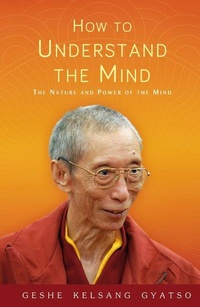
How to Understand the Mind
The Nature and Power of the Mind
Published on 1. August 2014
Book
Paperback/Softback
416 pages
978-1-906665-82-1 (ISBN)
Description
'We often say: My mind, my mind. But if someone were to ask us: What is your mind? We would have no correct answer. This is because we do not understand the nature and function of the mind correctly.' - Venerable Geshe Kelsang Gyatso Rinpoche. How to Understand the Mind offers us deep insight into our mind. It shows us how an understanding of our mind's nature and functions can be used to improve our lives practically, in our everyday experience. It begins by guiding us to develop and maintain a light, positive mind. It then explains how to recognize and abandon mental states that harm us, and shows us in how to replace them with peaceful beneficial states. The book goes on to describe different types of mind in detail, revealing the depth and profundity of the Buddhist understanding of the mind. The book concludes with a detailed explanation of meditation, which we use for controlling and transforming our mind until we attain a lasting state of joy, independent of external conditions.
Reviews / Votes
'Astonishingly, what has been produced here is actually a new and self-explanatory Buddhist commentarial text composed in English.' - Buddhist Studies ReviewMore details
Language
English
Place of publication
Ulverston
United Kingdom
Product notice
Paperback (trade)
Unsewn / adhesive bound
Dimensions
Height: 198 mm
Width: 128 mm
Thickness: 25 mm
Weight
451 gr
ISBN-13
978-1-906665-82-1 (9781906665821)
Copyright in bibliographic data and cover images is held by Nielsen Book Services Limited or by the publishers or by their respective licensors: all rights reserved.
Schweitzer Classification
Other editions
Previous edition
Book
08/2002
3rd Edition
Tharpa Publications
€34.84
Article exhausted; check for reprint
Person
Geshe Kelsang Gyatso is a fully accomplished meditation master and internationally renowned teacher of Buddhism who has pioneered the introduction of modern Buddhism into contemporary society. He is the author of 22 highly acclaimed books that perfectly transmit the ancient wisdom of Buddhism to our modern world. He has also founded over 1200 Kadampa Buddhist centres and groups throughout the world.
Content
Introduction PART ONE: What is Our Mind?; How the Mind is Able to Move The Gross, Subtle and Very Subtle Minds; Primary Minds and Mental Factors; The Five All-accompanying Mental Factors; The Five Object-ascertaining Mental Factors; The Eleven Virtuous Mental Factors; Virtue, Non-virtue and Delusion;The Six Root Delusions; The Twenty Secondary Delusions; The Four Changeable Mental Factors; PART TWO: Conceptual and Non-Conceptual Minds; Sense and Mental Awarenesses; Direct Perceivers; Subsequent Cognizers; Re-cognizers; Correct Beliefs; Non-ascertaining Perceivers; Non-deluded Doubts; Wrong Awarenesse;s Valid and Non-valid Cognizers; Meditation: Meditation of a person of initial scope; Meditation of a person of middling scope; Meditation of a person of great scope; Conclusion; Dedication; Appendix I - The Condensed Meaning of the Text; Appendix II - Sadhanas 'Liberating Prayer', 'Essence of Good Fortune'; Glossary; Bibliography; Study Programmes of Kadampa Buddhism; Tharpa Offices Worldwide; Index