

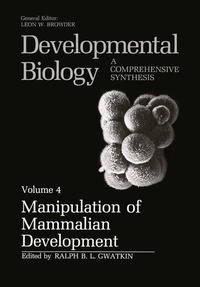
Manipulation of Mammalian Development
Published on 14. June 2012
Book
Paperback/Softback
XIV, 402 pages
978-1-4612-9265-4 (ISBN)
Description
Developmental biology has been transformed recently by discoveries in the fields of molecular biology, cell biology, and immunology. New ways of manip ulating mammalian development are uncovering control mechanisms and ena bling us to apply them in solving practical problems in animal production and human health. This book outlines some of these new manipulations and how they have contributed to the present state of developmental biology. Chapter 1 describes gene transfer by micro injection of cloned recombinant DNA into zygotes. Although the factors that affect transformation frequencies and integration sites are still unknown, such techniques offer a number of exciting prospects. Research models for human disease coula be artificially created and desirable characteristics in agricultural animals could be - hanced. . The theme of cell-to-cell transfer is continued in Chapters 2 and 3. Chapter 2 describes pronuclear transplantation by Sendai virus-induced fusion of the karyoplast with the enucleated embryo. Using this procedure, it has been dem onstrated that both male and female genomes are essential for normal develop ment, although the reason for this is not yet understood. Chapter 3 describes studies on the fusion of whole oocytes. .
More details
Series
Language
English
Place of publication
New York
United States
Target group
Professional and scholarly
Research
Illustrations
62 s/w Abbildungen
XIV, 402 p. 62 illus.
Dimensions
Height: 254 mm
Width: 178 mm
Thickness: 23 mm
Weight
764 gr
ISBN-13
978-1-4612-9265-4 (9781461292654)
DOI
10.1007/978-1-4613-2143-9
Schweitzer Classification
Other editions
Additional editions
Ralph B.L. Gwatkin
Manipulation of Mammalian Development
E-Book
11/2013
Springer
€96.29
Available for download
Ralph B.L. Gwatkin
Manipulation of Mammalian Development
Volume 4: Manipulation of Mammalian Development
Book
09/1986
Kluwer Academic / Plenum Publishers
€129.99
Article exhausted; check different version
Content
1 · Gene Transfer into Mouse Embryos.- 1. Introduction.- 2. Gene Transfer in Somatic Cells.- 3. Mouse Chimeras and Teratocarcinomas.- 4. Viral Transformation of Mouse Embryos.- 5. Transformation of Mouse Embryos with Recombinant DNA.- 6. Summary, Conclusions, and Perspectives.- References.- 2 · Nuclear and Cytoplasmic Transfer in Mammalian Embryos.- 1. Introduction.- 2. Nuclear Transfer in Amphibians versus Mammals.- 3. Nuclear Transfer in Nonenucleated Mammalian Embryos.- 4. Nuclear Transfer in Enucleated Mammalian Embryos.- 5. Microsurgical/Cell Fusion Nuclear Transplantation Procedure.- 6. Uses of the Nuclear Transfer Procedure.- 7. Cytoplasmic Transfer.- 8. Conclusions.- References.- 3 · Oocyte Fusion.- 1. Introduction.- 2. Cell Fusion.- 3. Oocyte Hybrids.- 4. Fusion of Fertilized Eggs and Cleavage-Stage Cells.- 5. Concluding Remarks.- References.- 4 · Animal in Vitro Fertilization and Embryo Development.- 1. Introduction.- 2. Techniques for in Vitro Fertilization.- 3. Techniques for in Vitro Fertilization: Advantages and Limitations.- 4. Regulation of Sperm-Fertilizing Ability.- 5. Embryonic Development following in Vitro Fertilization.- 6. Summary.- References.- 5 · Recent Progress in Human in Vitro Fertilization and Embryo Transfer.- 1. Introduction.- 2. Collection of Mature Oocytes.- 3. Fertilization in Vitro.- 4. Culture of the Embryo in Vitro.- 5. Embryo Replacement in Utero.- 6. Early Pregnancy.- 7. Egg Donation.- 8. Embryo Cryopreservation.- 9. Male Factor Infertility and IVF.- 10. The Scope of Human IVF.- References.- 6 · Embryo Sexing of Farm Animals.- 1. Introduction.- 2. Prefertilization Sexing.- 3. Preimplantation Sexing.- 4. Postimplantation Sexing.- 5. Other Approaches to Sex Selection by Predetermination.- 6. Discussion.- References.- 7 ·Cryopreservation of Mammalian Eggs and Embryos.- 1. Introduction.- 2. Sensitivity to Temperatures above Freezing.- 3. Current Concepts in Cryobiology.- 4. Cryopreservation of Eggs and Embryos.- 5. Embryo Preservation in Practice.- 6. Application of Embryo Preservation.- References.- 8 · Embryo Transfer in Animals.- 1. Background.- 2. Procedures.- 3. Experimental Applications.- 4. Commercial Applications.- 5. Future Considerations.- References.- 9 · Manipulation of Early Mammalian Development: What Does It Tell Us about Cell Lineages?.- 1. Introduction.- 2. Possibilities and Probabilities.- 3. The Origins of Cell Diversification: Polarization, Cell Flattening, and Cleavage.- 4. The Effect of Spatial Location on Cell Lineage.- 5. The Effect of Divison Order on Cell Lineage.- 6. The Effect of Manipulating Polarization, Flattening, or Cleavage on Cell Lineage.- 7. Conclusions.- References.- 10 · Tissue Interactions in Development of Teeth and Related Ectodermal Derivatives.- 1. Introduction.- 2. Ectodermal Differentiation.- 3. Tissue Isolation Methods.- 4. In Vitro Culture Methods: Cell versus Organ Cultures.- 5. In Vitro Grafting Methods.- 6. Xenoplastic Tissue Combinations.- 7. Mutants as Experimental Tools.- 8. The Nature of Epithelial-Mesenchymal Inductive Interactions.- 9. Summary.- References.- 11 · Tissue Combination and Organ Culture Studies in the Development of the Embryonic Mammary Gland.- 1. Introduction.- 2. Formation of Mammary Buds.- 3. Resting Phase and Early Morphogenesis.- 4. Hormone Response and Hormone Responsiveness.- References.- 12 · Immunogenetic Approaches to the Analysis of Mammalian Development.- 1. Introduction.- 2. Histocompatibility Antigens.- 3. Alloantigen Expression on Oocytes.- 4. Class I and Class II Antigen Expression on Embryos.-5. Expression of Non-H-2 Alloantigens on Embryos.- 6. Discussion.- References.- 13 · The Immunological Approach to the Study of Preimplantation Mammalian Development.- 1. Introduction.- 2. Developmental Tracking of Antigens.- 3. Cell Marking, Cell Purification, and Separation.- 4. Modulation, Topographical Distribution, and Cellular Localization of Antigens.- 5. Antigen Function.- 6. Molecular and Biochemical Characterization of Antigens.- 7. Conclusions and Future Directions.- References.