

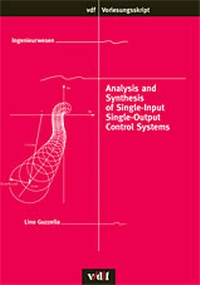
Analysis and Synthesis of Single-Input Single-Output Controll Systems
1st Edition
Published on 12. September 2007
Book
XIV, 354 pages
978-3-7281-3146-1 (ISBN)
Description
This text supports a first course on feedback control systems in an engineering undergraduate program. Its primary objectives are to introduce the main ideas and to show the basic approaches for the design of simple yet practically relevant control systems. Readers planning to work through this text should have a clear understanding of elementary complex analysis, of matrix algebra and of calculus, including ordinary differential equations. Basic concepts of engineering physics are assumed to be known as well.
The text is organized in a top-down way, along the following main points:
- systems modeling;
- analysis of open-loop systems in the time and frequency domain;
- analysis of closed-loop systems in the time and frequency domain;
- identification of unavoidable performance constraints;
- specification of the desired closed-loop system behavior;
- synthesis of feedback control systems; and
- implementation of control systems.
This course introduces all relevant steps of a control system design procedure. The price one must pay for such a breadth is the limitation of the discussion to relatively simple systems.
This text is organized in "lectures", which represent the amount of material that can be discussed in a typical two-hours class. Small exercises are included in the main text. The solutions to these "quick checks" can be found in the appendix.
The text is organized in a top-down way, along the following main points:
- systems modeling;
- analysis of open-loop systems in the time and frequency domain;
- analysis of closed-loop systems in the time and frequency domain;
- identification of unavoidable performance constraints;
- specification of the desired closed-loop system behavior;
- synthesis of feedback control systems; and
- implementation of control systems.
This course introduces all relevant steps of a control system design procedure. The price one must pay for such a breadth is the limitation of the discussion to relatively simple systems.
This text is organized in "lectures", which represent the amount of material that can be discussed in a typical two-hours class. Small exercises are included in the main text. The solutions to these "quick checks" can be found in the appendix.
More details
Series
Edition
1., Aufl.
Language
English
Place of publication
Zurich
Switzerland
Target group
Professional and scholarly
College/higher education
MaschineningenieurInnen, ElektrotechnikerInnen, InformatikerInnen, MathematikerInnen
Illustrations
Graf.
Graf.
Dimensions
Height: 24 cm
Width: 17 cm
Weight
368 gr
ISBN-13
978-3-7281-3146-1 (9783728131461)
Schweitzer Classification
Other editions
New editions
Book
08/2009
2nd Edition
vdf Hochschulverlag AG
€26.00
Article exhausted; check for reprint
Content
Definitions and Problem Formulations
1.1 Introduction
1.2 Definitions
1.3 System Classification
1.4 Models
1.5 Control Systems
1.6 Control System Design Problems
2 Modeling of Dynamic Systems
2.1 Introduction
2.2 General Modeling Guidelines
2.3 Some Examples
2.4 Model Uncertainty
3 System Representation and Transformation
3.1 Introduction
3.2 Normalization
3.3 Linearization
3.4 Parametric Uncertainty
3.5 Linear State Space Forms
4 Analysis of Linear Systems - Part I
4.1 Introduction
4.2 Time Domain Behavior of Linear Systems
4.3 First-Order Systems
4.4 Stability
5 Analysis of Linear Systems - Part II
5.1 Introduction
5.2 Reachability, Controllability and Stabilizability
5.3 Observability Conditions
5.4 State Space Decomposition
5.6 I/O Descriptions and Canonical Realizations
5.7 Concluding Remarks
6 Laplace Transformation - Part I
6.1 Introduction
6.2 Properties of the Laplace Transformation
6.3 Transfer Functions
7 Laplace Transformation - Part II
7.1 Introduction
7.2 Solution of Low-Order ODE
7.3 Poles and Zeros of Transfer Functions
7.4 Algebraic Stability Criteria
8 Frequency Responses
8.1 Introduction
8.2 Frequency Responses
8.3 Asymptotic System Properties
8.4 System Identification Using Frequency Responses
8.5 Nonparametric Uncertainty
9 Analysis of Feedback Systems
9.1 Introduction
9.2 Definitions
9.3 Closed-Loop System Stability
9.4 Nyquist Theorem
9.5 Constraints on Closed-Loop Systems
9.6 Summary
10 Specifications for Feedback Systems
10.1 Introduction
10.2 Static Errors
10.3 Specifications Based on Second-Order Systems
10.4 Frequency-Domain Specifications
10.5 Summary
11 Feedback Control Design - I
11.1 Introduction
11.2 PID Controllers
11.3 Classical Iterative Loop Shaping
11.4 Closed-Form Cross-Over Specification?
11.5 Aström and Hägglund Rules
11.6 Predictive PI Control Systems
12 Feedback Control Design - II
12.1 Introduction
12.2 Loop Shaping and Robustness
12.3 Loop Shaping and Non-Minimum Phase Zeros
12.4 Loop Shaping for Unstable Systems
13 Feedback Control Design - III
13.1 Introduction
13.2 Cascaded Control Loops
13.3 Root-Locus Methods
14 Control Systems Implementation
14.1 Introduction
14.2 PID Controllers in Practical Applications
14.3 Realization with Analog Components
14.4 Realization with Digital Computers
15 Case Study
15.1 Introduction
15.2 Modeling
15.3 Specifications
15.4 Controller Design
A Library of Standard Elements
A.1 Integrator Element
A.2 Differentiator Element
A.3 First-Order Element
A.4 Realizable Derivative Element ("Dirty D")
A.5 Second-Order Element
A.6 Lag Element
A.7 Lead Element
A.8 PID Element
A.9 First-Order All-Pass Element
A.10 Delay Element
B Some Mathematical Results
B.1 Linear Algebra
B.2 Complex Analysis
B.3 Proof of the Nyquist Theorem
B.4 Proof of the Cross-Over Frequency Specification Method
B.5 Proof of the Apollonius Circle Condition
C Solutions to Quick Checks
C.1 Definitions and Problem Formulations
C.2 Modeling of Dynamic Systems
C.3 System Representation and Transformation
C.4 Analysis of Linear Systems - Part I
C.5 Analysis of Linear Systems - Part II
C.6 Laplace Transformation - Part I
C.7 Laplace Transformation - Part II
C.8 Frequency Responses
C.9 Analysis of Feedback Systems
C.10 Specifications for Feedback Systems
C.11 Feedback Control Design - I
C.12 Feedback Control Design - II
C.13 Feedback Control Design - III
C.14 Control Systems Implementation
D Translation English to German
E List of Symbols
References
1.1 Introduction
1.2 Definitions
1.3 System Classification
1.4 Models
1.5 Control Systems
1.6 Control System Design Problems
2 Modeling of Dynamic Systems
2.1 Introduction
2.2 General Modeling Guidelines
2.3 Some Examples
2.4 Model Uncertainty
3 System Representation and Transformation
3.1 Introduction
3.2 Normalization
3.3 Linearization
3.4 Parametric Uncertainty
3.5 Linear State Space Forms
4 Analysis of Linear Systems - Part I
4.1 Introduction
4.2 Time Domain Behavior of Linear Systems
4.3 First-Order Systems
4.4 Stability
5 Analysis of Linear Systems - Part II
5.1 Introduction
5.2 Reachability, Controllability and Stabilizability
5.3 Observability Conditions
5.4 State Space Decomposition
5.6 I/O Descriptions and Canonical Realizations
5.7 Concluding Remarks
6 Laplace Transformation - Part I
6.1 Introduction
6.2 Properties of the Laplace Transformation
6.3 Transfer Functions
7 Laplace Transformation - Part II
7.1 Introduction
7.2 Solution of Low-Order ODE
7.3 Poles and Zeros of Transfer Functions
7.4 Algebraic Stability Criteria
8 Frequency Responses
8.1 Introduction
8.2 Frequency Responses
8.3 Asymptotic System Properties
8.4 System Identification Using Frequency Responses
8.5 Nonparametric Uncertainty
9 Analysis of Feedback Systems
9.1 Introduction
9.2 Definitions
9.3 Closed-Loop System Stability
9.4 Nyquist Theorem
9.5 Constraints on Closed-Loop Systems
9.6 Summary
10 Specifications for Feedback Systems
10.1 Introduction
10.2 Static Errors
10.3 Specifications Based on Second-Order Systems
10.4 Frequency-Domain Specifications
10.5 Summary
11 Feedback Control Design - I
11.1 Introduction
11.2 PID Controllers
11.3 Classical Iterative Loop Shaping
11.4 Closed-Form Cross-Over Specification?
11.5 Aström and Hägglund Rules
11.6 Predictive PI Control Systems
12 Feedback Control Design - II
12.1 Introduction
12.2 Loop Shaping and Robustness
12.3 Loop Shaping and Non-Minimum Phase Zeros
12.4 Loop Shaping for Unstable Systems
13 Feedback Control Design - III
13.1 Introduction
13.2 Cascaded Control Loops
13.3 Root-Locus Methods
14 Control Systems Implementation
14.1 Introduction
14.2 PID Controllers in Practical Applications
14.3 Realization with Analog Components
14.4 Realization with Digital Computers
15 Case Study
15.1 Introduction
15.2 Modeling
15.3 Specifications
15.4 Controller Design
A Library of Standard Elements
A.1 Integrator Element
A.2 Differentiator Element
A.3 First-Order Element
A.4 Realizable Derivative Element ("Dirty D")
A.5 Second-Order Element
A.6 Lag Element
A.7 Lead Element
A.8 PID Element
A.9 First-Order All-Pass Element
A.10 Delay Element
B Some Mathematical Results
B.1 Linear Algebra
B.2 Complex Analysis
B.3 Proof of the Nyquist Theorem
B.4 Proof of the Cross-Over Frequency Specification Method
B.5 Proof of the Apollonius Circle Condition
C Solutions to Quick Checks
C.1 Definitions and Problem Formulations
C.2 Modeling of Dynamic Systems
C.3 System Representation and Transformation
C.4 Analysis of Linear Systems - Part I
C.5 Analysis of Linear Systems - Part II
C.6 Laplace Transformation - Part I
C.7 Laplace Transformation - Part II
C.8 Frequency Responses
C.9 Analysis of Feedback Systems
C.10 Specifications for Feedback Systems
C.11 Feedback Control Design - I
C.12 Feedback Control Design - II
C.13 Feedback Control Design - III
C.14 Control Systems Implementation
D Translation English to German
E List of Symbols
References