

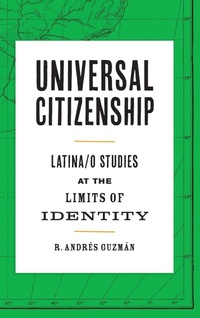
Universal Citizenship
Latina/o Studies at the Limits of Identity
Published on 15. January 2019
Book
Hardback
280 pages
978-1-4773-1762-4 (ISBN)
Description
Recently, many critics have questioned the idea of universal citizenship by pointing to the racial, class, and gendered exclusions on which the notion of universality rests. Rather than jettison the idea of universal citizenship, however, R. AndrEs GuzmAn builds on these critiques to reaffirm it especially within the fields of Latina/o and ethnic studies. Beyond conceptualizing citizenship as an outcome of recognition and admittance by the nation-state-in a negotiation for the right to have rights-he asserts that, insofar as universal citizenship entails a forceful entrance into the political from the latter's foundational exclusions, it emerges at the limits of legality and illegality via a process that exceeds identitarian capture.
Drawing on Lacanian psychoanalysis and philosopher Alain Badiou's notion of "generic politics," GuzmAn advances his argument through close analyses of various literary, cultural, and legal texts that foreground contention over the limits of political belonging. These include the French Revolution, responses to Arizona's H.B. 2281, the 2006 immigrant rights protests in the United States, the writings of Oscar "Zeta" Acosta, Frantz Fanon's account of Algeria's anticolonial struggle, and more. In each case, GuzmAn traces the advent of the "citizen" as a collective subject made up of anyone who seeks to radically transform the organizational coordinates of the place in which she or he lives.
Drawing on Lacanian psychoanalysis and philosopher Alain Badiou's notion of "generic politics," GuzmAn advances his argument through close analyses of various literary, cultural, and legal texts that foreground contention over the limits of political belonging. These include the French Revolution, responses to Arizona's H.B. 2281, the 2006 immigrant rights protests in the United States, the writings of Oscar "Zeta" Acosta, Frantz Fanon's account of Algeria's anticolonial struggle, and more. In each case, GuzmAn traces the advent of the "citizen" as a collective subject made up of anyone who seeks to radically transform the organizational coordinates of the place in which she or he lives.
Reviews / Votes
GuzmAn's incisive approach to the role of identity in Latino studies and broader collective group formation offers a timely intervention that will serve scholars in numerous disciplines across the humanities and social sciences. A compelling read that adds necessary revisions to understandings of undocumentation in Latino studies and of migration more broadly, GuzmAn's text offers a nuanced perspective on political action and structural change. By moving in scale from the individual's relation to the self to the individual's relationship to broader society, GuzmAn activates a wide range of methods for cohering the social into radical democratic acts, offering new ways to approach the subject at the limits of identity and the nation-state. (Aztlan: A Journal of Chicano Studies)More details
Series
Language
English
Place of publication
Austin, TX
United States
Target group
Professional and scholarly
Dimensions
Height: 235 mm
Width: 157 mm
Thickness: 21 mm
Weight
606 gr
ISBN-13
978-1-4773-1762-4 (9781477317624)
Copyright in bibliographic data and cover images is held by Nielsen Book Services Limited or by the publishers or by their respective licensors: all rights reserved.
Schweitzer Classification
Other editions
Additional editions
E-Book
01/2019
1st Edition
University of Texas Press
€76.99
Available for download
Person
R. AndrEs GuzmAn is an assistant professor of Latina/o and Latin American literature and culture at Indiana University.
Content
Acknowledgments
Introduction: Universal Citizenship at the Limits of Nature and Culture
Chapter 1. Cause and Consistency: The Democratic Act, Universal Citizenship, and Nation
Chapter 2. Ethnics of the Real: HB 2281 and the Alien(ated) Subject
Chapter 3. Criminalization at the Edge of the Evental Site: Migrant "Illegality," Universal Citizenship, and the 2006 Immigration Marches
Chapter 4. Oscar "Zeta" Acosta and Generic Politics: At the Margins of Identity and Law
Chapter 5. Between Crowd and Group: Fantasy, Revolutionary Nation, and the Politics of the Not-All
Notes
Bibliography
Index
Introduction: Universal Citizenship at the Limits of Nature and Culture
Chapter 1. Cause and Consistency: The Democratic Act, Universal Citizenship, and Nation
Chapter 2. Ethnics of the Real: HB 2281 and the Alien(ated) Subject
Chapter 3. Criminalization at the Edge of the Evental Site: Migrant "Illegality," Universal Citizenship, and the 2006 Immigration Marches
Chapter 4. Oscar "Zeta" Acosta and Generic Politics: At the Margins of Identity and Law
Chapter 5. Between Crowd and Group: Fantasy, Revolutionary Nation, and the Politics of the Not-All
Notes
Bibliography
Index