

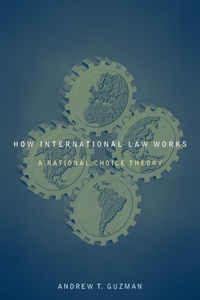
How International Law Works
A Rational Choice Theory
1st Edition
Published on 29. April 2010
Book
Paperback/Softback
272 pages
978-0-19-973928-8 (ISBN)
Description
How International Law Works presents a theory of international law, how it operates, and why it works. Though appeals to international law have grown ever more central to international disputes and international relations, there is no well-developed, comprehensive theory of how international law shapes policy outcomes.
Filling a conspicuous gap in the literature on international law, Andrew T. Guzman builds a coherent theory from the ground up and applies it to the foundations of the international legal system. Using tools from across the social sciences Guzman deploys a rational choice methodology to explain how a legal system can succeed in the absence of coercive enforcement. He demonstrates how even rational and selfish states are motivated by concerns about reciprocal non-compliance, retaliation, and reputation to comply with their international legal commitments.
Contradicting the conventional view of the subject among international legal scholars, Guzman argues that the primary sources of international commitment--formal treaties, customary international law, soft law, and even international norms--must be understood as various points on a spectrum of commitment rather than wholly distinct legal structures.
Taking a rigorous and theoretically sound look at international law, How International Law Works provides an in-depth, thoroughgoing guide to the complexities of international law, offers guidance to those managing relations among nations, and helps us to understand when we can look to international law to resolve problems, and when we must accept that we live in an anarchic world in which some issues can be resolved only through politics.
Filling a conspicuous gap in the literature on international law, Andrew T. Guzman builds a coherent theory from the ground up and applies it to the foundations of the international legal system. Using tools from across the social sciences Guzman deploys a rational choice methodology to explain how a legal system can succeed in the absence of coercive enforcement. He demonstrates how even rational and selfish states are motivated by concerns about reciprocal non-compliance, retaliation, and reputation to comply with their international legal commitments.
Contradicting the conventional view of the subject among international legal scholars, Guzman argues that the primary sources of international commitment--formal treaties, customary international law, soft law, and even international norms--must be understood as various points on a spectrum of commitment rather than wholly distinct legal structures.
Taking a rigorous and theoretically sound look at international law, How International Law Works provides an in-depth, thoroughgoing guide to the complexities of international law, offers guidance to those managing relations among nations, and helps us to understand when we can look to international law to resolve problems, and when we must accept that we live in an anarchic world in which some issues can be resolved only through politics.
Reviews / Votes
"Engaging and enterprising...Guzman presents a highly engaging and compelling theory of the forces behind international law...the book is very readable and offers a valuable perspective to anyone with an interest in international law or politics."--International Law and Politics"At last! A comprehensive rational choice account of international law that demonstrates why international law does work rather than why it does not. Andrew Guzman demonstrates remarkable mastery of both the international law and the international relations literature, drawing them together in ways that put theoretical and empirical flesh on the bones of more traditional international lawyers' assertions. How International Law Works is an important
contribution to an ongoing debate and is bound to inspire further debates of its own."--Anne-Marie Slaughter, Dean, Woodrow Wilson School of Public and International Affairs, Princeton University, and former
President of the American Society of International Law
"Guzman's lucid account of international law from a rationalist-institutionalist perspective presents his core concepts of reputation, reciprocity and retaliation in inter-state relations with a clarity that is ideal for students of law and political science, while making excellent use of his expertise in international law and economics to generate research agendas and insights into existing practices and legal doctrines that will enrich specialist
international law scholarship even among those who take entirely different approaches to the field."--Benedict Kingsbury, Director, Institute for International Law and Justice NYU Law School
"This is a crisply written, theoretically rigorous, and lucid argument about why international treaties, rules of custom, and even 'soft law' are more than forms of 'cheap talk.' Guzman tells us, in the modern language of game theory, why policymakers care when they give their 'word.'"--Jose E. Alvarez, Hamilton Fish Professor of International Law & Diplomacy Columbia Law School
More details
Language
English
Place of publication
New York
United States
Target group
College/higher education
Professional and scholarly
In addition to students and scholars of international law, it will also appeal to students and teachers of international relations
Illustrations
2 b/w illus.
Dimensions
Height: 234 mm
Width: 156 mm
Thickness: 15 mm
Weight
421 gr
ISBN-13
978-0-19-973928-8 (9780199739288)
Copyright in bibliographic data and cover images is held by Nielsen Book Services Limited or by the publishers or by their respective licensors: all rights reserved.
Schweitzer Classification
Other editions
Additional editions
Book
01/2008
Oxford University Press Inc
€81.40
Shipment within 15-20 days
E-Book
01/2008
1st Edition
OUP eBook
€21.99
Available for download

E-Book
01/2008
1st Edition
OUP eBook
€17.49
Available for download
Person
Andrew T. Guzman is Professor of Law and Director of the International Legal Studies Program at Boalt Hall School of Law, at the University of California, Berkeley. He has written extensively on international trade, international regulatory matters, foreign direct investment and public international law and has published in law, economics, and political science journals.
Content
1. Introduction
International Law at Work
Methodology
Compliance and Effectiveness in International Law
The Scope of the Book
2. A General Theory of International Law
Games States Play
The Three Rs of Compliance
International Tribunals and State Responsibility
Payoffs and Strategies Over Time
Modulating the Level of Commitment
Coercion and International Agreements
Multilateral Cooperation
3. Reputation
How Reputation is Gained and Lost
Managing Reputation Over Time
The Role of Information
The Compartmentalizing of Reputation
Limits and Caveats
4. International Agreements
Why Do States Make Agreements?
Matters of Form
The Interaction of Form and Substance
The Scope of Agreements
Membership in International Agreements
Conclusion
5. Customary International Law
The Traditional Definition of CIL
Rational Choice Critics
Compliance and CIL
Opinio Juris
State Practice
An Example of CIL: Pacta Sunt Servanda
CIL and Other International Law
6. Understanding International Law
Notes
Bibliography
Index
International Law at Work
Methodology
Compliance and Effectiveness in International Law
The Scope of the Book
2. A General Theory of International Law
Games States Play
The Three Rs of Compliance
International Tribunals and State Responsibility
Payoffs and Strategies Over Time
Modulating the Level of Commitment
Coercion and International Agreements
Multilateral Cooperation
3. Reputation
How Reputation is Gained and Lost
Managing Reputation Over Time
The Role of Information
The Compartmentalizing of Reputation
Limits and Caveats
4. International Agreements
Why Do States Make Agreements?
Matters of Form
The Interaction of Form and Substance
The Scope of Agreements
Membership in International Agreements
Conclusion
5. Customary International Law
The Traditional Definition of CIL
Rational Choice Critics
Compliance and CIL
Opinio Juris
State Practice
An Example of CIL: Pacta Sunt Servanda
CIL and Other International Law
6. Understanding International Law
Notes
Bibliography
Index