

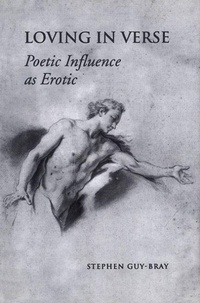
Loving in Verse
Poetic Influence As Erotic
Will be published approx. on 25. November 2006
Book
Hardback
184 pages
978-0-8020-9203-8 (ISBN)
Description
The current critical tendency in the study of Renaissance literature is to regard the relationship between a poet and his predecessor as either familial or antagonistic. Stephen Guy-Bray argues that neither of these models can be applied to all poetic relationships and that, in fact, the romantic and even sexual nature of some relationships must be considered.
Loving in Verse examines how three poets present their relationship to their most important predecessors, beginning with Dante's use of Virgil and Statius in the Divine Comedy, moving on to Spenser's use of medieval English poets in theFaerie Queene, and finally addressing Hart Crane's use of Whitman in The Bridge. In each case, Guy-Bray shows how the younger poet presents himself and the older poet as part of a male couple. He goes on to demonstrate how male couples are, in fact, found throughout these poems, and while some are indeed familial or hostile, many are romantic or sexual. Using concepts from queer theory and close readings of images and allusions in these texts, Loving in Verse demonstrates the importance of homoeroticism to an examination of poetic influence. A discussion of the theories of poetic influence from four twentieth-century writers (T.S. Eliot, Harold Bloom, Roland Barthes, and Frank O'Hara) concludes Guy-Bray's analysis.
Loving in Verse examines how three poets present their relationship to their most important predecessors, beginning with Dante's use of Virgil and Statius in the Divine Comedy, moving on to Spenser's use of medieval English poets in theFaerie Queene, and finally addressing Hart Crane's use of Whitman in The Bridge. In each case, Guy-Bray shows how the younger poet presents himself and the older poet as part of a male couple. He goes on to demonstrate how male couples are, in fact, found throughout these poems, and while some are indeed familial or hostile, many are romantic or sexual. Using concepts from queer theory and close readings of images and allusions in these texts, Loving in Verse demonstrates the importance of homoeroticism to an examination of poetic influence. A discussion of the theories of poetic influence from four twentieth-century writers (T.S. Eliot, Harold Bloom, Roland Barthes, and Frank O'Hara) concludes Guy-Bray's analysis.
More details
Language
English
Place of publication
Toronto
Canada
Product notice
sewn/stitched
Paper over boards
With dust jacket
Dimensions
Height: 232 mm
Width: 163 mm
Thickness: 16 mm
Weight
381 gr
ISBN-13
978-0-8020-9203-8 (9780802092038)
Copyright in bibliographic data and cover images is held by Nielsen Book Services Limited or by the publishers or by their respective licensors: all rights reserved.
Schweitzer Classification
Person
Stephen Guy-Bray is a professor in the Department of English at the University of British Columbia.
Content
Acknowledgments
Preface
Virgil into Statius into Dante
Chaucer and Spenser and Other Male Couples
Crane on Whitman
Eliot with Bloom, Barthes with O'Hara
Notes
Bibliography
Index
Preface
Virgil into Statius into Dante
Chaucer and Spenser and Other Male Couples
Crane on Whitman
Eliot with Bloom, Barthes with O'Hara
Notes
Bibliography
Index