

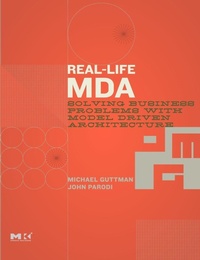
Real-Life MDA
Solving Business Problems with Model Driven Architecture
Published on 22. January 2007
Book
Paperback/Softback
224 pages
978-0-12-370592-1 (ISBN)
Description
Model Driven Architecture (MDA) is a new approach to software development that helps companies manage large, complex software projects and save development costs while allowing new technologies that come along to be readily incorporated. Although it is based on many long-standing industry precepts and best practices, such as UML, it is enough of a departure from traditional IT approaches to require some "proof of the pudding."
Real-Life MDA is composed of six case studies of real companies using MDA that will furnish that proof. The authors' approach MDA projects by describing all aspects of the project from the viewpoint of the end-users-from the reason for choosing an MDA approach to the results and benefits. The case studies are preceded by an introductory chapter and are followed by a wrap-up chapter summarizing lessons learned.
Real-Life MDA is composed of six case studies of real companies using MDA that will furnish that proof. The authors' approach MDA projects by describing all aspects of the project from the viewpoint of the end-users-from the reason for choosing an MDA approach to the results and benefits. The case studies are preceded by an introductory chapter and are followed by a wrap-up chapter summarizing lessons learned.
Reviews / Votes
"[There is] need for this book: No one has published a similar compendium of MDA case studies-making a transition to new technology is not simply a technical affair, although many of us tend to overlook this point. The authors are superb writers; these are people who have seen a lot in the industry and have a gift for articulating important trends." --David Frankel, consultant and authorMore details
Series
Language
English
Place of publication
San Francisco
United States
Publishing group
Elsevier Science & Technology
Target group
Professional and scholarly
The audience is technically conversant but not technically expert, including: CTO's, CIO's, & VP's of engineering, technical managers; and those that have to convince the aforementioned to try new things: software development managers, software architects, and software developers.
Product notice
Paperback (trade)
Illustrations
Illustrated
Dimensions
Height: 236 mm
Width: 190 mm
Thickness: 19 mm
Weight
467 gr
ISBN-13
978-0-12-370592-1 (9780123705921)
Copyright in bibliographic data and cover images is held by Nielsen Book Services Limited or by the publishers or by their respective licensors: all rights reserved.
Schweitzer Classification
Other editions
Additional editions
E-Book
12/2006
Morgan Kaufmann
€47.95
Available for download
Persons
Michael Guttman has over twenty-five years of expertise architecting, developing, and deploying large-scale complex enterprise software systems and infrastructures. He currently serves as director for the Object Management Group's MDA FastStart Program. Previously, he was chief technology officer (CTO) of Genesis Development Corporation, which he co-founded in 1992. After Genesis was sold to enterprise software vendor IONA Technologies, Mr. Guttman subsequently served as IONA's VP of Strategic Technology, and helped manage the operational integration of the two companies. While at Genesis and IONA, Mr. Guttman managed the development of SureTrack (TM), a groundbreaking process for transitioning large IT organizations to advanced software technologies. Mr. Guttman also was a major contributor to numerous key technology standards, including OMG's CORBA, which has become the embedded messaging protocol of choice for sophisticated enterprise middleware from such vendors as BEA, IBM, and Sun. More recently, he has been working with the OMG to promote the OMG's Model Driven Architecture (MDA), an integrated set of enterprise computing standards which includes Unified Modeling Language (UML), Meta-Object Facility (MOF), XML Meta-Data Interchange (XMI), and Common Warehouse Meta-Model (CWM). Mr. Guttman has been a contributing editor for such publications such as PCWorld, PCWeek (now e-Week), Object Magazine, Java Report, Application Development Advisor, Application Development Trends, and Software Magazine, where he currently authors a column on MDA. He is also a co-author of two highly regarded books on advanced uses of distributed computing technology, The Object Technology Revolution (Wiley, 1996) and Developing E-Business Systems and Architectures: A Manager's Guide (Morgan Kaufmann, 2000). John Parodi has more than twenty years experience in technical communication, including award-winning white papers, user documentation, trade press articles, technical overviews, and presentations on topics that include middleware, enterprise integration, security, software architecture, and development methodologies.
Content
Foreword
Preface
I. Introduction
II. Case Studies (this structure repeats for each of the six case studies)
A. Why the client chose an MDA Approach and What They Hoped to Achieve
B. How MDA Was Used
1. Process and Tools
2. Actual Project Experience
3. (Optional) Organizational Development
C. Results and Benefits
D. Ongoing and Planned Use of MDA
E. Client Assessment of the MDA Experience
III. Summary and Conclusions
A. Common Factors in MDA Usage and Success
B. Who Is Likely To Benefit from MDA?
C. Selected Scenarios of MDA Uptake
D. Final Words
Glossary
Index
Preface
I. Introduction
II. Case Studies (this structure repeats for each of the six case studies)
A. Why the client chose an MDA Approach and What They Hoped to Achieve
B. How MDA Was Used
1. Process and Tools
2. Actual Project Experience
3. (Optional) Organizational Development
C. Results and Benefits
D. Ongoing and Planned Use of MDA
E. Client Assessment of the MDA Experience
III. Summary and Conclusions
A. Common Factors in MDA Usage and Success
B. Who Is Likely To Benefit from MDA?
C. Selected Scenarios of MDA Uptake
D. Final Words
Glossary
Index